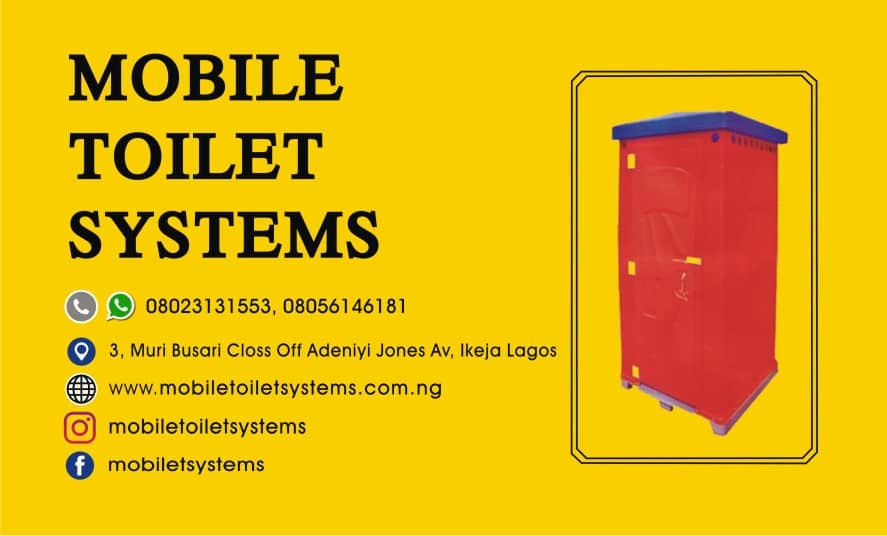
Mobile Toilet Systems was Incorporated under the laws of the Federation of Nigeria in the year 2002. The company is an active player in Environmental Business.
SHORT TERM LIWUIDITY
Short term liquidity is the company ability to met immediate financial obligations like payroll and vendors bills using available cash and easily convertible assets over the next 30 to 90 days .
It helps operational liquidity and helps business to avoid emergency loans. For example Mobile Toilets System operates a day to day expenses and it has a short term liquidity that can sustain at least 7 days operation .
For further information;
Fundamentals of Corporate Finance ; Jordan Westerfield and Ross
https://t.co/0Mz6ZeqTbx.
Editor : Akinyinka Kalejaiye
SHORT TERM LIABILITY
Short term liability are business financial obligations and debts that are due in one year or one operating cycle.
They are listed on the balance sheet and are usually paid off using current assets
Common Examples
A) Accounts payable - Money owed to suppliers and vendors for goods or services received.
b) Accurred expenses : operational expenses that have been incurred but not yet paid such as salaries and wages or utilities.
c) Short https://t.co/ZNs82o1hYa.- Bank loans or lines of credit within a 12 month payment period. For examples Mobile Toilets System just took a vehicle purchase loan from her bankers whichust be liquidated within 12 months
d) Unearned Revenue - payment recieved in advance for goods and services yet to be delivered.
For further reading:
Fundamentals of Corporate Finance
https://t.co/0Mz6ZeqTbx
Editor: Akinyinka Kalejaiye
Cost of Equity
The cost of Equity capital in a company for example Mobile Toilets System is difficult to estimate because it is forward looking based unobservable investors observations regarding future cash flows and risks rather than explicit contractual rates unlike debts , it has no fixed coupon rates making it dependent on subjective estimates of market risk, future dividends and growth .
Key reasons for the estimation difficulty include :
a) Unobservable Expectations - the cost of Equity is the returns investors expect to receive which cannot be directly measured and often replies on noisy historical data as a proxy for the future.
b) Sensitivity to input assumptions models.: models like the capital assets pricing model ( APM) are highly sensitive to estimates of the risk free rate , market rates premium.
c) Dividends/ growth ambiguity. The dividends model requires estimating long term growth rates which is difficult and is inapplicable to non dividend paying firms .
d) Market volatility, changes in investors sentimenta and market conditions often cause required returns to flactuate frequently using a single stable estimate
For further information:
Fundamentals of Corporate Finance: Ross , Westerfield and Jordan
Mobiletoiletsystem. https://t.co/wQK1M28qtO
Editor: Akinyinka Kalejaiye
BUSINESS AND FINANCIAL RISKS
Business risk refers to operational uncertainty of generating enough revenue to cover expenses, while financial risks relate to the threat of default on debts and obligations.
Key risks include competition, market demand ( business)and interest rate changes or high leverage ( financial) .
Business rate is independent of debt and focuses on viability.
a) Customer concentration: relying on a small number of customers can threaten cash flow
b) Operating costs : changes in the cost of raw materials and labour
c) Competition and demand : market fluctuations and new competitions can reduce profits margin.
Financial risk factors ( capital structure) .
Financial risk occurs when. A company uses debt to finance operations .
a) leverage - high debt levels increase the obligation to make fixed payments
b) Interest rate risks : raising rates increases the costs of debts
c) Credit risks - The danger that a borrower may fail to repay a loan
d) Liquidity risks - inability to meet short term financial demands.
Key difference and managementa
Focus - business risks is about covering operational costs ( rent , salaries ) financial risk is about covering capital structure cost ( interest , debt)
b) Management - Business risks are managed through efficiency , diversification and market research , financial risks and managed through proper debt management.
For further information:
Fundamentals of Corporate Finance
https://t.co/0Mz6ZeqTbx
Editor: Akinyinka Kalejaiye
CASH OUTFLOWS
Cash outflows refer to the movement of funds out of a business in order to meet operating expenses, investment obligations, and debt commitments.
Major cash outflows include operating expenses such as payroll, rent, and utilities; inventory purchases; capital expenditures on machinery and vehicles; tax payments; and financing costs such as loan repayments and dividends.
These Outflows Generally Fall into Three Categories:
A) Operating Activities (Day-to-Day Activities)
These are expenses incurred in the normal running of a business, including:
•Payroll and staff salaries
•Payments to suppliers
•Rent and utilities
•Marketing and advertising expenses
•Taxes
For example, Mobile Toilets System includes the cost of advertisement and publication as part of its operating expenses.
B) Investing Activities (Long-Term Assets)
These involve expenditures on long-term investments and assets, such as:
•Capital expenditure
•Purchase of fixed assets including buildings, vehicles, and machinery
•Acquisition of marketable securities such as stocks and bonds
C) Financing Activities / Capital Structure
These relate to the financing obligations of a business, including:
•Debt repayment
•Interest payments
•Dividend payments
•Share repurchase programs
For Further Information:
Fundamentals of Corporate Finance — Ross, Westerfield, and Jordan
Mobile Toilet System
Editor: Akinyinka Kalejaiye
CASH FLOW STATEMENT
A cash flow statement records cash inflows and outflows across operating, investing, and financing activities, thereby providing a clear breakdown of a company’s liquidity and financial position.
Sources of cash inflow include revenue from sales, disposal of assets, and funds obtained through debt or equity financing. Cash outflows include operating expenses, purchase of equipment, and payment of dividends.
The Main Sources of Cash Flow Statement Include:
A) Operating Activities
These are cash inflows generated from the day-to-day operations of a business.
For example, income from waste recycling serves as a major source of cash inflow for Mobile Toilets System.
B) Investing Activities
These involve cash generated from investment-related transactions, such as:
•Sale of property and assets
•Rental income
•Securities and investments
•Dividends received from shares
C) Financing Activities
These refer to cash generated through capital and financing transactions, including:
•Issuance of stocks or shares
•Loans and borrowings
•Insurance proceeds
•Issuance of debt instruments
For Further Information:
Fundamentals of Corporate Finance — Ross, Westerfield, and Jordan
Mobile Toilet System
Editor: Akinyinka Kalejaiye
“I heard Peter Obi say he is not desperate to be president; he’s only desperate to rescue Nigeria. That has to be built on something. We set up a manifesto committee that grafted through almost two to three months to develop a manifesto for the party and came out with clear positions on what we’ll do differently. You may invite Peter Obi here and ask him: what is the ADC position on fuel subsidy? What is the ADC framework on security? He doesn’t know because he has never been interested.” — Bolaji Abdullahi
FINANCIAL STATEMENTS
Financial statements are formal records that summarize a company’s activities, performance, and financial position.
The four core financial statements include the balance sheet, income statement, cash flow statement, and statement of shareholders’ equity.
These reports are primarily used by investors, creditors, and management to assess profitability, liquidity, and solvency.
The purpose of financial statements is to support decision-making, evaluate performance, ensure regulatory compliance, and promote transparency.
⸻
For further information:
Fundamentals of Corporate Finance
(Ross, Westerfield, and Jordan)
Website:
https://t.co/0Mz6ZeqTbx
Editor:
Akinyinka Kalejaiye
PAYBACK PERIOD
The payback period is the time required for an investment to generate sufficient cash flow to recover its initial cost.
It is a simple capital budgeting metric, usually expressed in years and months,
Website:
https://t.co/RBfPlao6LJ
Editor:
Akinyinka Kalejaiye
Financial Planning and Analysis
Financial Planning and Analysis (FP&A) is a corporate function that supports strategic decision-making through budgeting, forecasting, and financial analysis.
Website:
https://t.co/RBfPlao6LJ
Editor:
Akinyinka Kalejaiye
LIQUIDATION
Overview
Liquidation is the process of converting a company’s assets—such as inventory, machinery, or property—into cash, typically to settle debts and bring business operations
Website: Mobile Toilets System — https://t.co/ynjsVH4o6d
⸻
Editor
Akinyinka Kalejaiye
CAPITAL INVESTMENT DECISIONS
Overview
Capital investment decisions, also known as capital budgeting, are long-term strategic choices involving significant financial commitments to assets expected to generated
Website: Mobile Toilets Systems — https://t.co/ynjsVH4o6d
EVALUATING INVESTMENT OPPORTUNITIES
Evaluating investment opportunities involves a comprehensive analysis of financial viability, market potential, and associated risks. This process typically employs key financial metrics such as Net Present Value
Mobile Toilet System Nigeria
Appreciation of Assets
Appreciation of assets refers to the increase in the market value or book value of an asset over time. This increase may be driven by factors such as market Finance by Ross, Westerfield, and Jordan
https://t.co/yoRWb4008j�
Editor: Akinyinka Kalejaiye
Expected Return on Investment
Expected return is the anticipated profit or loss from an investment over a given period. It is calculated as the weighted average of all possible outcomes,
https://t.co/TJd53vGbj9�
Editor: Akinyinka Kalejaiye
PROFITABILITY INDEX
The profitability index also known as the Value Investment Ratio (VIR) or Profit Investment Ratio ( PIR) is a
https://t.co/RBfPlao6LJ
Editor: Akinyinka Kalejaiye