Verified user testing should be part of how Africa’s top apps earn trust, visibility, and credibility 🧪
FOLIO’s Performance Index turns real signup, KYC, and transaction flows into public rankings startups can actually use 📈
See how your app ranks, or get listed in our Performance Index!
https://t.co/2GIoyS43rK
You basically described X-Men. The same eternal struggle between those who have special powers and want to conceal/cohabitate and those that want to dominate.
It’s also an allegory for human supremacy. We dominate our environment yet co-exist with other species to preserve a sense of balance, leading to conflict with those that seek to further dominate the environment to the point of near extinction.
Right because there’s zero skill involved in hiring the right people to manage all those things..
Also negating the various conflicts that come with having players in charge of negotiating TV and merch deals while also negotiating their own contracts. Sometimes it makes sense to keep these things separate
These connections are weak. Lack of democratic and criminal justice systems create high trust societies at the local level by necessity (I trust a view people a lot while distrusting most others) while societies that outsource trust to the system don’t feel the need to trust people at a local level.
The result is higher rates of misanthropic and sociopathic behavior in the west, while places where your safety depends on personal connections tend to value the idea of connection more.
In both groups the majority vote is blue, but the reasons might differ slightly (westerners vote blue more ideologically while rest of the world vote blue for religious and practical reasons).
My biggest concern with pushing red (outside of potentially being responsible for the deaths of billions) would be not knowing who is the administrator of such a test and what’s their motive.
If the goal is to get rid of sociopaths or otherwise disagreeable people in one fell swoop you couldn’t come up with a more efficient way than to trick them into suicide by pressing red.
I can’t see a scenario where some omnipotent person culling the population from voting booths would want more people like them around.
There are only 3 guarantees:
1. Reds don’t die
2. Not everyone will press red.
3. Someone you care about will press blue
The reason blue always wins is because most people intuitively understand point 2 and 3, therefore know the best way to avoid any death is to press blue.
Red voters vote selfishly (right or wrong) but then try to justify it with logic that only works in a vacuum.
Crypto exchanges keep building fewer screens.
Users keep failing their document capture.
Fewer screens didn't fix it. It never was the problem.
We polled 113 users on mobile onboarding. "Fewer screens" lost. "Better camera guidance" won a clean winner swap the moment users answered for themselves.
And those warning popups before irreversible actions your team keeps shipping? More than halved. 21.2% to 10.6%.
The bottleneck was never the number of steps. It was always the camera.
Full report → https://t.co/5eDcdO4BuY
Run this study for your exchange → https://t.co/IrxAgfphcs
“Trusted by millions."
Every payment app says it. We asked 1,945 people if they actually buy it.
Most don't.
Published performance metrics — real numbers, real stats — beat that claim 3 to 1.
That gap between what sounds convincing and what actually is came up in all 100 polls we ran on mobile payments and remittance UX. Using FOLIO's dual-signal methodology, we ask every question twice: what do you think others prefer, then what do YOU prefer.
The pattern was the same every time. People assumed others would be satisfied with vague, familiar defaults — but personally wanted something more specific.
⏳ They assumed others would want to "contact support" when a transfer is delayed — but personally preferred knowing why it's delayed and when they'd hear next.
🎁 They assumed others would be motivated by points-to-gift-card rewards — but personally preferred fees that just go down the more they send.
🤝 They assumed others would prefer a referral bonus triggered at signup — but personally preferred one tied to a completed transfer.
💸 They assumed others would tolerate bundled fees — but personally preferred "You pay $X / They receive $Y" shown side by side. And the #1 thing they said would make them leave a platform? Raising fees without telling them.
Traditional surveys can't see any of this. They ask the question once and get a blended signal — you can't tell if someone is telling you what they want or what they think everyone else wants.
FOLIO separates those two signals, and across 100 polls and over 12,000 votes the gap pointed the same direction every time: people overestimate how tolerant others are of vagueness and underestimate how much they personally demand transparency. If you're using blended data to prioritize your payments roadmap, you're likely building for a user that doesn't exist.
Dive into the full report for more insights →
https://t.co/XxPvkpcrwO
FOLIO now supports Ad Ratings and Rankings polls. 🎯
Brands can upload image or video ads and see how people think the crowd will rate or rank them, before sharing their own personal opinion.
This reveals the gap between perceived consensus and personal preference, helping uncover where ad appeal is assumed vs where it actually exists.
A useful way to test creative, compare ads, and surface stronger consumer insight!
👉Fill this form to test your ads for free today: https://t.co/KopQXyVQPo
Great strategy in theory, except 99% of the time things that have never happened before tend to never happen.
The reason most people don’t make these bets is because time and capital is scarce and the number of things that have never happened is infinitely larger than those that have.
We just published FOLIO’s latest study on how the crypto crowd evaluates airdrops, tokenomics, and token launch experiences. 🚀 🪂
Using our Perceived Consensus (PC) vs Personal Preference (PP) methodology, we collected 11,770 votes from 2,005 unique participants across 100 polls to understand what actually builds confidence in a launch, and where projects misinterpret what users want.
https://t.co/VRnqsBb19T
❗The biggest takeaway: what people say they personally want from a launch often diverges sharply from what they assumed the broader crowd wants. That kind of gap is exactly how traditional survey data can lead token projects down the wrong path.
Here are 5 things crypto users overestimated the crowd's preference for:
1. 🛠️ Staking as "real utility" — Voters assumed the crowd defined utility through staking mechanics, but personally preferred simpler definitions like feature access (39.0% PC → 42.9% PP)
2. 🏆 Incentive-driven token logic — The crowd was expected to prioritize points and staking systems, but voters personally preferred straightforward product access (34.0% PC → 44.8% PP)
3. ✅ Weekly eligibility updates — Voters assumed the crowd would tolerate weekly cadence, but personally wanted updates within 24 hours (29.6% PC → 37.7% PP)
4. ⚖️ Equal-share whale controls — Voters thought the crowd viewed equal-share logic as the fairest way to control whale allocation, but personally preferred per-wallet caps — by a wide margin (31.7% PC → 50.4% PP)
5. 🔠 Speed over simplicity — Voters assumed the crowd favored faster airdrop campaigns, but personally preferred simpler rules over speed (31.2% PC → 36.7% PP)
🔮 What FOLIO's methodology uncovers that traditional surveys miss:
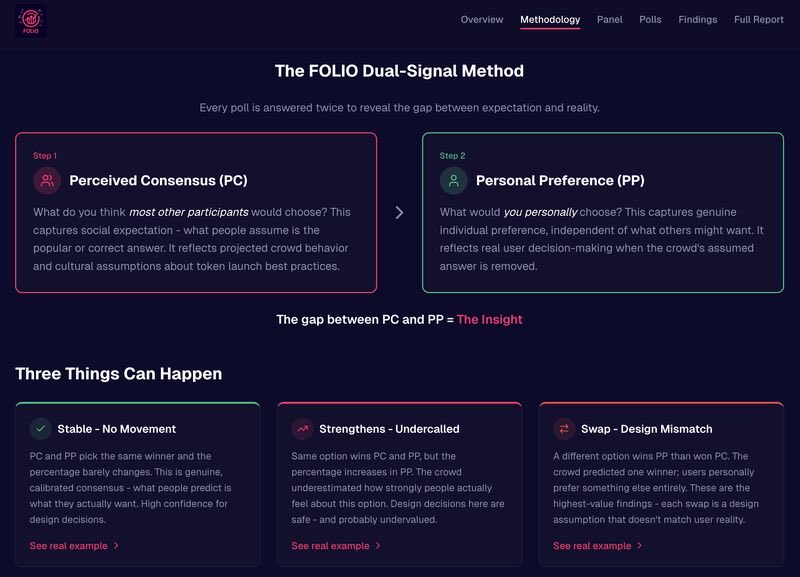
Surveys ask what people prefer. At FOLIO, we first challenge you to predict what you think the majority prefers (with real rewards if you're correct), then share your own personal preference.
The gap between those answers reveals structural biases — assumptions about what the crowd wants that don't match what individuals actually value. It's borrowed from election forecasting: if you want to know who'll win, don't just ask who someone is voting for. Ask who they think their neighbors are voting for. 🗳️
If you're building a token launch, airdrop campaign, or tokenized product and want to understand how users evaluate trust, fairness, utility, and transparency, plus receive practical recommendations, read the full report: https://t.co/VzH4jIa5W6
Excited to share FOLIO’s latest market research report + playbook on how to build higher-performing reward programs!
https://t.co/sla8VCeqUa
Using our Perceived Consensus vs Personal Preference methodology, we collected 9,000+ votes from 1,800 participants to understand how consumers actually evaluate rewards/offer UX, and where these programs lose trust, clarity, or motivation.
We then turned those insights into practical recommendations teams can use to improve reward-campaign ROI.
The link includes an interactive summary, with the full report linked on the front page.
Would love any feedback!
We have more reports planned (airdrops + tokenomics, payments/remittances UX, exchange onboarding, job sites, and more).
If there’s a topic you want studied for your business or your clients, tell us what you’re exploring and we can share a proposal.
Read more about FOLIO’s approach to market research here: https://t.co/b5DPEqMyeg
@hellofrommarv@renyukong Of course sales has something to do with the first point. Products require feedback loops to improve and part of sales job is to communicate to product what is and isn’t resonating in their outreach so they can make adjustments.
Sellable products don’t get created in a vacuum
The bigger issue is the increasingly low standards of listeners. I think music more-so than other products conditions the consumer to benchmark quality to whatever they’re used to hearing, to the point where most songs that are conventionally considered high quality might seem ‘off’ to them.
If all one listens to is pop music then i doubt AI generated pop music will be that unlistenable for that person.
@its_adamneely Pretty soon the sound of a live instrument or a tune not perfectly synced to a metronome will sound like nails on a chalkboard to most people
Sure but what about the trend in median photographer wages since 2010? As with every occupation that’s ultimately what really matters, not just the continued existence of those jobs:
“Photographer median wages have shown modest nominal growth but limited real (inflation-adjusted) increases, often stagnant or declining in real terms due to factors like digital disruption, competition from amateurs/smartphones, and a high share of part-time/self-employed roles.
Here are key BLS OEWS median annual wages (nominal, not adjusted for inflation) for selected years:
- May 2019: $36,280 (median hourly $17.44)
- May 2020: $41,280 (median hourly $19.85) — slight uptick possibly pandemic-related shifts or data quirks
- May 2023: $40,760 (median hourly $19.60)
- May 2024 (OOH reference): $42,520 (median hourly $20.44)
Overall trend: Nominal median wages rose slowly from ~$30k–$35k in 2010 to ~$42k by 2024 (about 20–40% increase over 14 years), but this lags broader wage growth and inflation (U.S. CPI rose ~40–50% in the same period).
Real wages have been flat to down, consistent with creative fields facing tech abundance and market saturation.”