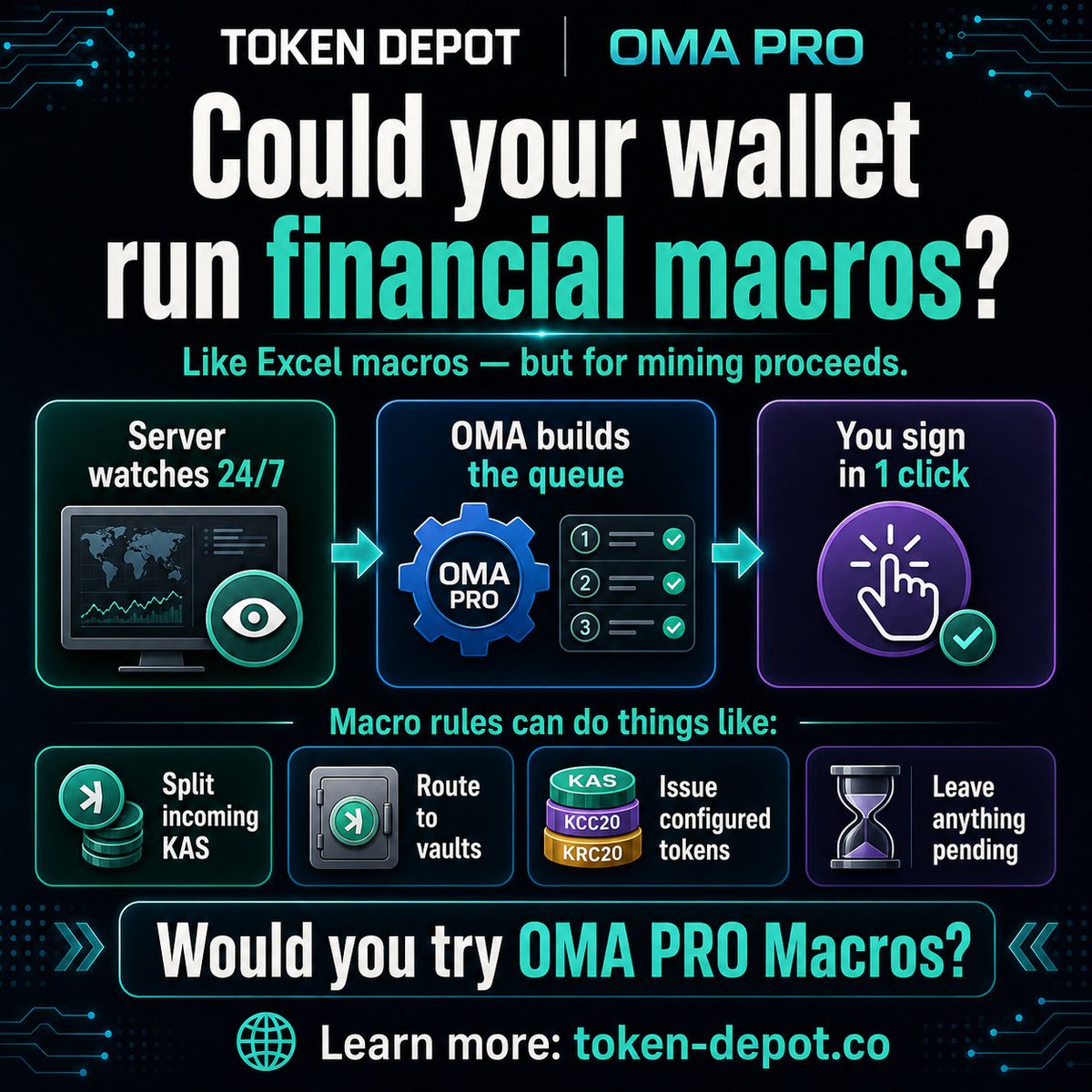
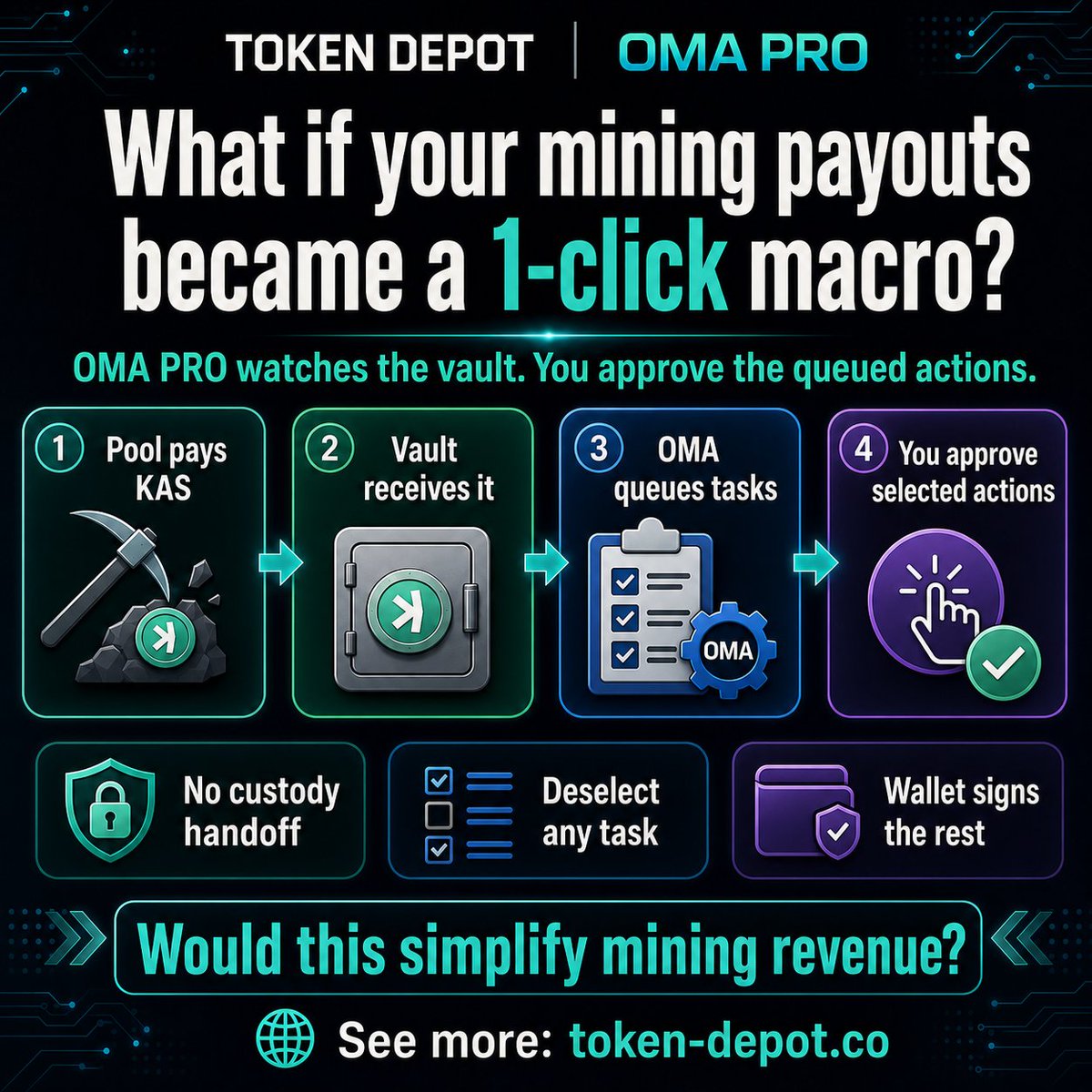
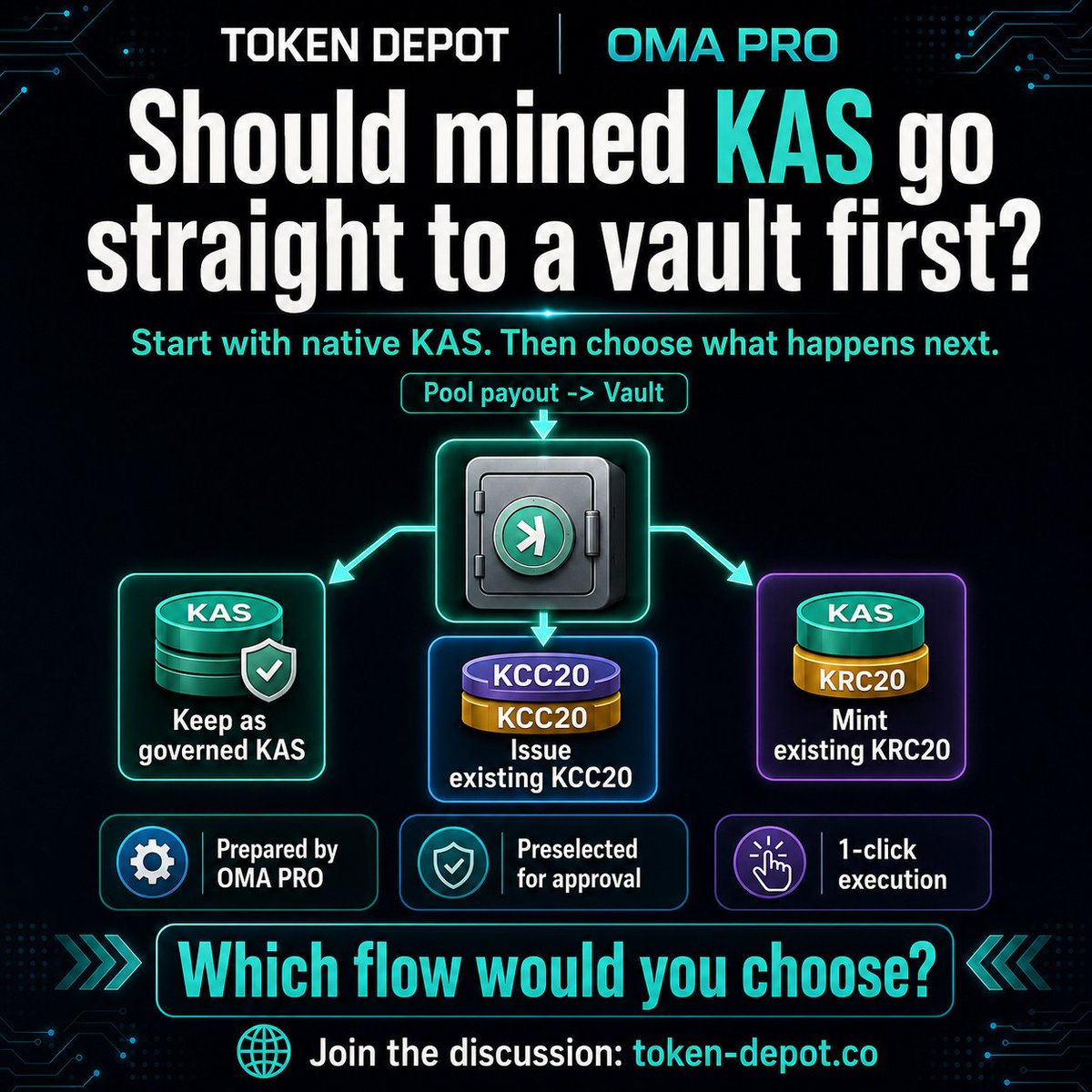
Token Depot builds tools for tokens that mean something, “Tokens with a Purpose”. Token Depot exists to turn Kaspa’s strengths into a stack for any project.
About Token Depot Corp.
We do not build anonymous money. We build self-custodial, transparent or governed assets that protect personal and commercial privacy while preserving auditable accountability. Financial freedom should protect innocent people from unnecessary surveillance—not guarantee that fraud, theft, trafficking, extortion, or corruption can never be traced. Our standard is self-custody without impunity, privacy without unaccountability, and lawful governance without arbitrary control.
@Classicxbt@KaspaCom I'm updating this page now so that it explains more carefully, exactly how things work. Thank you! That's the first useful feedback I've received.
After spending over a year writing software for Kaspa, it appears the only thing that people want is for the price to go up. The existence of new wallets, new tools, new features, and even a new e-commerce platform, seem to have no interest to actual users. #kaspa#sad#OMA #token-depot
@KaspaSilver@cryptogenerian We can't make any posts to promote KAS or projects, or they kick you off. Kind of stupid if you ask me. Kaspa needs adoption, so why block advertising it?
Kaspa is sitting in a different phase now. The old conversation was speed: GHOSTDAG, blockDAG ordering, parallel blocks, 10 BPS, and proof-of-work without forcing every honest block into a linear orphan race. That part matters, but it is no longer the whole story. The current state of Kaspa is about what that high-frequency PoW substrate can now carry.
Toccata changes the transaction layer. A Kaspa transaction is no longer just a value-transfer object. Transaction v1 gives it a programmable surface: compute budget for explicit script metering, covenant bindings for stable lineage, payload and gas semantics for app lanes, and the ability to carry proof-backed state transitions. That means the transaction can become a payment, a covenant transition, a settlement receipt, a ZK verification target, or an ordered user operation for an off-chain app.
The important design choice is that Kaspa did not throw away the UTXO model to chase an account-chain VM. State can stay local. A covenant UTXO can commit to old state, reveal it during spend, validate the transition, and force the correct successor output. KIP-20 gives that moving state a stable covenant ID, so the application can preserve lineage even as the actual script commitment changes. KIP-16 adds ZK verification. KIP-21 adds partitioned sequencing, letting based apps prove lane-local activity instead of proving the entire DAG.
That creates a cleaner split: Kaspa orders and settles; apps execute off-chain when they need heavier shared state; proofs bring the result back to L1.
The next battle is not raw protocol theory. It is standards and tooling: covenant ABIs, transaction builders, indexers, wallet policies, lane schemas, proof journals, exits, receipts, and developer frameworks.
Kaspa has moved from fast money into programmable PoW infrastructure. The primitives are live. Now the ecosystem has to make them usable.