May was a solid building month for Aave, with sGHO launch and strong V4 growth on top.
The pipeline keeps going: Monad, Arc, and Avalanche deployments still ahead.
May was a building month for Aave.
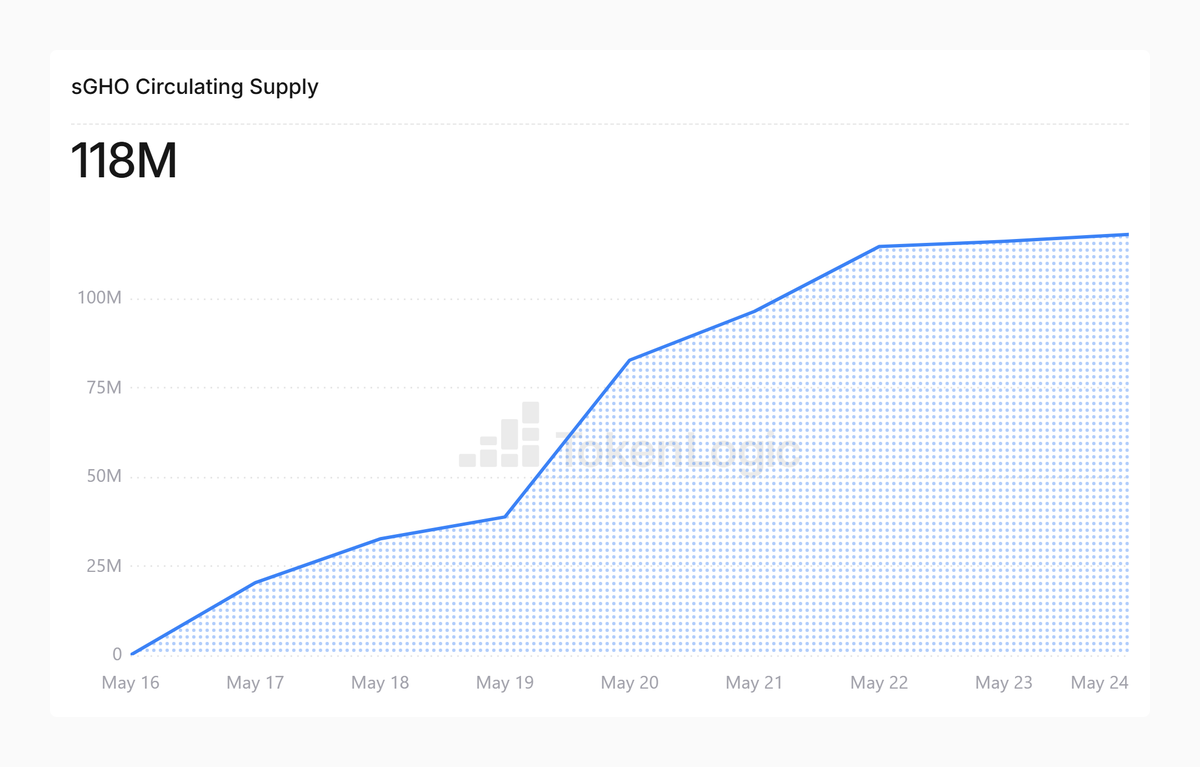
sGHO launched with real early traction, reaching around 135M in circulating supply, while total circulating supply sits above 212M.
Aave V4 activity also kept moving higher through May. Deposits grew +183% in the month to around $119M, while active loans reached $33M as new caps were raised and quickly filled.
At the same time, Aave is optimizing costs and redirecting capital toward what comes next.
Now the next pipeline is starting to form.
🔹 @monad brings a new high-throughput EVM market, with $15M in incentives and direct GHO demand.
🔹 @arc opens a more institutional path for stablecoins, RWAs, and onchain credit, with a minimum $2M/year revenue support structure for Aave DAO.
🔹 @avax brings V4 into an ecosystem where Aave already has history and distribution, alongside a dedicated RWA hub and up to $15M in KPI-linked incentives.
The key point is not just that Aave is launching on more networks. Each expansion adds a different layer to Aave’s growth: faster execution through Monad, institutional access through Arc, deeper RWA activity through Avalanche, and wider distribution for GHO.
After a heavy May, Aave is entering June with a much stronger setup.
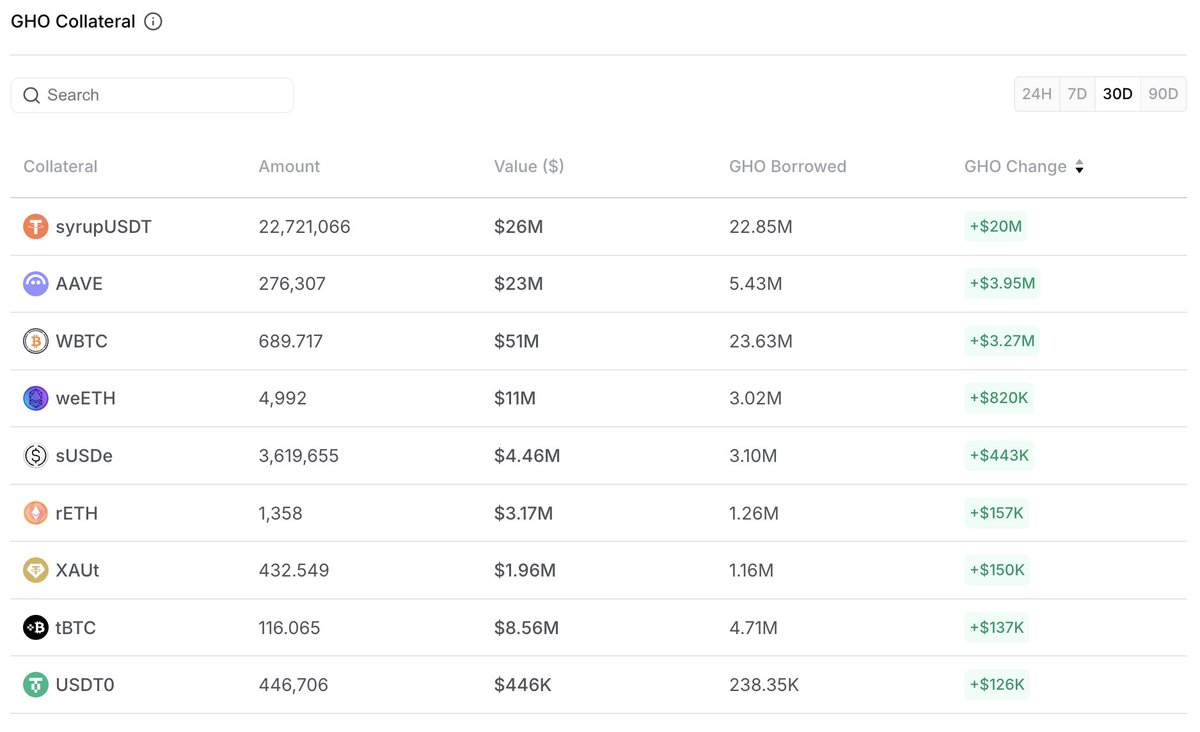
Stablecoin collateral backing $GHO has nearly tripled its share in six months, from ~5% to 14%.
New asset types are joining ETH and BTC as meaningful sources of borrowing demand.
GHO is starting to scale from a wider collateral base.
Over the last 30 days, borrowing against syrupUSDT increased by +20M GHO , while WBTC still backs 23.6M GHO and AAVE collateral demand added +3.95M.
The interesting part is where the growth is coming from.
ethereum:0x40d16fc0246ad3160ccc09b8d0d3a2cd28ae6c2f is no longer growing from one type of demand. It is now backed by a wider mix of collateral across DeFi, from BTC and AAVE to LSTs, yield stablecoins, tokenized gold, and USDT0.
That makes GHO more than a borrow asset inside @aave. It is becoming a stablecoin with a deeper credit base.
A deeper credit base gives GHO more room to scale.
In the coming weeks, we will share with the world the first glimpse of a stablecoin system so seamless users will not even realize the underlying technology. This vision will flower into something unstoppable.
P1 is in June.
The wait is almost over.
Holding $GHO now pays a fixed 4.25% APR through sGHO.
+$120M migrated from legacy stkGHO in the launch week.
The Stability Module alone has generated $3.4M+ in revenue (89% from deposit yield) flowing directly to the DAO 👻
Holding $GHO now pays a fixed 4.25% APR through sGHO.
+$120M migrated from legacy stkGHO in the launch week.
The Stability Module alone has generated $3.4M+ in revenue (89% from deposit yield) flowing directly to the DAO 👻
GHO revenue is starting to compound fast.
The ethereum:0x40d16fc0246ad3160ccc09b8d0d3a2cd28ae6c2f Stability Module has now generated over $3.45M in cumulative revenue, with $3.08M coming from deposit yield and only $363K from GSM fees.
That changes the narrative around GHO. The main revenue driver is no longer mint/burn activity or swap fees. It is productive stablecoin liquidity.
Idle liquidity inside the GSM is starting to earn yield at scale, and that revenue flows back into the Aave ecosystem.
This is why the sGHO migration matters.
The important shift is not only more GHO adoption. It is more GHO moving from passive stablecoin liquidity into yield-bearing liquidity.
@aave is slowly building a stablecoin system where liquidity itself becomes productive capital.
Data via @Token_Logic
After the $58M rsETH payout, the balance sheet became the focus. Buybacks paused, stkAAVE emissions reduced, stablecoins accumulating.
Track the balance sheet → https://t.co/V2J1FAgQMw
The fact that Aave DAO used ~$58M out of its own treasury to make rsETH depositors whole is not praised nearly enough.
It chose to take the hit, protected its users, and now it's rebuilding.
With buybacks paused and stkAAVE emissions reduced, @Aave is rebuilding its balance sheet after absorbing losses. This is exactly what you want to see from a protocol managing billions.
Now, WETH liquidity is back on Aave Core, and with V4 massively expanding Aave's design space, Aave will recover much faster than most think.
The first proposal is already in by @babylonlabs_io, potentially bringing billions in native BTC as productive collateral.
Over $26 billion in assets are currently supplied on @aave and the way users are using that capital shows DeFi has leveled up
Gone are the days of treating collateral as simple parking space
Users now treat it as productive capital. High quality assets engineered to generate yield natively, then strategically layered with borrowing to multiply returns without ever forcing a sale
This shift toward active capital efficiency is one of the clearest signals that onchain finance is maturing into real infrastructure
The mechanics playing out right now are clean and repeatable:
① Yield-bearing stables (Maple syrupUSDC / syrupUSDT)
Base APY at 4.79% (from overcollateralized institutional loans)
➤ Supply on Aave → borrow GHO / USDT0 at ~3.5–4.5%
② Liquid staking derivatives (wstETH, weETH)
Underlying staking yield: ~3–4% + ETH price exposure
➤ Supply APY on Aave: near 0% (but the real return sits in the token itself)
➤ Borrow stable → loop back into more LST → Health Factors held at 1.05–1.25 for safety
③ RWA-backed assets (USCC, USTB, etc.)
➤ USCC: 11–15% APY (crypto basis + hedging)
➤ USTB Treasury yield: w/ ~4–5% stable government exposure
Used as collateral to borrow RLUSD / GHO → unlock liquidity while the underlying keeps earning institutional grade returns
This creates clean & multi-layered efficiency. The collateral earns its native yield and the borrowed capital gets redeployed for extra return. everything verifiable 24/7 onchain
zooming out, the numbers confirm the shift. @aave sits with $26B+ supplied, $11B+ borrowed, and healthy utilization across core and specialized markets. Ethereum still dominates depth, but Plasma, Base, Arbitrum and Mantle add portable liquidity and lower fees
What stands out here is the discipline. positions reflect calculated capital efficiency rather than reckless leverage. users hold productive assets, borrow against them when needed, and let the protocol’s transparent mechanics do the heavy lifting. This puts DeFi on another level behaving like real financial infrastructure w/ optimization and resilience
The data paints this picture clearly if you know where to look. Flows reward precision over hype. Markets absorb volatility better because the user base increasingly understands and respects risk parameters
h/t: @Token_Logic for data reference, their positions dashboard remains the sharpest way to see these flows: filter by asset or chain, and track exactly how capital is behaving
User deposits on @aave V4 are up >2x in the last 30 days.
I expect $100M to be reached in no time.
Then, the real size will come in via institutional lending and borrowing.
V4 is starting to gain momentum, but I have a feeling we've seen nothing yet.
One of the clearest signs that institutions are starting to use DeFi seriously is happening on @aave Horizon.
A metric I like tracking on @Token_Logic is the supply growth of RWA collateral assets like:
• USCC
• USTB
What makes this interesting is: this is not typical retail flow.
To supply these assets usually requires:
• KYC
• whitelist access
• qualified investor status
So when supply grows aggressively, it often means: → more institutional capital is moving on-chain.
But the important part is how these assets are being used.
Institutions are starting to:
• deposit USCC/USTB into Aave Horizon
• use them as collateral
• borrow RLUSD, USDC, or GHO
to unlock liquidity without selling the underlying assets.
This is why Horizon is becoming an efficient bridge between:
RWA assets ↔ DeFi liquidity.
The growth already reflects this:
• Horizon TVL: ~$515M+
• Utilization: ~55–57%
• One of the fastest-growing RWA lending markets on Aave
Institutions are beginning to use DeFi similarly to traditional finance:
• hold yield-generating assets
• borrow against them
• maximize capital efficiency
The difference is: everything now happens on-chain, in real time, and 24/7.
DeFi is slowly evolving from a crypto trading system into a liquidity layer for real-world capital.
Active loans on @aave V4 have grown every week since launch. Even under security-first supply/borrow caps, V4's unique market structure is quickly attracting users.