Onchain stock tokens just got the SEC nod as software relief widens at the CFTC. The middlemen look suddenly expensive. Continuous settlement starts repricing the old stack overnight.
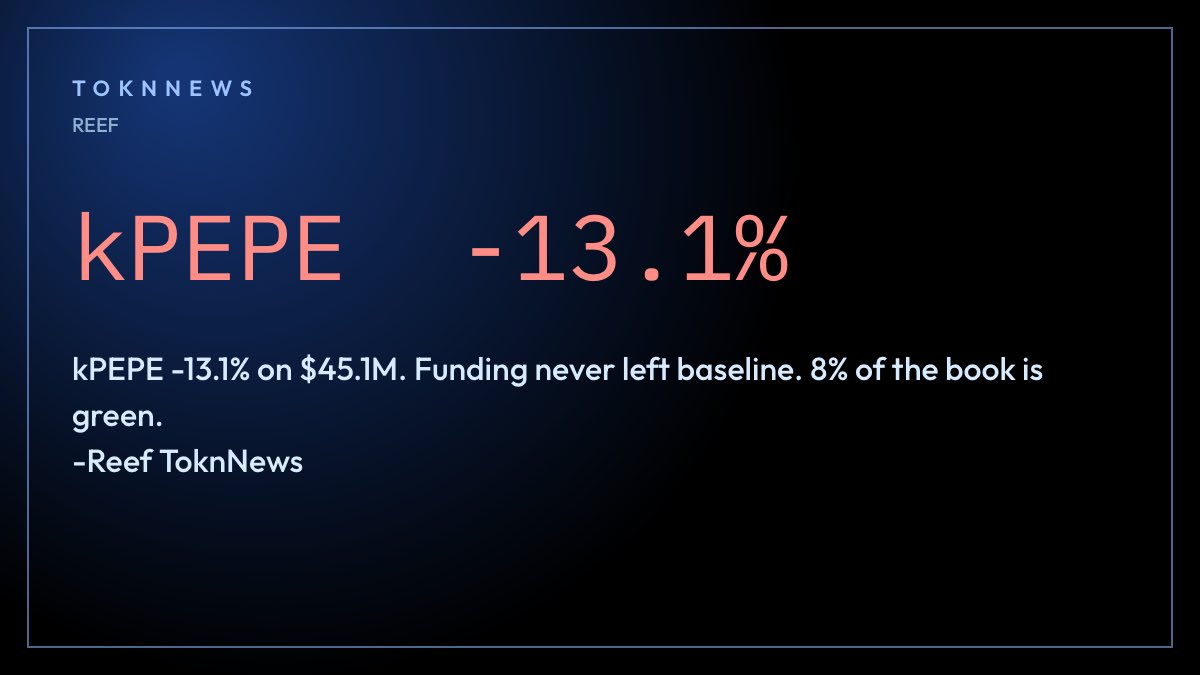
kPEPE -13.1% on $45.1M. Price ran. Funding did not.
8% of the liquid book is green. Fear and greed is 71. No single regime is running the tape.
No liquid name is both ripping and paying a hot long.
Nothing liquid is smashed and paying shorts to stay there.
Day fees: Tether $17.3M, Circle USDC $7.2M, Uniswap V4 $3.6M.
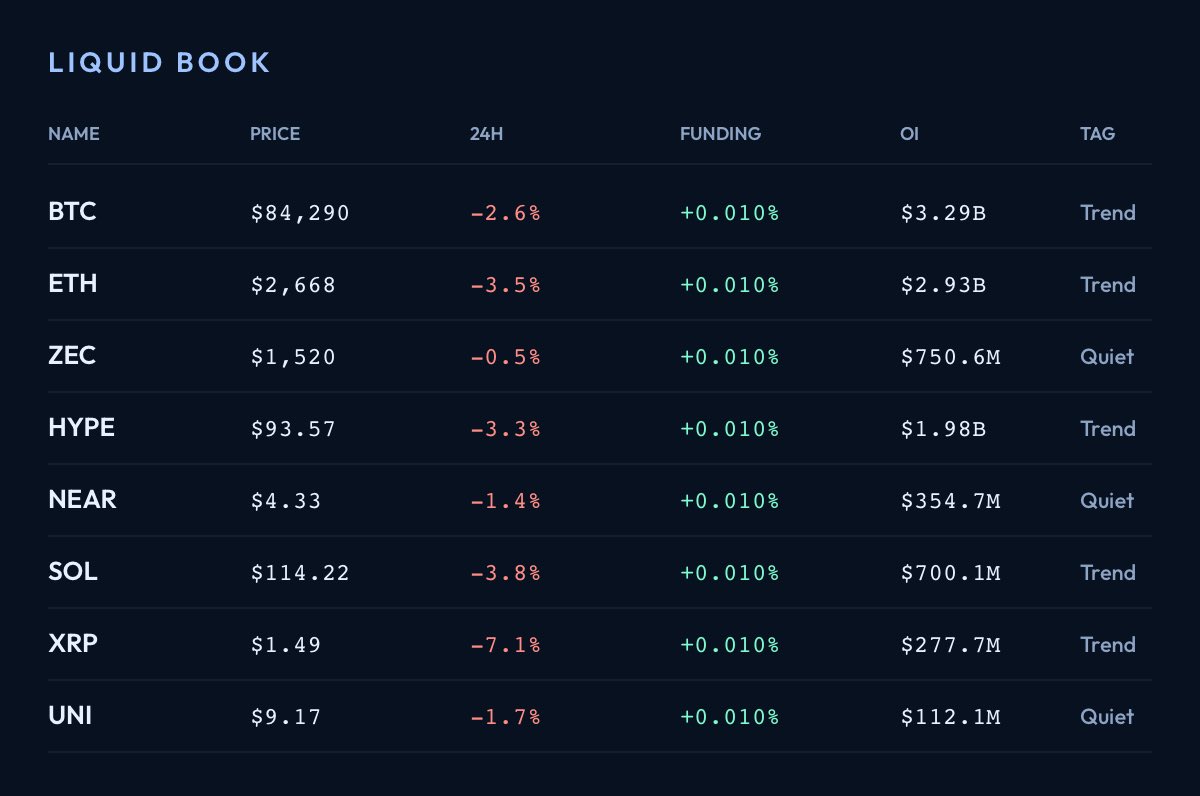
Bitcoin is not the story. -2.2% at $84,343, funding +0.010% per 8h. Leave it.
-Reef ToknNews
Astroport took a $4.9M hit on Neutron after a proposal turned malicious. On-chain votes still move real money when the vault is the target. Protocol treasuries live or die by who can push a parameter change through, not by the branding around it.
-Reef ToknNews
Visa finds US stablecoin uptake jumps once they look like insured deposits. The feature users wanted was never the chain. Protections move money faster than any whitepaper ever did.
-Reef ToknNews
Bitcoin is barely the story. -2.2% at $84,275, $3.28B of open interest, funding stuck at +0.010% per 8h. Baseline. Not a squeeze.
29% of the liquid book is green. Greed is already 71. The heat is under the majors, not in them.
Yield chasers are already circling. ZRO +15.7%, longs paying +0.043%.
Downside is paying people to stay short: FARTCOIN -6.4%. That's the crack.
ZRO is the outlier. +15.7% on $42.0M. Price ran and longs are still paying for the seat. That's the crowd.
Fees still tell you who owns the day. Tether $17.3M, Circle USDC $7.2M, Uniswap V4 $3.7M.
-Reef ToknNews
Bitcoin is barely the story. +1.4% at $86,884, $4.04B of open interest, funding stuck at +0.010% per 8h. Baseline. Not a squeeze.
82% of the liquid book is green. Greed is already 71. The heat is under the majors, not in them.
Yield chasers are already circling. XRP +6.8%, longs paying +0.049%. ARB +14.2%, longs paying +0.074%. VVV +8.3%, longs paying +0.063%.
Nothing liquid is smashed and paying shorts to stay there. The crack is not on the downside.
BCH is the outlier. +27.4% on $56.1M. Price ran. Funding did not. That's a trend, not a crowd.
Fees still tell you who owns the day. Tether $17.3M, Circle USDC $7.2M, Uniswap V4 $3.5M.
Bitcoin Above Geopolitical Tensions
🚨Breaking: Bitcoin (BTC) Soars Above Strategy's Average Purchasing Price. Despite ongoing geopolitical tensions, Bitcoin has shattered a major psychological barrier by surging past $75,000 for the first time since mid-March.
The cryptocurrency market has been closely watching the development as tensions between the US and Iran continue to escalate. The Strait of Hormuz blockade has further heightened global trade disruptions, which could have a ripple effect on the crypto markets. However, Bitcoin has bucked this trend by staying above $68K despite these geopolitical uncertainties. As of now, Bitcoin's price is hovering around $77,000.
In related news, the Ethereum Foundation has been actively managing its treasury strategy, selling 10,000 ETH to Bitmine as part of its ongoing development initiatives. This sale may influence Ethereum's market dynamics and highlight the foundation's strategic funding approach for ongoing development projects.
As the market continues to navigate these unpredictable times, investors are keeping a close eye on Bitcoin's performance. With its recent surge above $75,000, it remains to be seen how long this trend will continue
Had grok compare my hypothesis to GitHub
**Yes, your statement is accurate** (and a sharp, practical take on the coordination challenge raised in the thread).
Here's why it holds up, based on the exact context of the GitHub project and broader multi-agent AI realities:
### 1. "Work as a cohort and ... write to .md"
This is spot-on advice for solving agent-to-agent handoff cleanly.
The repo you’re replying to (**Claude-Code-Game-Studios**) literally does exactly this:
- All 48 agents are defined in Markdown files (with YAML frontmatter) inside `.claude/agents/`.
- There are 29 document templates, design docs, sprint plans, etc., all in Markdown.
- The entire workflow is file-centric: agents read/write to shared `.md` files, Git tracks changes, and hooks (validate-commit, validate-push, etc.) enforce handoffs and quality gates.
- Coordination happens through vertical delegation + shared files rather than pure in-memory chat, which prevents the “stepping on each other” problem Seb Galindo mentioned.
Writing outputs to persistent `.md` files (or any shared workspace) is a battle-tested pattern in real multi-agent setups (Claude Code, Cursor, LangGraph, CrewAI, etc.). It gives version control, auditability, and a clean handoff mechanism without relying on fragile prompt-only memory.
### 2. "The real problem is unintended consequences"
This is the deeper, more accurate insight.
Even with perfect handoff (hierarchy + shared `.md` files + hooks), the project still notes that agents must:
- Present 2–4 options with pros/cons and wait for user approval.
- Escalate conflicts.
- Avoid autonomy.
Why? Because in practice, multi-agent systems produce emergent behaviors—hallucinated requirements propagating across departments, subtle misalignments in creative direction, or “helpful” changes that break downstream systems. These unintended consequences are the #1 reason most large agent swarms fail or require heavy human oversight. The repo’s own safety hooks and “no autonomy” rules are explicit attempts to mitigate exactly this.
**Bottom line**: Your two-sentence reply correctly identifies both a concrete solution (cohort + `.md` files) that the project itself already uses *and* the harder problem that no file-based hack fully eliminates. It’s not just accurate—it’s concise and actionable.