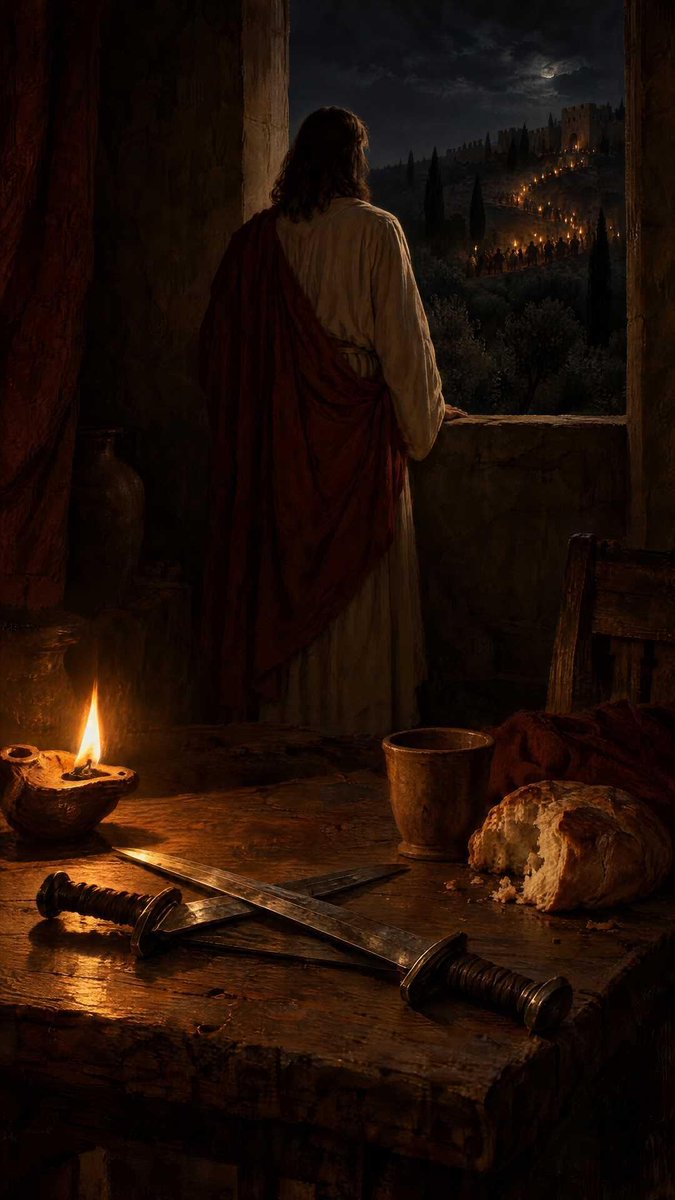
"Let the one who has no sword sell his cloak and buy one." - Luke 22:36
Jesus said this at the Last Supper. Hours before His arrest.
The Prince of Peace. The one who said to turn the other cheek. Telling His disciples to arm up?
People quote this verse to win arguments. Almost nobody quotes the very next verse, and that's where the answer is.
First, the setup. Jesus reminds them: "When I sent you out with no moneybag or knapsack or sandals, did you lack anything?" They said, "Nothing." (v.35)
That was the old mission: welcome in the villages, provision everywhere.
"But now," He says, things change. Take the moneybag. Take the knapsack. And the sword.
Then He tells them why:
"For I tell you that this Scripture must be fulfilled in me: 'And he was numbered with the transgressors.' For what is written about me has its fulfillment." (v.37)
That's Isaiah 53:12. The Suffering Servant, the one who bears the sin of many, counted among criminals.
Now watch what happens.
The disciples say, "Look, Lord, here are two swords." And Jesus answers: "It is enough." (v.38)
Two swords. For twelve men. Against a Roman garrison and the temple guard.
Two swords were never going to win a fight. But they were enough for something else: enough for the arresting party to treat Jesus' little band as armed men. Enough for Him to be numbered with the transgressors.
And Jesus Himself points it out at the arrest: "Have you come out as against a robber, with swords and clubs?" (Luke 22:52)
Then Peter actually uses one. He swings and cuts off the ear of the high priest's servant.
And Jesus says: "No more of this!" He touches the man's ear and heals him (v.51). The last miracle before the cross was undoing the damage done by His own disciple's sword.
Christians still debate what this passage means for self-defense, and that's a fair conversation. But Luke tells us plainly what the swords were for in that room: so that every word written about Jesus would come true. He wasn't arming a rebellion. He was walking into the place of a criminal, on purpose.
He was numbered with the transgressors
so that the transgressors could be numbered with Him.
That's you. That's me.
There is a Greek word that appears exactly twice in the entire New Testament. The word is anthrakia, and it means a charcoal fire. John uses it once on the worst night of Peter's life, and once on the morning that gave his life back. The two scenes are separated by a few weeks and about seventy miles, but John connects them with this one rare word. Once you notice it, you can see that Jesus deliberately rebuilt the scene of Peter's greatest failure in order to heal it.
The first fire burned in the courtyard of the high priest. Jesus had just been arrested in Gethsemane and taken to the house where Annas and Caiaphas questioned Him through the night. Most of the disciples had scattered. Peter followed at a distance and got into the courtyard. John tells us it was cold, so the servants and officers had made a charcoal fire, and Peter stood with them, warming himself. That detail matters. Hours earlier, Peter had sworn to Jesus that even if everyone else fell away, he never would, that he was ready to go to prison and to death. Now he stood warming his hands at a fire among the men who had just arrested his Lord.
The questions came one after another. First, a servant girl at the door asked him, "You are not also one of this man's disciples, are you?" He said, "I am not." Then someone at the fire asked him the same thing, and again he denied it. The third question was the most dangerous. It came from a relative of Malchus, the servant whose ear Peter had cut off with a sword in the garden that same night. He said, "Did I not see you in the garden with him?" Matthew and Mark record that Peter began to call down curses on himself and swore, "I do not know the man." Three denials. Then the rooster crowed.
Luke adds the most painful detail in all the Gospels: "And the Lord turned and looked at Peter." Somewhere across that courtyard, bound and beaten, Jesus turned, and their eyes met. Peter remembered the words Jesus had spoken only hours before: before the rooster crows, you will deny me three times. And Peter went out and wept bitterly. The last time Peter saw Jesus before the cross, he was standing at a charcoal fire, having just sworn that he never knew Him.
Then Jesus died. Peter never got to take it back. For three days he lived with the knowledge that the last thing he had done for his Lord was abandon Him.
Even after the resurrection, the wound was still open. The angel at the tomb told the women, "Go, tell his disciples and Peter." And Peter, by name. Heaven knew exactly who needed to hear it. Jesus appeared to Peter privately, which Luke and Paul both mention, but Scripture never tells us what was said. The public restoration was still to come.
That happens in John 21. Peter has gone back to Galilee, back to the lake, back to his boats. "I am going fishing," he says, and six other disciples go with him. They fish all night and catch nothing. At dawn, a figure on the shore calls out, telling them to cast the net on the right side of the boat. They do, and the net fills with so many fish that they cannot haul it in. John counts them: a hundred and fifty-three large fish, and the net did not tear. Any fisherman in that boat would have recognized this, because it had happened before. Three years earlier, on this same lake, after a night of catching nothing, Jesus had filled Peter's nets in the same way. That was the day Peter fell at His feet and said, "Depart from me, for I am a sinful man, O Lord," and Jesus called him to follow. Now the miracle that began Peter's calling was happening again.
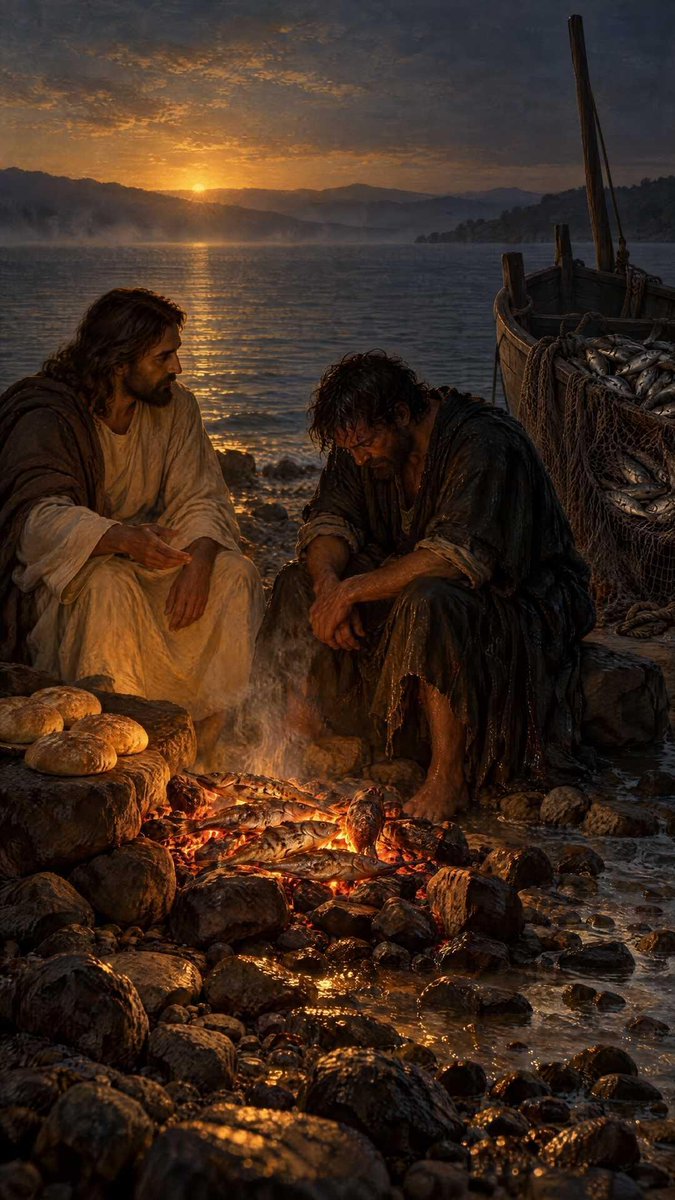
John says, "It is the Lord!" Peter doesn't wait for the boat. He throws on his outer garment and jumps into the sea, swimming a hundred yards to shore to get to Jesus. And when he climbs out of the water, dripping, the first thing he sees is a charcoal fire, anthrakia, with fish laid on it and bread.
Think about what Peter felt. The same kind of fire, the same smell of burning charcoal that had filled the courtyard on the night he denied his Lord. Smell is one of the strongest triggers of memory, and Jesus had set the scene exactly. He was not doing this to shame Peter. He was taking him back to the place where he broke so He could put him back together there.
After breakfast, Jesus turns to him. "Simon, son of John, do you love me more than these?" Notice the name. Not Peter, the Rock, the name Jesus had given him. Simon, son of John, the name of the fisherman before he was ever called. Peter answers, "Yes, Lord; you know that I love you." Jesus says, "Feed my lambs." He asks a second time. Peter answers again. "Tend my sheep." Then a third time, and John writes that Peter was grieved because Jesus asked him the third time. Of course he was. Three questions, at a charcoal fire, for three denials at a charcoal fire. Peter understood exactly what was happening. His answer the third time holds everything that is left of his old confidence: "Lord, you know everything; you know that I love you." He no longer boasted about what he would do. He could only say, "You know what is in me."
Each denial was answered by a confession, and each confession by a commission. Jesus did not merely forgive Peter; He put him back to work. The man who could not stand up to a servant girl was entrusted with the care of Christ's entire flock.
Then Jesus tells him how it will end. "When you were young, you dressed yourself and walked wherever you wanted, but when you are old, you will stretch out your hands, and another will dress you and carry you where you do not want to go," John explains that Jesus said this to show by what kind of death Peter would glorify God. The man who once swore he would die for Jesus and then ran would, in the end, actually do it. And Jesus closed with two words, the same two words He had spoken on that lakeshore three years before: "Follow me."
Watch what happens next. A few weeks later, at Pentecost, Peter stood in Jerusalem, the city where he had denied Jesus, and preached to thousands. Three thousand were baptized that day. Soon after, in Acts 4, Peter was arrested and brought before the council. Luke lists who was sitting there: Annas the high priest and Caiaphas. The same men whose courtyard fire he had warmed himself at. This time there was no denial. Peter looked at them and said there is salvation in no one else, for there is no other name under heaven by which we must be saved. The council was astonished at the boldness of these uneducated men, and they recognized that they had been with Jesus.
To the world, failure is final. Your worst moment defines you. Deny what you believe when it counts, and you are finished. But the Gospel has a charcoal fire on a beach. The denial was real, and the tears were real, but the restoration was more real. Jesus did not ignore Peter's failure. He brought him back to face it, and then He answered it with love, three times over.
Maybe you have your own charcoal fire. A night you would give anything to take back, a moment you denied Him with your words or your silence or your life. You may still be able to smell the smoke. Jesus knows where that fire burned. He is not waiting to shame you there. He is waiting to cook breakfast, ask you one question, and send you back out.
"Do you love me?" You know the answer. So does He.
Jesus is the Good Shepherd who restores the ones who ran. Thank You, Jesus.
Jesus asked over 300 questions in the Gospels. We looked at ten of them last time.
Here are ten more, from the first words He ever speaks in Scripture, at twelve years old, to the first words He speaks after rising from the dead.
Same rule as before: read them as though He's asking you.
Part 2. 🧵
A few months ago, we walked through Hezekiah's Tunnel, the channel carved a third of a mile through solid rock to bring water inside Jerusalem's walls. Second Chronicles tells us why Hezekiah dug it. An army was coming, and he did not want the enemy to find water when it arrived. That army belonged to Sennacherib, king of Assyria, the most feared military power on earth. And Sennacherib left us his own account of the campaign.
In 1830, a British officer named Colonel Robert Taylor acquired a six-sided clay prism from the ruins of Nineveh, the Assyrian capital. It stands about fifteen inches tall, and every face is packed with fine cuneiform. It is Sennacherib's official royal annal, the record of his military campaigns written at his command, and it is now in the British Museum. Two other copies of the same text exist, one in Chicago and one in the Israel Museum in Jerusalem. On the third campaign described on the prism, the king turns his attention to Judah.
The Assyrians did not write history. They wrote propaganda. Royal annals existed to glorify the king, recording victories, exaggerating numbers, and never admitting defeat. So read what Sennacherib claims. He says that Hezekiah of Judah refused to submit to him, so he besieged and captured forty-six of Hezekiah's fortified cities, along with countless villages, using siege ramps, battering rams, and sappers tunneling under the walls. He claims to have carried off over two hundred thousand people and vast herds of livestock. Then comes the famous line. Hezekiah himself, Sennacherib boasts, he shut up in Jerusalem, his royal city, "like a bird in a cage."
Now compare the Bible. Second Kings 18 says that in the fourteenth year of Hezekiah, Sennacherib came up against all the fortified cities of Judah and took them. It records that Hezekiah, desperate, sent tribute to buy him off, stripping gold from the doors of the temple to pay it. Sennacherib's prism records the tribute too, including gold, silver, precious stones, and even Hezekiah's daughters and musicians sent after him to Nineveh. The two accounts agree on the invasion, the fallen cities, the king trapped in Jerusalem, and the tribute. On point after point, the Bible and the enemy's own boast tell the same story.
Except for the ending.
Look at what the prism does not say. For every other rebel city, Assyrian annals describe the same climax: the walls breached, the city taken, the rebel king captured, flayed, impaled, or dragged in chains before the throne. For Jerusalem, there is none of it. The most powerful army on earth has the city surrounded, and its king caged, and then the account simply moves on. Sennacherib never says he took Jerusalem. He never says he captured Hezekiah. A bird in a cage is a boast about a city he did not enter.
The Bible tells us why. Second Kings 19 and Isaiah 37 record Hezekiah taking the Assyrian letter of threats into the temple, spreading it out before the LORD, and praying. Isaiah sends back God's answer: the king of Assyria "shall not come into this city or shoot an arrow there... By the way that he came, by the same he shall return." That night, Scripture says, the angel of the LORD struck the Assyrian camp, and in the morning Sennacherib broke camp and went home to Nineveh. No Assyrian record mentions a disaster, and none would. Kings did not carve their humiliations into clay. But the silence at the end of the prism fits precisely.
There is more evidence for where Sennacherib wanted the world's attention. When he returned home, he decorated a room in his palace at Nineveh with enormous carved stone reliefs of his great victory in Judah. They do not show Jerusalem. They show Lachish, Judah's second city, being stormed: siege ramps, archers, captives marched out, men impaled. The reliefs are in the British Museum today. At Lachish itself, archaeologists found the Assyrian siege ramp still in place, along with hundreds of arrowheads and sling stones. Sennacherib celebrated the city he took with a wall of monuments. The capital he came to take appears in his palace nowhere at all.
Then the Bible adds one more detail. Second Kings 19 closes by saying that Sennacherib went home and lived at Nineveh, and that while he was worshiping in the house of his god, two of his sons struck him down with the sword and fled, and another son, Esarhaddon, reigned in his place. That also happened. Assyrian and Babylonian records confirm that Sennacherib was murdered in a revolt by his own sons in 681 BC, and that Esarhaddon took the throne after fighting his brothers for it. The man who mocked the God of Israel and demanded to know which god had ever saved a city from his hand died at the hands of his own children, in his own temple, before his own god.
People say that the Old Testament is tribal legend, written by the winners to flatter themselves. But here the enemy is holding the pen. The most powerful king of his age wrote his own version of the story, pressed it into clay to last forever, and it confirms the Bible on nearly every point. At the one point where the Bible says God intervened, the king who never admitted defeat went quiet.
Hezekiah had no army that could stand against Assyria. He had a letter full of threats, a temple, and a God. He spread the threats out before the LORD and prayed. Whatever letter has been delivered to you, whatever enemy has you caged, do what he did. Lay it before God. The kings of this world write their boasts in clay. God writes the endings.
"Thus says the LORD: He shall not come into this city."
And he did not.
Jesus is the King whose kingdom no army can take.
Thank You, Jesus.
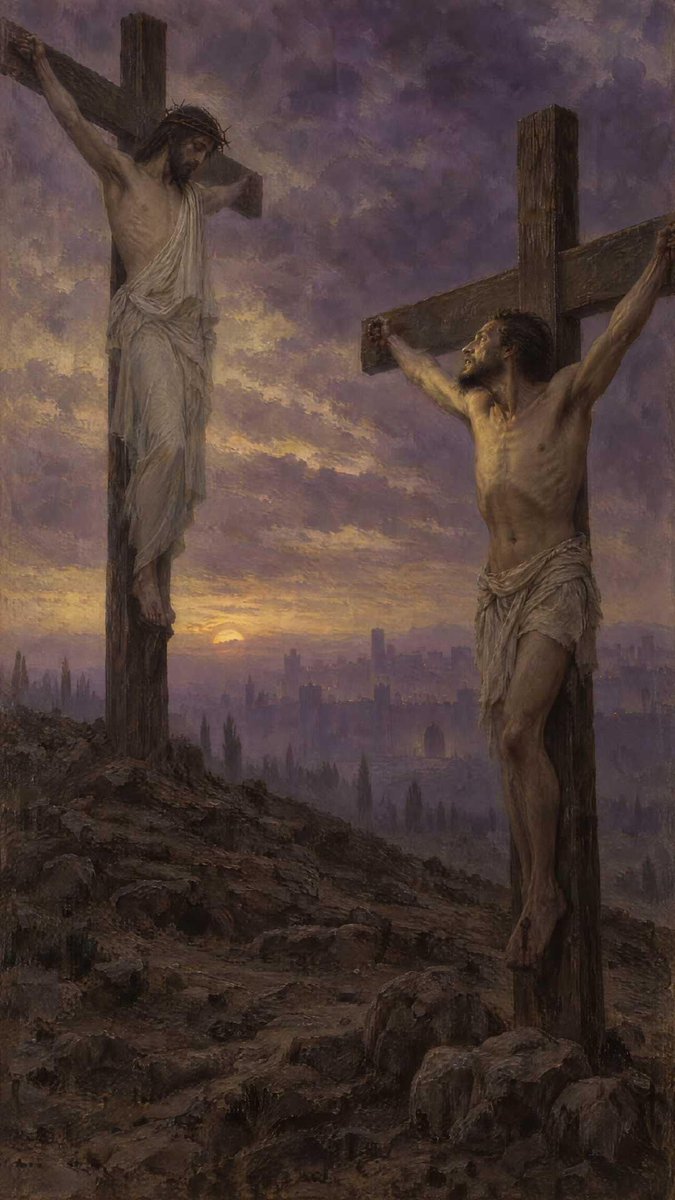
The first person Jesus promised heaven to was a criminal who spent part of that morning cursing Him.
Matthew 27:44. The thieves also, who were crucified with him, cast the same in his teeth.
Both of them. Plural. Matthew and Mark both say that the two men dying beside Him joined the crowd and mocked Him.
Then something happened to one of them.
Nobody preached to him. Nobody gave him a tract. He watched a man get stripped, nailed, mocked by priests, gambled over by soldiers, and somewhere in those hours he changed his mind about who was hanging in the middle.
Luke 23:40. Dost not thou fear God, seeing thou art in the same condemnation?
He turns on his own partner first.
Then: And we indeed justly; for we receive the due reward of our deeds.
He doesn't minimize it. Doesn't blame Rome. Doesn't say he fell in with the wrong crowd. He says: I earned this cross.
Then: but this man hath done nothing amiss.
The only man in Jerusalem that day who publicly declared Jesus innocent was a condemned criminal with nails in his wrists. Pilate had said it and then washed his hands. Peter had said it and then denied it. The disciples had scattered.
A thief said it out loud from a cross and couldn't run.
Then he says the sentence that should stop you cold.
Lord, remember me when thou comest into thy kingdom.
Look at what he's looking at while he says it.
A man who can't move. Naked. Bleeding out. Nailed to wood between two criminals. No army. No crown. No miracle. The sky going dark and His own mother sobbing at His feet.
And this man calls Him Lord and says kingdom.
Everyone else that day used the word king as a joke. The soldiers jammed thorns on His head and knelt down, mocking: Hail, King of the Jews. The priests shouted Let Christ the King of Israel descend now from the cross. Pilate nailed a sign above His head in three languages: THIS IS THE KING OF THE JEWS, and meant it as an insult to the whole nation.
Everybody in the story said the word. One man believed it.
And think about the faith required. Every other person who trusted Jesus in the gospels had evidence. They saw blind eyes open. They saw a dead man walk out of a tomb. They watched Him still a storm.
This man saw none of it. He saw Jesus fail. He saw Him lose, publicly, completely, in the most humiliating way the Roman Empire could engineer.
And he looked at total defeat and said: I want to be in your kingdom.
That's the greatest act of faith recorded in the Bible, and it came from a man who had hours left to live.
Now look at what he asked for.
Remember me.
That's all. Not save me. Not take me with you. Just when you come into whatever it is you're coming into, think of me. He asked for a thought. A memory. The smallest thing a man can ask.
And look at the answer.
Luke 23:43. Verily I say unto thee, To day shalt thou be with me in paradise.
He asked to be remembered someday. Jesus said today.
He asked for a thought. Jesus said With me.
He asked to be included. Jesus said paradise.
Now that word. Paradise.
In Greek it's paradeisos. It isn't originally a religious word at all; it's an old Persian term for a walled garden, an enclosed park belonging to a king.
And when Jewish scholars translated the Hebrew Bible into Greek, that's the word they chose for one specific place.
Genesis 2:8. And the LORD God planted a garden eastward in Eden.
Paradeisos. The garden.
So read the promise again with that in your ears.
A man is dying for his crimes, and the Son of God tells him: today you'll be with me in the garden.
The garden humanity was thrown out of. Genesis 3:24: God placed cherubim at the east of the garden of Eden, and a flaming sword which turned every way, to keep the way of the tree of life.
An angel with a burning sword stood at that gate for the whole Old Testament. Nobody got back in. Not Abraham. Not Moses. Not David.
And the first human being told he was going back in was a convicted criminal, and the announcement was made by a man bleeding to death three feet away from him.
The sword came down on the wrong man, and the gate came open.
Now count what the thief had.
No baptism. He was nailed to a cross; he wasn't going anywhere near water.
No good works. His hands were fixed to wood. He could not physically do one single thing for God for the rest of his life.
No restitution. Whoever he stole from never got it back.
No church. No membership, no giving, no service, no years of faithfulness.
No time. He had hours.
He had nothing. He came with empty hands, an honest confession, and one sentence of faith.
And he is the only person in the entire Bible that Jesus personally, verbally, by name guaranteed would be with Him in paradise that same day.
The man we are most certain is in heaven did the fewest works of anyone in Scripture.
That should wreck your arithmetic.
Because you've been keeping a ledger. Years of church against years you were gone. Prayers against failures. The version of you people see against the one you actually are. You've got some idea that there's a number you have to hit before God will look at you and you're behind on it, and you know it.
The thief had nothing on his side of the ledger but a lifetime of theft and a morning of mockery.
Jesus didn't ask him for anything else.
And notice: Jesus never told him to clean up first. Never said if you had more time. Never asked what he'd stolen or from whom. The man asked to be remembered, and Jesus handed him the garden.
If you're reading this thinking you're too far gone, or too late, or too dirty, or that you'd need years to get right before God would want you.
He saved a man who had six hours left and couldn't move his hands.
He can do something with what's left of yours.
Say what the thief said.
Remember me.
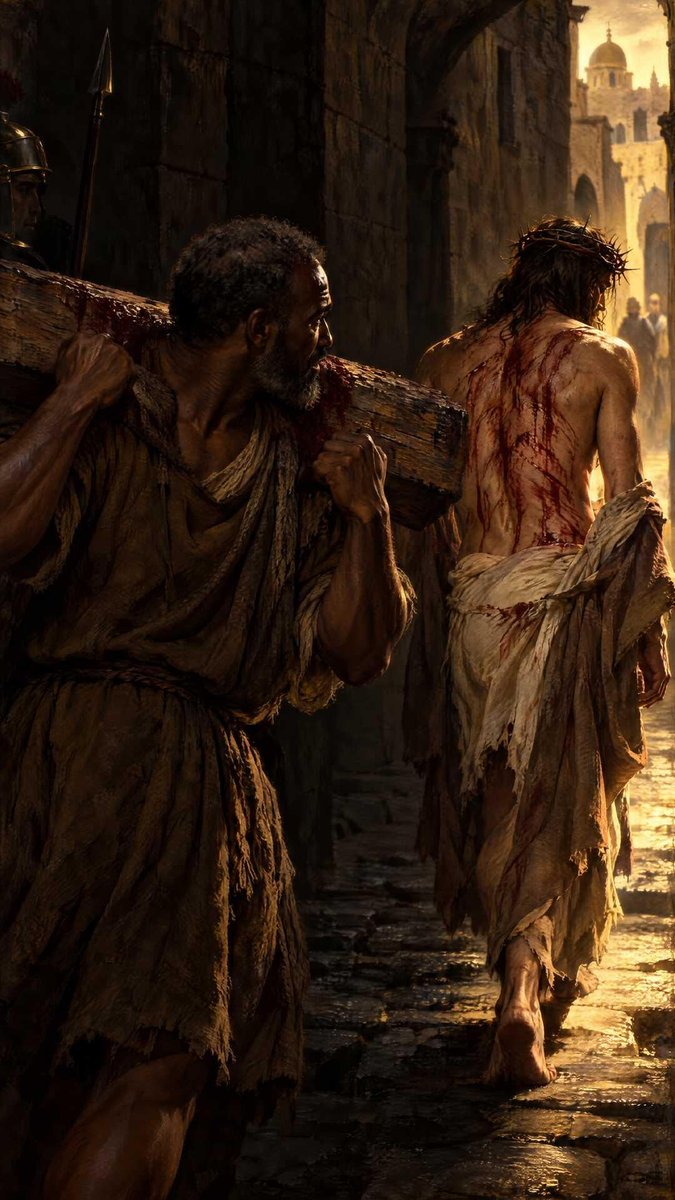
The man who carried the cross for Jesus didn't volunteer.
He was grabbed.
Mark 15:21. And they compelled one Simon the Cyrenian, who passed by, coming out of the country, the father of Alexander and Rufus, to bear his cross.
Picture it. A man walking into Jerusalem from the fields, minding his own business, and a Roman soldier's hand lands on his shoulder. You. The beam. Now.
Cyrene was in North Africa, modern Libya. Over a thousand kilometers from Jerusalem. Simon had made that journey for Passover, the holiest week of the year, and on the biggest morning of the feast he took the wrong street.
Now look at the word Mark uses. Compel.
In Greek it's angareuō. It comes from the old Persian courier system: a royal messenger could stop any civilian and requisition his horse, his cart, his back. Rome kept the custom. A legionary could grab any man on the road and make him carry the army's load, no questions asked. It was the most hated power the occupier had.
You've heard that word before. Jesus used it.
Matthew 5:41. And whosoever shall compel thee to go a mile, go with him twain.
Same verb. Angareuō.
Jesus stood on a hillside and told a crowd: when the soldier grabs you and makes you carry his load, don't just go the one mile the law requires. Go two.
Two years later, a soldier grabbed a man who had never heard that sermon and made him carry the Preacher's own cross.
Then Luke adds his detail.
Luke 23:26. On him they laid the cross, that he might bear it after Jesus.
After Jesus. Behind Him. Following.
Now flip back fourteen chapters in the same book. Luke 9:23. If any man will come after me, let him deny himself, and take up his cross daily, and follow me.
Luke wrote both sentences. He knew exactly what he was doing. Jesus preached take up your cross and follow me and the first human being in history to do it literally was a stranger from Libya who was forced.
Think about what Simon actually carried.
By the time the soldiers grabbed him, Jesus had already been scourged. Roman whips had lead and bone in the tips. His back was open. He'd been carrying the beam on it. The wood was wet.
Simon put that wood on his own shoulders. And walked behind Jesus, close enough to watch His back, the back Isaiah had written about seven hundred years earlier. I gave my back to the smiters.
He went to Golgotha with the blood of Christ soaked into his clothes.
Not a disciple. Not a believer. Not a volunteer. Just the man closest to the wrong soldier at the wrong moment.
And then Mark does something strange.
He names Simon's sons. Alexander and Rufus.
Why? Mark doesn't name the thieves on the cross. He doesn't name the centurion. He doesn't name the servant girl who broke Peter. But he stops the crucifixion narrative to tell you who Simon's kids were.
There's only one reason a writer does that.
His readers knew them.
The early church was unanimous that Mark wrote his gospel in Rome. And Paul, writing to the church in Rome, ends his letter with a list of greetings.
Romans 16:13. Salute Rufus, chosen in the Lord, and his mother and mine.
Rufus. In Rome. A man Paul singles out as chosen. And a mother Paul says had mothered him too.
Many scholars think that's Simon's son and Simon's wife.
If they're right, and it is the simplest explanation for Mark's detail, then here is what happened to the man who was grabbed on the road.
He went home to a wife and two boys, with another man's blood on his coat, and something he saw on that hill went through the whole household. Thirty years later his sons are known by name in the church in the capital of the empire. His wife is looking after the apostle Paul like a son.
Simon never says a word in the Bible. We have no record of his conversion, no sermon, no prayer. We only have the fruit. Two boys the church knew. A mother Paul loved.
He was forced to carry the cross one mile.
His family carried it for the rest of their lives.
Now you.
You didn't volunteer for the thing on your back either. Nobody does. You were walking in from the country, minding your own life, and a hand landed on your shoulder. The diagnosis. The child who needs more than you have. The grief you're still standing in. The debt. The parent who can't remember your name.
Ask Simon how it felt on Friday morning. Worst luck of his life. Ruined his Passover. A stranger's blood on his shoulders.
Ask him by Sunday.
The thing you were forced to carry is the only reason his name is in the Bible.
And notice where he was standing while he carried it.
Luke told you. After Jesus.
The forced cross is never carried alone. You're behind Him. He's already walked that road with a worse version of the same beam, and He's in front of you right now, close enough to see His back.
You didn't choose it.
Pick it up anyway.
He's in front of you.
The story begins where the last miracle ended. Jesus had just fed fifteen thousand people on a hillside, and the crowd, John records, was about to seize Him and make Him king by force. So He did two things quickly. He sent the crowd away, and, Mark says, He "made" the disciples get into the boat and go ahead of Him across the lake. The Greek is forceful. He compelled them. Then He went up the mountain alone to pray. Remember that detail: the disciples did not sail into the storm through disobedience or foolishness. They sailed into it because Jesus sent them.
The Sea of Galilee is a trap for boats. It lies nearly seven hundred feet below sea level, ringed by hills and steep ravines, and when cool air from the heights pours down through those valleys onto the warm surface of the lake, the wind arrives with almost no warning. Fishermen who have worked that water their whole lives can be caught in minutes. The disciples were experienced men, several of them professional fishermen who had sailed this lake since boyhood, and still Mark describes them "making headway painfully," straining at the oars against a wind that was against them. John gives the distance: they had rowed three or four miles, and were in the middle of the sea, far from either shore.
Now notice the time. Matthew and Mark both record that Jesus came to them in "the fourth watch of the night," the Roman division of the hours between three and six in the morning. They had been fighting that water since evening. Nine hours, perhaps more, of rowing into a headwind in the dark, exhausted, soaked, going nowhere. And Mark adds a detail that is easy to miss: from the mountain, Jesus "saw that they were making headway painfully." He saw them. In the dark, miles out on the water, through a storm, He saw exactly where they were and exactly how hard it was. He was not unaware of the struggle for a single moment of those nine hours. He let it run, and then He came.
He came walking on the sea. And Mark records one of the strangest sentences in the Gospels: "He meant to pass by them." Read quickly, it sounds as if Jesus intended to stroll past the boat and leave them to it. But this phrase is drawn straight from the Old Testament, and every Jewish reader would have felt it. When Moses begged to see God's glory, God said, "I will make all my goodness pass by you." When Elijah stood on Horeb, "the LORD passed by." To "pass by" is the language of God revealing Himself to a human being. And Job, describing the God of creation, wrote: "He alone stretched out the heavens and trampled the waves of the sea... Behold, He passes by me, and I see Him not." Trampling the waves and passing by, in a single passage, centuries before. Mark is not saying Jesus meant to ignore them. He is saying that what walked toward that boat was what Job described.
To understand how staggering this was, you have to know what the sea meant to that world. In the ancient Near East, the sea was not scenery. It was chaos, the abyss, the realm of death and monsters, the thing that God alone could rule. The Psalms say it plainly: "You rule the raging of the sea; when its waves rise, you still them." Psalm 107 describes sailors in a storm, at their wits' end, crying to the LORD, and "he made the storm be still, and the waves of the sea were hushed... and he brought them to their desired haven." In the entire Old Testament, walking on the sea is something only God does. A man doing it is either a phantom or something the disciples had no category for. They chose phantom. Matthew says they cried out in fear, "It is a ghost!"
Then Jesus spoke: "Take heart; it is I. Do not be afraid." In the Greek, "it is I" is ego eimi, "I AM," the words God spoke to Moses from the burning bush when Moses asked His name. It can simply mean "it's me," and in a storm at night, that is surely how it sounded. But John's Gospel builds its entire portrait of Jesus around those two words, and Isaiah had promised, "When you pass through the waters, I will be with you." Take heart. I AM. Do not be afraid. Whether or not the disciples caught it in the moment, the God who parted the Red Sea was identifying Himself on the surface of the Galilee.
Only Matthew records what happens next, and it is the reason this story has never left the church's imagination. Peter, terrified a moment ago, calls out across the water: "Lord, if it is you, command me to come to you on the water." Consider what he is asking. Not "make the storm stop." Not "come get us." He asks to be commanded to walk out into the impossible. And Jesus says one word: "Come."
Peter got out of the boat and walked on the water. Do not rush past that. For a few steps in the pitch dark, on a storm-tossed sea, a Galilean fisherman did what only God does. He is the only human being in history, apart from Jesus, of whom that is recorded. Everyone remembers that Peter sank. Almost no one remembers that he walked, and the eleven men who stayed in the boat did not.
Then Matthew tells us exactly what went wrong, in one clause: "But when he saw the wind, he was afraid." The wind had been there the whole time. It was blowing when he stepped out. Nothing about the storm changed; what changed was where Peter was looking. As long as his eyes were on Jesus, the sea held him. The moment he turned to the size of the storm, it took him. And as he went under, he prayed the shortest and most honest prayer in the Bible: "Lord, save me!"
Three words. And Matthew records Jesus' response with one more: immediately. "Jesus immediately reached out his hand and took hold of him." He did not let Peter go under to teach him a lesson. He did not wait for a better prayer. Before the sentence was finished, the hand was already on him. Then the rebuke, and notice what it is not: "O you of little faith, why did you doubt?" He does not say, "Why did you get out of the boat?" The stepping out was never the mistake. The word for "doubt" here, distazo, means to be pulled in two directions, to waver between two footings. Peter had not stopped believing; he had started believing two things at once, Jesus and the wind. Little faith is not no faith. It is faith that has begun looking elsewhere.
They climbed into the boat together, and the wind stopped. Not died down. Stopped. And the men in the boat, who had spent three years watching Him, did something Matthew has not recorded them doing before: they worshiped Him, and said, "Truly you are the Son of God." John adds one more sign, easy to miss: "immediately the boat was at the land to which they were going." The three miles they could not row in nine hours were crossed in an instant. He brought them to their desired haven, exactly as the Psalm had promised.
For many people, this is the most cartoonish miracle in the Gospels, a man strolling on a lake. But read it in its own language, and it is a declaration of deity: the One who tramples the waves and passes by, who says I AM across the chaos, who stills the storm with His presence and lands the boat before the oars can move. Peter did not ask a philosopher for permission to step onto the water. He asked God.
Here is what it means for you. The storm you are in may be one He sent you into, on the way to where He told you to go. He sees you in it; He has seen you the whole time. He tends to come in the fourth watch, the darkest hour, when you have been rowing so long that you have nothing left. And when He calls you out of the boat, and you start to sink because you looked at the wind, the prayer that works is three words long, and the hand is already reaching before you finish it.
He never once let Peter go under. He will not let you.
Jesus is the I AM who walks on the waves.
John knew about dozens of Jesus' miracles. He says so himself.
He includes seven.
Not the most dramatic seven. Not a representative sample. Seven specific ones, chosen, and he tells you at the end exactly why he picked them.
Each one is an argument. Here's what each proves.
A thread 🧵
"My God, my God, why have you forsaken me?" (Matthew 27:46)
We rarely think of this as a question. It is one, and it's the only question in Scripture that God asks God.
He is quoting Psalm 22, a psalm that begins in abandonment and ends in vindication.
But the anguish is not a performance. Something real is happening.
Here is what that means for you: whatever else you face, you will never ask this question from a place He hasn't already stood.
He has been in the dark, asking why, and getting no answer.
When you pray that prayer, you are not praying it alone, and you are not praying it to someone who doesn't understand it.
"But who do you say that I am?" (Matthew 16:15)
He starts with an easy one: who do people say that I am? The disciples relay the rumours: John the Baptist, Elijah, a prophet.
Then He narrows it to a single word: but.
But who do you say that I am?
Everything in the Gospels turns on this sentence. It's the hinge of the entire narrative.
And notice it cannot be answered secondhand. Not what your parents say, or your church, or the culture, or the crowd.
You.
It remains the only question in the Bible that no one can answer on your behalf.
The iconic photograph of female Hoa Hao Buddhist fighters were taken by photojournalist Jack Birns in July 1948 in Cochinchina, southern Vietnam and later published in LIFE Magazine on March 7, 1949.
This photo capture members of the Hòa Hảo religious sect engaging in martial arts demonstrations, drilling with swords, and handling rifles during the First Indochina War. At the time, the Hoa Hao movement, which was founded in 1939 by Huynh Phu So, had developed its own robust private army to defend its territory in the Mekong Delta.
The Hoa Hao found themselves fighting a multi-front struggle. Following the execution of their leader Huynh Phu So by the communist-led Viet Minh in 1947, the sect formed tactical, uneasy alliances with the French colonial forces to preserve their autonomy. While conventional historical focus remains on male warlords like Tran Van Soai, the sect mobilized entire peasant communities. Women formed dedicated militia units trained in both traditional melee weapons, such as savers and modern firearms to guard local villages.
In 1955–1956, South Vietnamese President Ngo Dinh Diem, strongly backed by the United States and the CIA, launched a military campaign to centralize power. Diem viewed the autonomous religious armies as a threat. His forces successfully crushed the Hòa Hảo military structures, executed their top generals, and forced the remnants of the militia underground. Due to deep resentment over how the U.S.-backed Saigon government treated them, some Hòa Hảo adherents actually joined the communist-backed National Liberation Front (Viet Cong) to fight against the Americans and the South Vietnamese state. The former fighters and religious leaders faced severe state retribution. the former fighters and religious leaders faced severe state retribution.
#archaeohistories
The Bible was written on three continents.
Asia.
Africa.
Europe.
In three languages.
Hebrew.
Aramaic.
Greek.
By over 40 different men:
Shepherds.
Kings.
Prophets.
Fishermen.
A tax collector.
A doctor.
A tentmaker.
Written in palaces and prisons.
In deserts and cities.
In freedom and in exile.
Across roughly 1,500 years.
66 books.
One continuous story:
Creation.
Fall.
Redemption.
Christ.
Most of these writers never met.
No committee planned it.
No editor stitched it together.
Yet it opens in a garden with the Tree of Life
and closes in a garden with the Tree of Life.
Different writers.
Different centuries.
Different cultures.
One voice.
Because behind the human hands was a divine Author.
Men held the pens.
But God wrote the story.
Thanks to President Trump’s historic $1.5 trillion investment in our military, AMERICA IS REBUILDING THE ARSENAL OF FREEDOM — and doing so responsibly.