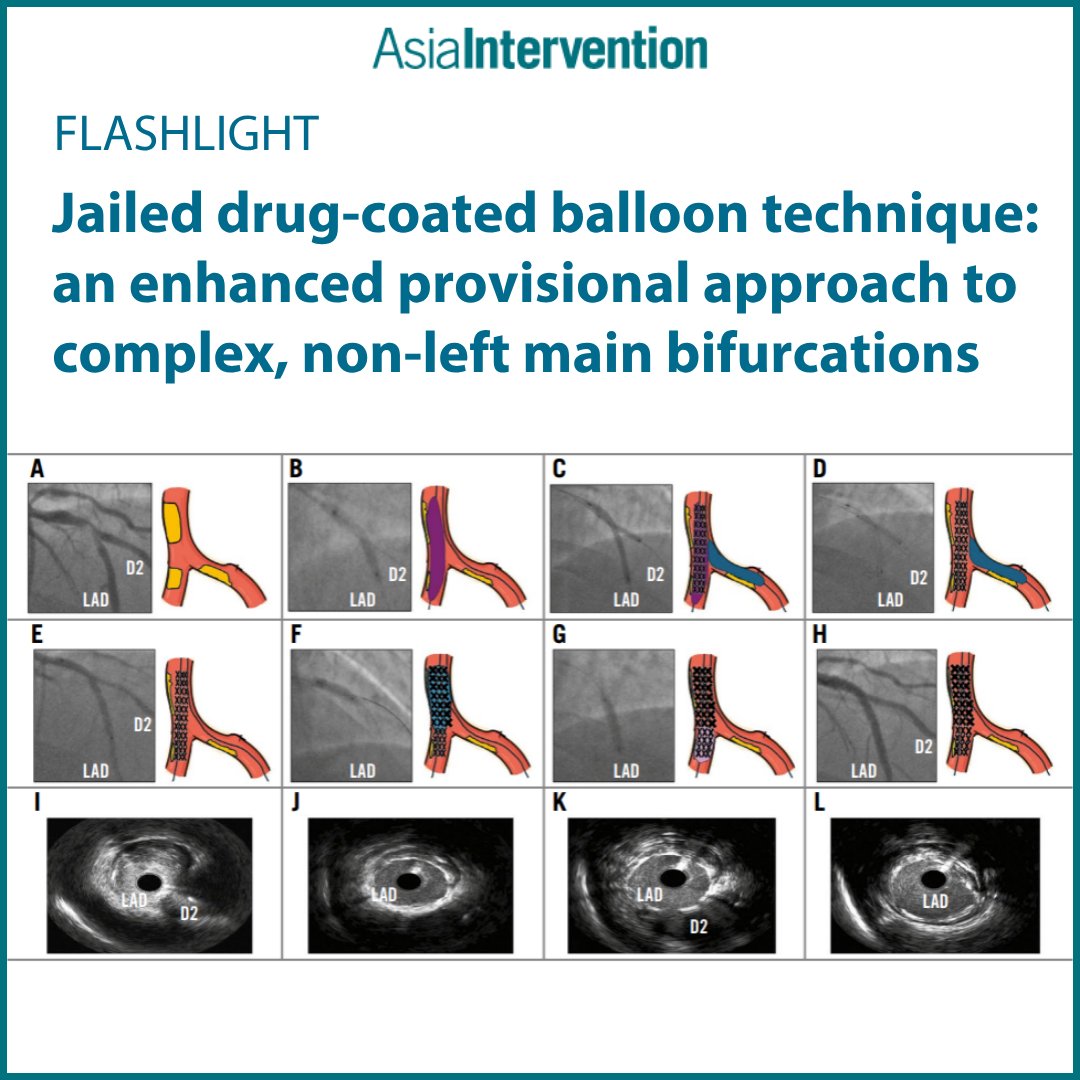
Bifurcation #PCI continues to evolve toward hybrid strategies 🫀
Combining provisional stenting with #DCB technology may offer a balanced approach for complex non-left main lesions.
🔗 https://t.co/O0c5sfcqpC
@APSIC6@EuroInterventio@PCRonline#InterventionalCardiology
Welcome to the “skipping rope technique” for managing burr entrapment during rotational atherectomy, based on sequential counterclockwise rotational force is applied to the drive shaft, generating alternative torque dynamics https://t.co/sz8tj6y5my @ccijournal
Stuck burr? The “skipping rope” technique is worth a quick try 🪢
We created an ex vivo model demonstrating the mechanics here:
https://t.co/xoa8mjcEVR
🔑 Key point:
Place the forceps over the interlocking hands, rather than the drive shaft rope itself.
🔄 The skipping rope motion appears counter-clockwise when viewed from the patient’s feet towards the head.
In our case, a combination of both techniques was helpful and reduced trauma to vessel. @Parko_85@BrettCookman@cghanratty
Thanks for sharing @MichaelMegalyMD
A backtable illustration of a couple techniques you can use if the #Rotaburr gets stuck,
1-The skipping rope technique.
We have known it for a couple years, and it was recently published
https://t.co/fqTn6NXkaT
2-The final resort of cutting the rota driveshaft and advance a guideliner through it to get more leverage to pull.
Of course the first thing you do is to pull hard and maybe try to balloon around it, but those can help with tougher situations.
#CardioX community, please share your additional tips and comments
The Lus! Nice case
Lusoria comes from the Latin verb ludere → “to play,” so lusoria roughly translates to:
“playful”…
We must remember that rather than the usual expletives when this variant is found!
Really important real-world issue.
If we move to clopidogrel monotherapy long-term, do we end up “bridging” back to aspirin for procedures? That feels messy and may ↑ bleeding without clear benefit.
We need data on P2Y12 monotherapy in non-cardiac surgery — especially off all therapy post-PCI.
And there’s regional variation — we inherit many pts with older, complex multivessel stents (1st gen DES and limited imaging), which makes stopping therapy particularly difficult.
@hvanspall@SripalBangalore Sorry for your loss. What a beautifully written piece. Your dad would be so proud of you sharing his story and helping our field get better
Medicine keeps reminding us how temporary our “truths” are.
Today’s NEJM data: in high-grade carotid stenosis without recent symptoms, stenting lowered 4-year stroke/death vs intensive medical therapy while endarterectomy didn’t show a significant benefit.
Guidelines, dogmas, and routines… all provisional.
We’re always just catching up with the evidence.
🌅 Live & work near the beach!
Our Central Coast Local Health District Cardiac Research Unit is hiring a Lead Cardiac Research Nurse / Unit Manager.
Join a supportive team, work with engaged patients and contribute to meaningful cardiac research.
🕒 Applications close Wednesday → https://t.co/ZM5cnWJ3TY
PROCTOR RCT in prior-CABG: when both strategies were feasible, SVG PCI had lower 1-yr MACE than native-vessel PCI (18.7% vs 34.3%) with less target-territory MI and revasc; similar mortality. Findings challenge “native-first” guidance, long-term data awaited. #TCT2025
The 10-year outcome of Noble trial may be the most impactful data presented at #TCT2025
PCI=CABG for isolated left main disease regardless of Syntax score
Which isolated LM patients (suitable for PCI) will you refer to CABG?