@johndaviesrev63 That makes sense. I like your point about looking for recurring themes rather than reacting to every game, while using the next opposition to give the work context.
Something I’m thinking about more in my coaching:
If a practice is too easy for one player and too difficult for another, is it really working?
Same practice doesn’t have to mean same challenge.
How do you manage this in your sessions?
When a practice isn’t working, does the player need more information or does the practice need changing?
Change one thing. Let them play. See what happens.
How do you approach it?
I’m trying to get better at not jumping in after every mistake.
Sometimes one more repetition tells you far more.
Does it happen again? Does the player adapt themselves?
Interested to hear from other coaches — what makes you decide it’s time to step in?
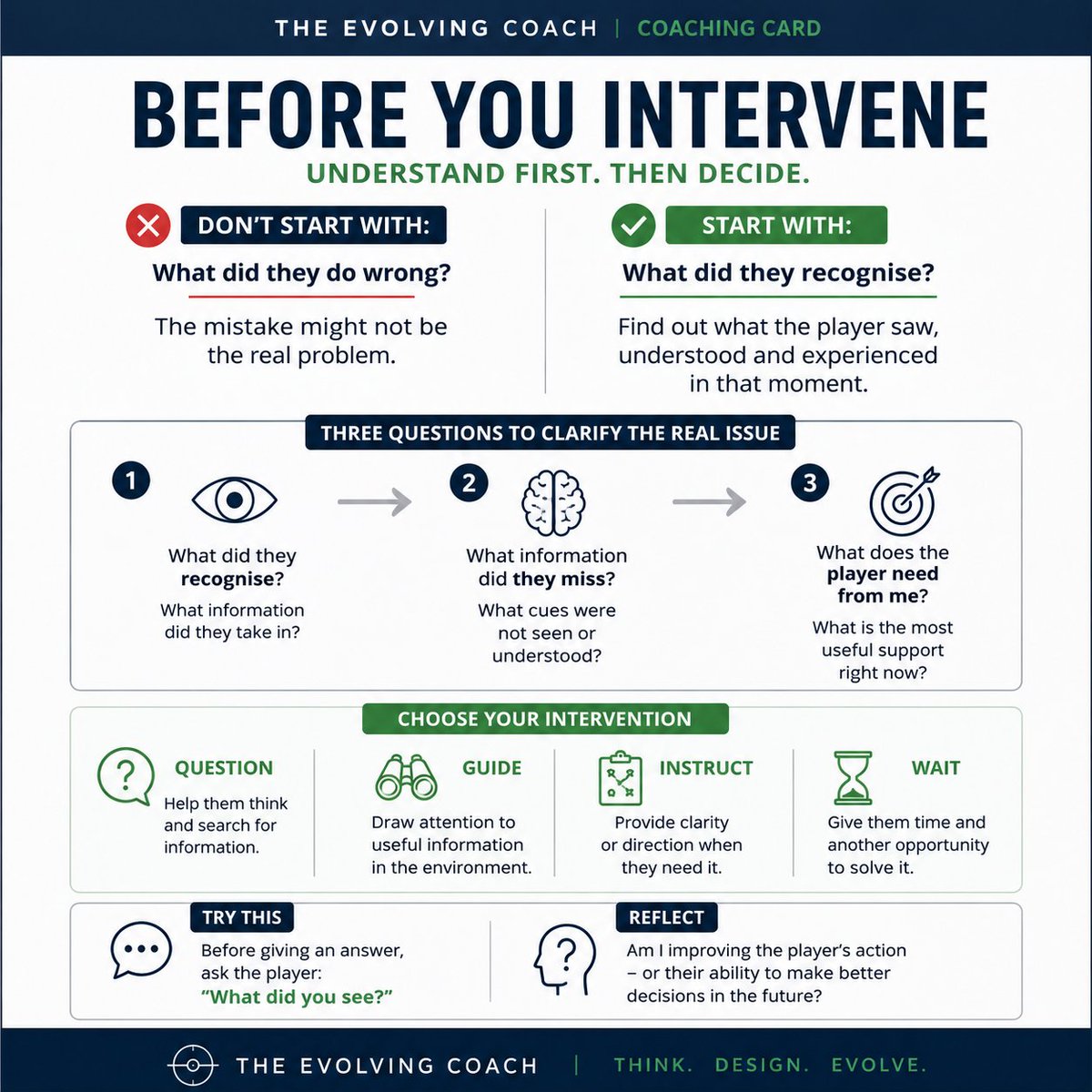
Not every mistake needs an intervention.
Before stepping in, give the player one more repetition.
Does it happen again?
Do they adapt without your help?
Sometimes the best coaching decision is to wait and observe.
Read more 👇
https://t.co/lkiBTNrC2f
A player makes the wrong decision.
Our instinct is often to correct the action.
But what if they never recognised the opportunity in the first place?
Before giving the answer, ask:
“What did you see?”
Sometimes the problem happens before the decision is ever made.
Your players don’t need more information.
Football is already full of it.
The challenge is helping players recognise which information matters.
That’s a very different coaching problem.
Read more ↓
https://t.co/MsXGhRvrb4
Every coaching intervention sends a message.
A substitution.
A tactical tweak.
A shout from the touchline.
The question isn’t just “Was it the right decision?”
It’s “What did it tell the players?”
Read more ↓
https://t.co/zpYMblkIk4
@TheS_Resource We often frame it as winning vs development, when the real challenge is developing to win.
That means designing environments where players learn to solve the problems that matter most. Mistakes are part of that process, so is providing the right level of challenge and support.
A player making the “right” decision doesn’t always mean they’ve learned the game.
Sometimes they recognised the opportunity.
Sometimes they guessed.
The challenge for us as coaches is knowing the difference.
@TheS_Resource Nice idea. I always find myself asking whether players are transferring because they’ve recognised the opportunity, or because they know that’s the next step in the practice.
@Keepitonthedeck I like this. It also raises an interesting question about transfer. If training consistently reflects how you want to play, players have more opportunities to recognise those situations when they appear in matches.
@Teamgrassroots_ Really interesting read. It made me wonder whether the biggest impact isn’t the instruction itself, but what it does to a player’s attention.
If we’re constantly telling players what to do, are they still searching for the information the game is providing?
The game doesn’t tell players what to do.
It presents information.
The challenge isn’t just making decisions.
It’s recognising what matters before the decision is made.