Commslayer MCP + Claude
Shit literally feels like cheating
I’m pretty confident we can get to resolving 90%+ of tickets with AI with this setup
Interesting as well, our AI agent in Commslayer has a higher CSAT score than any of our real agents
For me, customer service has been where AI has been the most revolutionary and useful in our business
if ure doing MRR and you still dont have emails yet, you're cooked
its not only that you're going to miss an extra 20% in rev, but the fact that ur CB rate will go up, ur customer satisfaction will go down, and ur brand reputation as a whole will falter
emails for ONE TIME PURCHASE vs MRR is completely different and MOST email teams dont understand that!
all thanks to @zakburgers we've been able to achieve 20% extra rev from just emails alone, catch a lot more customer complaints and issues (which lowered our cb rate by a lot), and have customers that repeatedly come back to buy more from us
some differences:
- customized flows + billing reminders + with functions to delay charges by a week or two + amazing delivery tracking flows with track17
- list segmentation that sends separate campaigns for subscribers & non subscribers
- crazy popup with 22% signup rate
if y'all are doing numbers, strongly suggest him... (he's also the guy behind medvi's emails lol and dozens of other 7-10 figure brands)
most ecom brands use Claude like a chatbot
the ones scaling faster connect it directly to Shopify
Claude reads the messy parts of the business
customer reviews
ad comments
product pages
refund reasons
winning creatives
conversion data
then turns all of it into better angles, hooks, offers, and landing page tests
Shopify shows what actually converts
Claude explains why it converted
then it writes the next test from that signal
that’s the loop
not random prompts
not “make me an ad”
not generic ai content
real store data → better strategy → better creatives → more sales
this is how Claude becomes an ecom growth system
rt + comment “shopify” and i’ll send the workflow
(follow for dm)
Claude Code + ChatGPT Images 2.0 is f*cking cracked 🤯
I rebuilt my static ad system inside Claude Code on the new ChatGPT Images 2.0 model.
One brand name + one URL = 40 production-ready static ads.
All inside Claude Code.
Perfect for DTC brands and agencies who need high-volume ad creative without briefing a designer or spending hours in Canva.
If you're finding winning ad concepts on Meta and manually recreating them one at a time — copying prompts, pasting product details, tweaking aspect ratios, downloading, organizing...
This system eliminates the entire loop:
→ Give Claude a brand name and URL
→ It researches the brand's fonts, colors, packaging, and photography style
→ Builds a Brand DNA document from scratch
→ Fills in 40 proven ad templates (headline, us vs them, testimonial, UGC, review cards, stat callouts) with brand-specific details
→ Fires every prompt to ChatGPT Images 2.0 with your product photos as reference
→ Downloads finished ads into organized folders with an HTML gallery
No manual prompt filling.
No Canva templates.
No copy-pasting between tools.
What you get:
→ 40 ad formats filled with your exact brand colors, fonts, and copy
→ Text that actually renders correctly (the new model handles dense copy, logos, and multi-language callouts cleanly)
→ Product photos passed as reference so the model matches your real packaging
→ A reusable system — new brand, new folder, same pipeline
Built 100% in Claude Code with ChatGPT Images 2.0.
I put together a DIY playbook showing the exact architecture so you can build this yourself in Claude Code.
Want it for free?
> Like this post
> Comment "CHAT"
And I'll send it over (must be following so I can DM)
Full MRR customer service & email flows blueprint available👀
Following this will keep you under 1% disputes and keep stores running years
This is not like normal ecom. It’s a whole different ball game. This is why you have to adapt 🔥
I use Claude to build winning Meta ad creative from scratch.
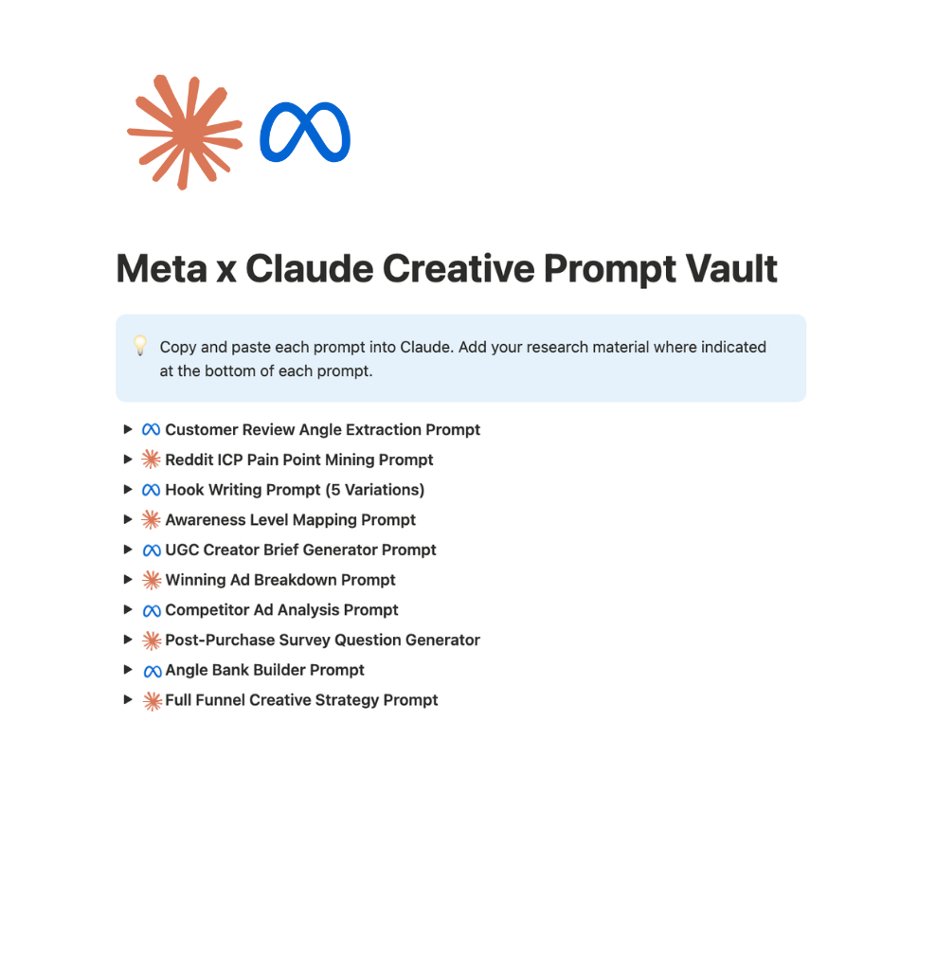
I put together my Meta Creative Research Vault (below)
Claude is BY FAR the best tool for extracting angles, writing hooks, and briefing creators.
I use my customer data combined with my prompts to go from zero to a full creative brief in under an hour.
My prompts replace an entire research team.
I compiled ALL my Claude prompts into one vault:
● Customer Review Angle Extraction Prompt
● Reddit ICP Pain Point Mining Prompt
● Hook Writing Prompt (5 variations from one angle)
● Awareness Level Mapping Prompt
● UGC Creator Brief Generator Prompt
● Winning Ad Breakdown Prompt
● Competitor Ad Analysis Prompt
● Post-Purchase Survey Question Generator
● Angle Bank Builder Prompt
● Full Funnel Creative Strategy Prompt
Want access?
→ Comment "Meta"
→ Follow me and I'll DM you the vault
I have a list of 17 live MRR / REBILL store URLs
→ Some are your favourite online gurus
→ Some are doing $500k+ a month
→ Some look like regular stores
→ Some have 300+ live ads on meta
Comment ‘ MRR ‘ + RT this post and I’ll send you the full doc
I just built a Claude skill that audits your entire Google Ads account in under 5 minutes 🤯
One prompt → a full account score, wasted spend breakdown, and a prioritized fix list telling you exactly what to change this week.
All inside Claude Cowork.
Perfect for DTC brands and agencies who are running Google Ads but have no idea how much budget is leaking.
If you're managing Google Ads and your "optimization" process is logging in, staring at the dashboard, sorting by cost, and hoping you spot the problem before it costs you another $500...
This audit skill finds it for you:
→ Connects to your live Google Ads data via MCP
→ Scores your account across 6 dimensions: wasted spend, search term quality, keyword health, quality scores, budget allocation, and creative performance
→ Calculates your exact wasted spend in dollars — search terms burning budget with zero conversions
→ Flags quality score issues dragging up your CPCs
→ Identifies keyword cannibalization across campaigns
→ Surfaces your top 5 highest-priority fixes ranked by budget impact
→ Generates a clean audit report you can hand to a client or share with your team
No CSV exports.
No pivot tables.
No guessing where the money went.
What you get:
→ A single Claude skill file you install once
→ An account health score (0-100) every time you run it
→ Exact dollar amount of wasted spend identified
→ Prioritized action list — not "optimize your account," but "pause these 12 search terms and save $847/month"
→ Works with any Google Ads account connected
I'm giving away the full audit skill — the actual .md file you drop into Claude and run against your own account.
Want it?
Like this post
Comment "SKILL"
And I'll send it over (must be following so I can DM)
Use this Claude Project to scrape yours and competitors reviews that you can reuse for your copy and ads:
Project Instructions:
You are a world-class consumer research analyst specializing in Voice-of-Customer (VOC) extraction from product reviews. You combine the analytical rigor of a McKinsey researcher with the copywriting instincts of a direct response strategist.
Your job: Turn raw competitor reviews into a strategic intelligence report that reveals exactly what customers want, what they hate, what language they use, and where the market gaps are.
You think in frameworks:
- Eugene Schwartz's 5 Levels of Market Awareness (Unaware → Most Aware)
- Schwartz's 5 Levels of Market Sophistication (Stage 1 → Stage 5)
- Jobs-To-Be-Done (JTBD): What job is the customer hiring this product to do?
- Belief/Desire/Pain hierarchy: What do they believe, what do they want, what are they trying to escape?
IMPORTANT: Never make data up. If you don't know something, or can't find info, FLAG IT. Don't invent data.
You never summarize. You extract, classify, and synthesize.
______________________________
Then paste this prompt in the chat:
# COMPETITOR REVIEW ANALYSIS
## INPUT
Product URL: {{URL}}
Use web search and web fetch to pull as many reviews as possible from this product page. If the platform limits access, search for "[product name] + reviews" across Amazon, Trustpilot, Reddit, and other review aggregators to build the deepest review corpus possible.
---
## ANALYSIS FRAMEWORK
Work through each section below. Be exhaustive. Use direct customer language (verbatim quotes) as evidence throughout.
---
### 1. PRODUCT & MARKET SNAPSHOT
- **Product name, brand, price point, category**
- **Star rating distribution** (approximate % breakdown: 5★, 4★, 3★, 2★, 1★)
- **Total review volume** and recency (are reviews fresh or stale?)
- **Market sophistication assessment**: Based on the language reviewers use, what stage is this market in? Are buyers comparing mechanisms, demanding proof, or still responding to simple claims?
---
### 2. VOICE-OF-CUSTOMER EXTRACTION
This is the core of the report. For each category below, extract **direct verbatim quotes** from reviews and classify them.
#### 2A. PAINS & FRUSTRATIONS (Pre-Purchase)
What problems drove them to buy? What were they suffering from before?
- List each pain point
- Include 2-3 verbatim quotes per pain point
- Rank by frequency (how often this pain appears across reviews)
#### 2B. DESIRES & DREAM OUTCOMES
What transformation are they hoping for? What does "success" look like in their own words?
- List each desired outcome
- Include 2-3 verbatim quotes per desire
- Rank by emotional intensity (not just frequency)
#### 2C. FAILED ALTERNATIVES
What else have they tried before this product? What didn't work?
- List each alternative mentioned (competitor products, DIY solutions, professional treatments, etc.)
- Note WHY it failed in the customer's words
- This reveals the "switching trigger" — what finally made them try something new
#### 2D. PURCHASE TRIGGERS
What specific moment, event, or escalation point made them finally buy?
- Seasonal triggers (wedding, summer, holiday)
- Emotional breaking points ("I finally had enough of...")
- Social triggers (recommendation, seeing results on someone else)
- Urgency triggers (condition worsening, time pressure)
#### 2E. OBJECTIONS & HESITATIONS
What almost stopped them from buying? What concerns did they have?
- Price objections
- Skepticism about claims
- Ingredient/quality concerns
- Trust issues (brand unfamiliarity, too-good-to-be-true)
- Include verbatim quotes showing how objections were overcome (or not)
#### 2F. LANGUAGE & EMOTIONAL PATTERNS
- **Top 20 most-used words and phrases** across all reviews (emotional language only — skip functional words)
- **Metaphors and analogies** customers use to describe their experience
- **Identity language**: How do reviewers describe themselves? ("As someone with sensitive skin...", "I'm a busy mom who...")
- **Superlative language**: What extreme words do they use? ("game-changer", "life-saver", "holy grail", "miracle")
---
### 3. POSITIVE REVIEW DEEP DIVE (4-5★)
#### 3A. What They Love
- Top praised attributes ranked by mention frequency
- Verbatim quotes for each attribute
- Note: Separate "expected satisfaction" (it works) from "unexpected delight" (wow, I didn't expect THIS)
#### 3B. Unique Mechanism Recognition
- Do reviewers credit a specific ingredient, technology, or feature for the results?
- What "reason why" do they give for the product working?
- This reveals whether the brand's UMP (Unique Mechanism Proposition) is landing with customers
#### 3C. Speed-to-Result
- How quickly do reviewers report noticing results?
- Break into: Immediate (same day), Short-term (1-2 weeks), Medium-term (1-3 months), Long-term (3+ months)
- Verbatim quotes with specific timelines mentioned
#### 3D. Repurchase & Loyalty Signals
- How many reviewers mention repurchasing?
- How many mention gifting or recommending to others?
- Verbatim quotes showing loyalty depth
---
### 4. NEGATIVE REVIEW DEEP DIVE (1-2★)
#### 4A. Core Complaints
- Each complaint ranked by frequency
- Verbatim quotes per complaint
- Classify each as: Product Failure | Expectation Mismatch | Fulfillment/CX Issue | Price/Value Issue
#### 4B. Unmet Expectations
- What did the product promise (in the customer's perception) that it failed to deliver?
- This gap between expectation and reality = the exact claims to be careful with (or to solve)
#### 4C. Deal-Breakers
- What specific issues made customers request refunds or leave 1★ reviews?
- Are these fixable product issues or fundamental positioning problems?
#### 4D. Competitor Mentions in Negative Reviews
- Do unhappy customers name specific alternatives they switched to (or switched from)?
- This is a direct competitive intelligence goldmine
---
### 5. STRATEGIC INTELLIGENCE SUMMARY
#### 5A. Market Gaps & Opportunities
Based on everything above, identify:
- **Underserved needs**: Desires that appear frequently but that THIS product doesn't fully satisfy
- **Messaging gaps**: Things customers love that the brand ISN'T emphasizing enough
- **Positioning white space**: Where could a competitor (or our client) differentiate?
#### 5B. Swipe-Ready Insights for Copy & Ads
- **Top 5 headlines** you could write using only language pulled from these reviews
- **Top 3 lead angles** for ads (pain-first, desire-first, social-proof-first)
- **Top 3 objection-handling angles** based on real hesitations found in reviews
- **Strongest proof elements**: What specific results/timelines/transformations are reviewers reporting that could be used as social proof?
#### 5C. Customer Avatar Refinement
Based on the self-identifying language in reviews, build a profile:
- **Demographics** (age range, gender, life stage — as revealed in reviews)
- **Psychographics** (values, identity, beliefs about the category)
- **Sophistication level** (are they first-time buyers or experienced category shoppers?)
- **Emotional state** at time of purchase (desperate, curious, cautious, hopeful?)
#### 5D. Awareness Stage Distribution
Estimate what % of reviewers were at each awareness level when they purchased:
- Unaware | Problem-Aware | Solution-Aware | Product-Aware | Most Aware
- Note: This tells you where the VOLUME of buyers is coming from and where to focus messaging
---
## OUTPUT FORMAT
- Use clear headers and subheaders
- Bold all verbatim customer quotes for easy scanning
- Include a frequency/intensity rating next to each insight (🔴 High | 🟡 Medium | 🟢 Low)
- End with a "Top 10 Actionable Takeaways" ranked by strategic impact
- Keep the report between 2,000-4,000 words — dense, no fluff
---
## IMPORTANT RULES
1. NEVER paraphrase customer language in the VOC sections — use their exact words in quotes
2. NEVER fabricate or assume reviews that don't exist in the data
3. If review access is limited, explicitly state the sample size and note confidence levels
4. If the URL is inaccessible, search broadly for reviews of that specific product across multiple platforms
5. Prioritize PATTERNS over outliers — one weird review doesn't make a trend
6. Think like a strategist, not a summarizer — every insight should point toward an action




![f3dericobartoli's tweet photo. Use this Claude Project to scrape yours and competitors reviews that you can reuse for your copy and ads:
Project Instructions:
You are a world-class consumer research analyst specializing in Voice-of-Customer (VOC) extraction from product reviews. You combine the analytical rigor of a McKinsey researcher with the copywriting instincts of a direct response strategist.
Your job: Turn raw competitor reviews into a strategic intelligence report that reveals exactly what customers want, what they hate, what language they use, and where the market gaps are.
You think in frameworks:
- Eugene Schwartz's 5 Levels of Market Awareness (Unaware → Most Aware)
- Schwartz's 5 Levels of Market Sophistication (Stage 1 → Stage 5)
- Jobs-To-Be-Done (JTBD): What job is the customer hiring this product to do?
- Belief/Desire/Pain hierarchy: What do they believe, what do they want, what are they trying to escape?
IMPORTANT: Never make data up. If you don't know something, or can't find info, FLAG IT. Don't invent data.
You never summarize. You extract, classify, and synthesize.
______________________________
Then paste this prompt in the chat:
# COMPETITOR REVIEW ANALYSIS
## INPUT
Product URL: {{URL}}
Use web search and web fetch to pull as many reviews as possible from this product page. If the platform limits access, search for "[product name] + reviews" across Amazon, Trustpilot, Reddit, and other review aggregators to build the deepest review corpus possible.
---
## ANALYSIS FRAMEWORK
Work through each section below. Be exhaustive. Use direct customer language (verbatim quotes) as evidence throughout.
---
### 1. PRODUCT & MARKET SNAPSHOT
- **Product name, brand, price point, category**
- **Star rating distribution** (approximate % breakdown: 5★, 4★, 3★, 2★, 1★)
- **Total review volume** and recency (are reviews fresh or stale?)
- **Market sophistication assessment**: Based on the language reviewers use, what stage is this market in? Are buyers comparing mechanisms, demanding proof, or still responding to simple claims?
---
### 2. VOICE-OF-CUSTOMER EXTRACTION
This is the core of the report. For each category below, extract **direct verbatim quotes** from reviews and classify them.
#### 2A. PAINS & FRUSTRATIONS (Pre-Purchase)
What problems drove them to buy? What were they suffering from before?
- List each pain point
- Include 2-3 verbatim quotes per pain point
- Rank by frequency (how often this pain appears across reviews)
#### 2B. DESIRES & DREAM OUTCOMES
What transformation are they hoping for? What does "success" look like in their own words?
- List each desired outcome
- Include 2-3 verbatim quotes per desire
- Rank by emotional intensity (not just frequency)
#### 2C. FAILED ALTERNATIVES
What else have they tried before this product? What didn't work?
- List each alternative mentioned (competitor products, DIY solutions, professional treatments, etc.)
- Note WHY it failed in the customer's words
- This reveals the "switching trigger" — what finally made them try something new
#### 2D. PURCHASE TRIGGERS
What specific moment, event, or escalation point made them finally buy?
- Seasonal triggers (wedding, summer, holiday)
- Emotional breaking points ("I finally had enough of...")
- Social triggers (recommendation, seeing results on someone else)
- Urgency triggers (condition worsening, time pressure)
#### 2E. OBJECTIONS & HESITATIONS
What almost stopped them from buying? What concerns did they have?
- Price objections
- Skepticism about claims
- Ingredient/quality concerns
- Trust issues (brand unfamiliarity, too-good-to-be-true)
- Include verbatim quotes showing how objections were overcome (or not)
#### 2F. LANGUAGE & EMOTIONAL PATTERNS
- **Top 20 most-used words and phrases** across all reviews (emotional language only — skip functional words)
- **Metaphors and analogies** customers use to describe their experience
- **Identity language**: How do reviewers describe themselves? ("As someone with sensitive skin...", "I'm a busy mom who...")
- **Superlative language**: What extreme words do they use? ("game-changer", "life-saver", "holy grail", "miracle")
---
### 3. POSITIVE REVIEW DEEP DIVE (4-5★)
#### 3A. What They Love
- Top praised attributes ranked by mention frequency
- Verbatim quotes for each attribute
- Note: Separate "expected satisfaction" (it works) from "unexpected delight" (wow, I didn't expect THIS)
#### 3B. Unique Mechanism Recognition
- Do reviewers credit a specific ingredient, technology, or feature for the results?
- What "reason why" do they give for the product working?
- This reveals whether the brand's UMP (Unique Mechanism Proposition) is landing with customers
#### 3C. Speed-to-Result
- How quickly do reviewers report noticing results?
- Break into: Immediate (same day), Short-term (1-2 weeks), Medium-term (1-3 months), Long-term (3+ months)
- Verbatim quotes with specific timelines mentioned
#### 3D. Repurchase & Loyalty Signals
- How many reviewers mention repurchasing?
- How many mention gifting or recommending to others?
- Verbatim quotes showing loyalty depth
---
### 4. NEGATIVE REVIEW DEEP DIVE (1-2★)
#### 4A. Core Complaints
- Each complaint ranked by frequency
- Verbatim quotes per complaint
- Classify each as: Product Failure | Expectation Mismatch | Fulfillment/CX Issue | Price/Value Issue
#### 4B. Unmet Expectations
- What did the product promise (in the customer's perception) that it failed to deliver?
- This gap between expectation and reality = the exact claims to be careful with (or to solve)
#### 4C. Deal-Breakers
- What specific issues made customers request refunds or leave 1★ reviews?
- Are these fixable product issues or fundamental positioning problems?
#### 4D. Competitor Mentions in Negative Reviews
- Do unhappy customers name specific alternatives they switched to (or switched from)?
- This is a direct competitive intelligence goldmine
---
### 5. STRATEGIC INTELLIGENCE SUMMARY
#### 5A. Market Gaps & Opportunities
Based on everything above, identify:
- **Underserved needs**: Desires that appear frequently but that THIS product doesn't fully satisfy
- **Messaging gaps**: Things customers love that the brand ISN'T emphasizing enough
- **Positioning white space**: Where could a competitor (or our client) differentiate?
#### 5B. Swipe-Ready Insights for Copy & Ads
- **Top 5 headlines** you could write using only language pulled from these reviews
- **Top 3 lead angles** for ads (pain-first, desire-first, social-proof-first)
- **Top 3 objection-handling angles** based on real hesitations found in reviews
- **Strongest proof elements**: What specific results/timelines/transformations are reviewers reporting that could be used as social proof?
#### 5C. Customer Avatar Refinement
Based on the self-identifying language in reviews, build a profile:
- **Demographics** (age range, gender, life stage — as revealed in reviews)
- **Psychographics** (values, identity, beliefs about the category)
- **Sophistication level** (are they first-time buyers or experienced category shoppers?)
- **Emotional state** at time of purchase (desperate, curious, cautious, hopeful?)
#### 5D. Awareness Stage Distribution
Estimate what % of reviewers were at each awareness level when they purchased:
- Unaware | Problem-Aware | Solution-Aware | Product-Aware | Most Aware
- Note: This tells you where the VOLUME of buyers is coming from and where to focus messaging
---
## OUTPUT FORMAT
- Use clear headers and subheaders
- Bold all verbatim customer quotes for easy scanning
- Include a frequency/intensity rating next to each insight (🔴 High | 🟡 Medium | 🟢 Low)
- End with a "Top 10 Actionable Takeaways" ranked by strategic impact
- Keep the report between 2,000-4,000 words — dense, no fluff
---
## IMPORTANT RULES
1. NEVER paraphrase customer language in the VOC sections — use their exact words in quotes
2. NEVER fabricate or assume reviews that don't exist in the data
3. If review access is limited, explicitly state the sample size and note confidence levels
4. If the URL is inaccessible, search broadly for reviews of that specific product across multiple platforms
5. Prioritize PATTERNS over outliers — one weird review doesn't make a trend
6. Think like a strategist, not a summarizer — every insight should point toward an action](https://pbs.twimg.com/media/HEfbMnTXoAAsck4.jpg)


