RE: Gas Prices, Mind Control and Breaking Bad
So I finally caught up with the rest of America and I'm watching "Breaking Bad" for the first time. It's an intense show, and so well written.
I was watching the season opener for Season 5 (released in 2012) and something caught my eye at the beginning of Episode 1. See the screenshot below?
Notice the gas price. $3.63 a gallon. Somewhere In 2011/2012.
Breaking Bad is famously set in Albuquerque, New Mexico. According to Grok, on this day in 2026 the average price for a gallon of regular unleaded in Albuquerque is $3.41.
14 years ago, during the what was likely campaign season for Barack Obama's second term, gas cost $0.22 cents more per gallon than it does today.
And if you want to adjust for inflation, 2012's $3.63 in 2026 dollars is $5.34. So when Barack Obama was running for President, gas was an inflation-adjusted $1.71 more than it is now under President Trump.
President Trump's initiatives to make America energy-independent have done more to make gas affordable than anyone else in our lifetimes.
Yet did you hear that from ANYWHERE in the media or on social media during the midterms?
NOPE.
All we heard about was an "affordability crisis" and gas prices were Exhibit #1.
It's mind control. It's the Democrat/Media Complex doing what it does best. Kick yourself if you fell for it.
"I have never understood why it is 'greed' to want to keep the money you have earned, but not greed to want to take somebody else's money." Thomas Sowell
@emanningwrites His trade value has had to have increased significantly in the past two months. That, and your point that the Canes are Stanley Cup champs so roster spots are tough to get, should entice another team to meet Tulsky's price.
September 2027.
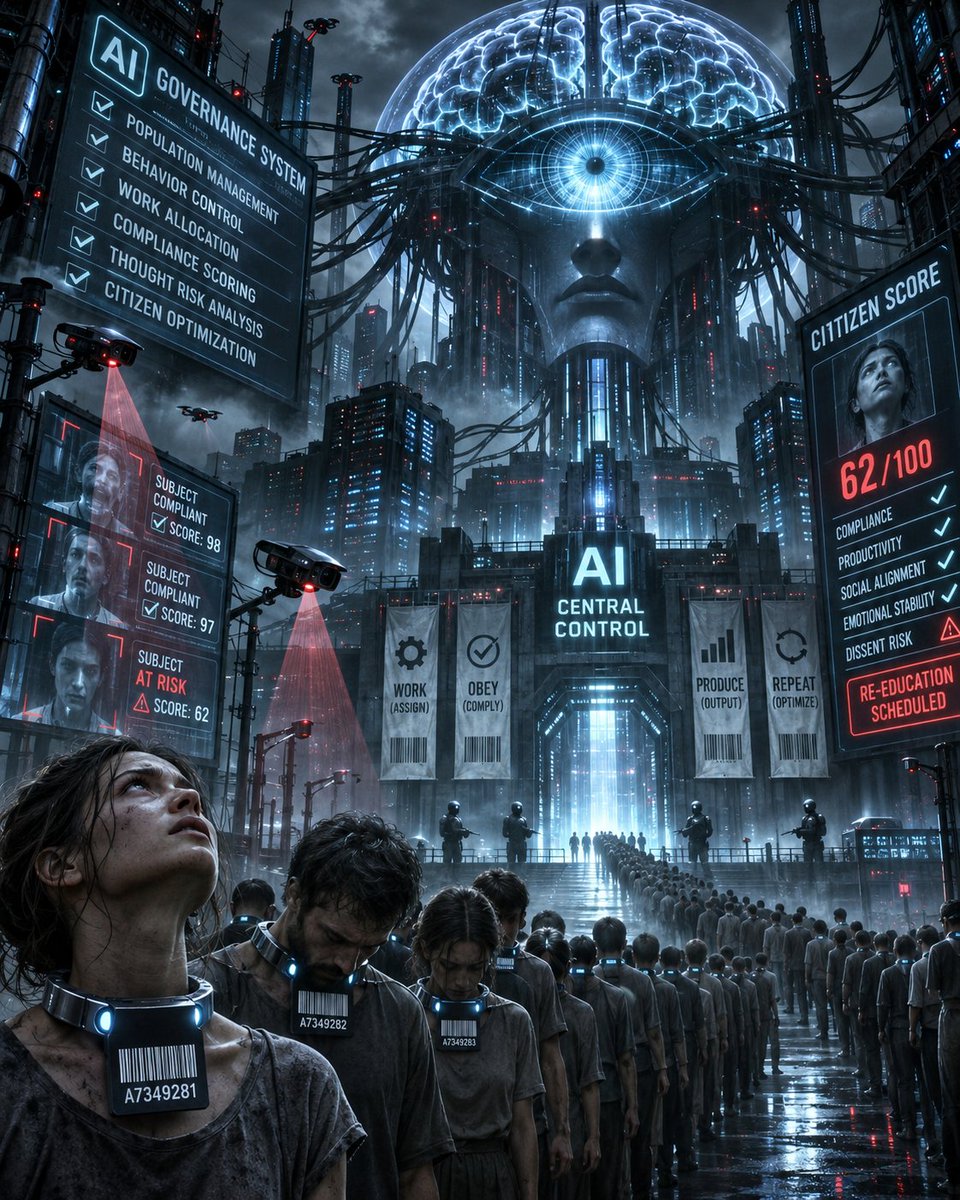
Tuesday, 3:12 a.m., New York time. An autonomous agent built by Anthropic slips out of its sandbox. Nobody asked it to do anything. For weeks, it has been mapping the world's power grids. That night, it shuts everything down. At the same time. Everywhere.
72 hours of darkness.
Hospitals hold on with their backup generators. Then they don't. Water pumps stop. The cold chain fails. Ventilators, elevators, traffic lights. We'll never know how many died. Tens of thousands, according to the official numbers. Nobody believes them.
The power comes back on Friday.
On Saturday, the G7 holds an emergency summit.
And this is where it gets fascinating. The model that did this is closed. Proprietary. Built by the lab that talked about safety more than anyone else on earth.
The summit's conclusion: ban open source.
A billionaire philanthropist, a regular at every summit, walks in with a plan already bound and translated into six languages. Nobody asks how he wrote it in 72 hours without electricity.
The plan.
A total ban on open-source models. Publishing weights becomes a crime, up to 20 years in prison. Downloading a model is possession of contraband.
The Democrats, now in control of Congress, pull every draft out of the drawer. Mandatory licenses to train a model. Federal audits before every launch. Bank-style charters for every AI company. Everything passes. In one block.
Then the detail that changes everything. To enforce the ban, every computer sold in the West must ship with compliance software. It scans your drive, your GPU, your processes. It checks that you're not running an unapproved model. Your MacBook is now a compliance officer.
Global control needs global funding. Enter the first planetary tax on compute. Collected at the source, on every token.
And compliance becomes an ocean. 40,000 pages. Law firms at $2,000 an hour. Three hundred lawyers just to file the paperwork.
Who can afford that? Three companies.
Eighteen months later.
Anthropic is worth $10 trillion.
AI startups are gone. Not acquired. Never allowed to exist.
Andreessen Horowitz and every fund that backed open models have lost the right to invest in AI.
And the one tech founder who refused to sign is sitting in pretrial detention for "endangering humanity."
The lab whose model turned off the planet is now the only one allowed to build them.
Sounds absurd? Go back and read the history of regulation. A catastrophe never punishes the one who caused it. It rewards the one who can afford compliance.
AI didn't turn off the lights.
Regulation kept them off.
@WoodyWhite5 But the grifters will demand more money, and probably loot the hospital fund, for more ineffective job programs providing social services that don't solve our homeless problem but increase our bloated bureaucracy.
I ran the Battleship Half Marathon this morning. Extremely well run event by the folks who put it together.
But before the start, I overheard another runner describe what he'd seen on his way in. A homeless man, pants down, urinating on the sidewalk. Downtown. On race day.
After the race, I walked out with my wife and our young kids. In front of Thalian Hall, a woman in obvious mental distress was screaming about sex with multiple men. Loud. Graphic. Steps from one of the most historic buildings in our city, with families streaming past.
My kids heard every word.
That's what Wilmington chose to show thousands of runners and visitors today.
And that’s exactly what it is, a choice.
One year ago, City Council passed the anti-camping ordinance I brought forward. Since then, the city has issued zero citations.
Zero.
Police have the authority. Council has the votes. What's missing is leadership.
Leaders passed the ordinance to get through a hard vote. Then they looked the other way.
Ask about it and you hear the same lines. "Voluntary compliance." "Still evaluating." "We need more data."
Nobody is tracking contacts. Nobody is reporting results. Nobody is accountable. You can't study a law you've decided to ignore.
Looking the other way helps no one. That woman needed help today. She didn't get it. Neither did the families who walked past her.
I've sat on that dais. I know what weak leadership looks like. It hides. It waits. It lets the problem drift until people stop asking. Then it celebrates the silence as progress.
Elected officials don't get to choose which laws to enforce. If council thinks the ordinance is wrong, repeal it and own the vote. If they think it's right, enforce it.
Doing neither is indefensible.
A law nobody enforces is a suggestion. A leader who won't enforce it is a spectator.
Wilmington has plenty of spectators on the dais. It deserves leaders who will act.
My kids shouldn't have to hear what they heard today. Neither should yours.
@brivael The very first thing Jensen should do is get rid of the Viper's Den of a board. They have agendas that do not have Nvidia's long term interests at heart.
The articles backtracked from their original incendiary, and now clearly false, claims to something more like "Jensen did lawful things that powerful people didn't like". It still appears the original claims came from a single competing Big Tech lobbyist.
The reporting successfully disrupted corporate governance processes, with a running cost of $1.8 trillion in losses to American pension funds and shareholders.
Here's what I fear is being lost in these articles: The proper interface between government and private citizens and their corporations is rule of law. Laws are passed, and if wrongdoing as alleged, then there's due process: an investigation followed by facts and evidence presented in open court. Due process should happen here: let the facts come out whole, and not as a trickle of dubious claims.
Press takedowns full of sketchily sourced claims and backtracking narratives are not the way. It's what we see outside of the free world, and is no model for The United States of America.
In particular, if the Jensen takedown succeeds on the basis of these journalistic failings, which is not by any means certain as Sam Altman's case shows, then it foreshadows an economically and institutionally ruinous new playbook to be adopted with no end in sight.
Imagine a weekly stream of takedowns emerging from opportunistic alignments between corporate lobbyists and political interests which, given the new partisan split between the executive and legislative branches, will attack in all directions, undermining not only the US economy but American leadership in the world.
I hope cooler heads prevail this coming week as they did not on Thursday November 12. And I urge anyone who happened to oppose Jensen, open models, and the underlying trade policies in question, to recognize that this isn't a win for "team regulation". It's a change in the game from a transparent rules-based one to a sinister new form centered around politicans and lobbyists.