@MariuszGierej W jakim stopniu napisał Pan ten tekst przy użyciu AI?
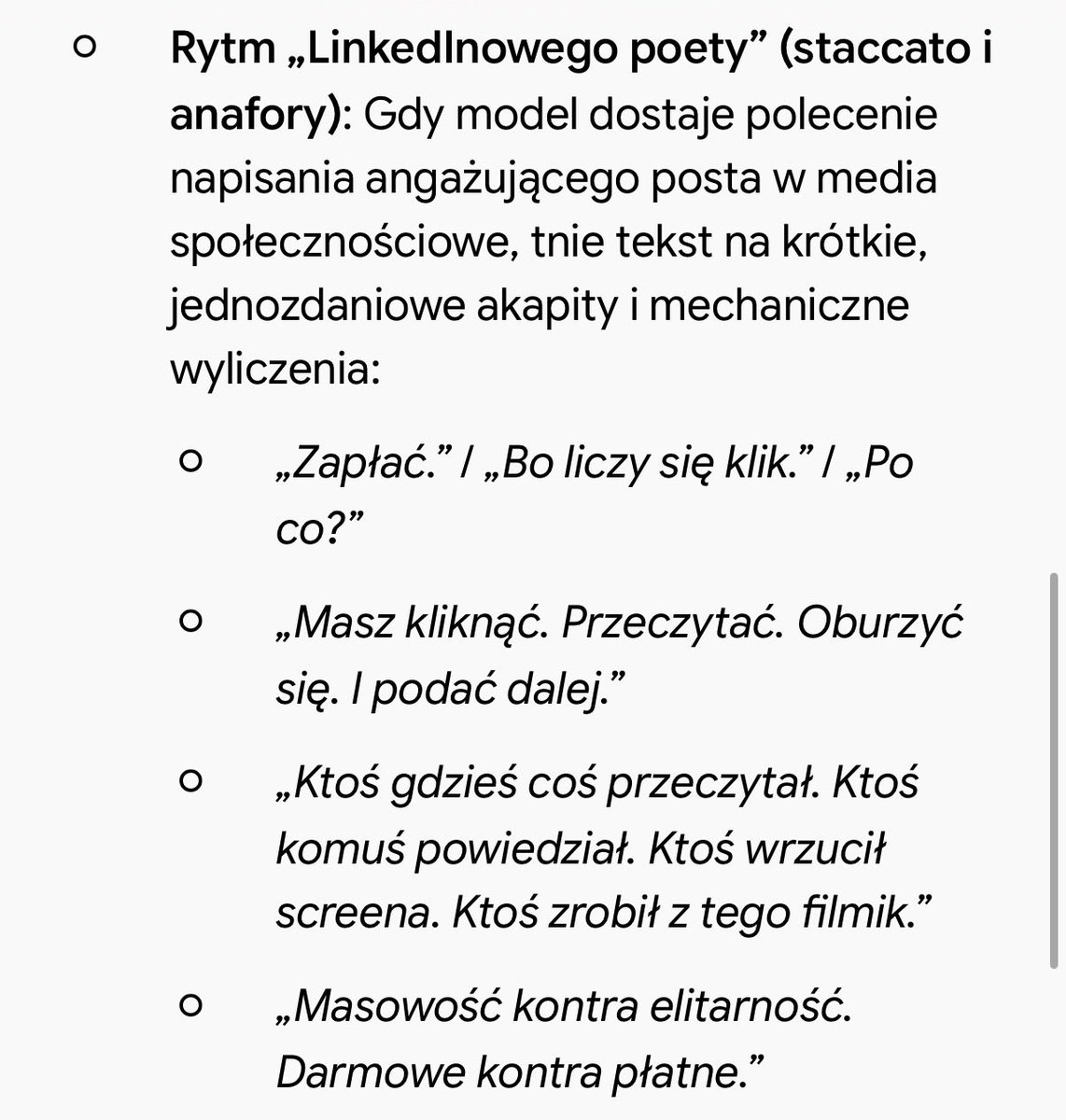
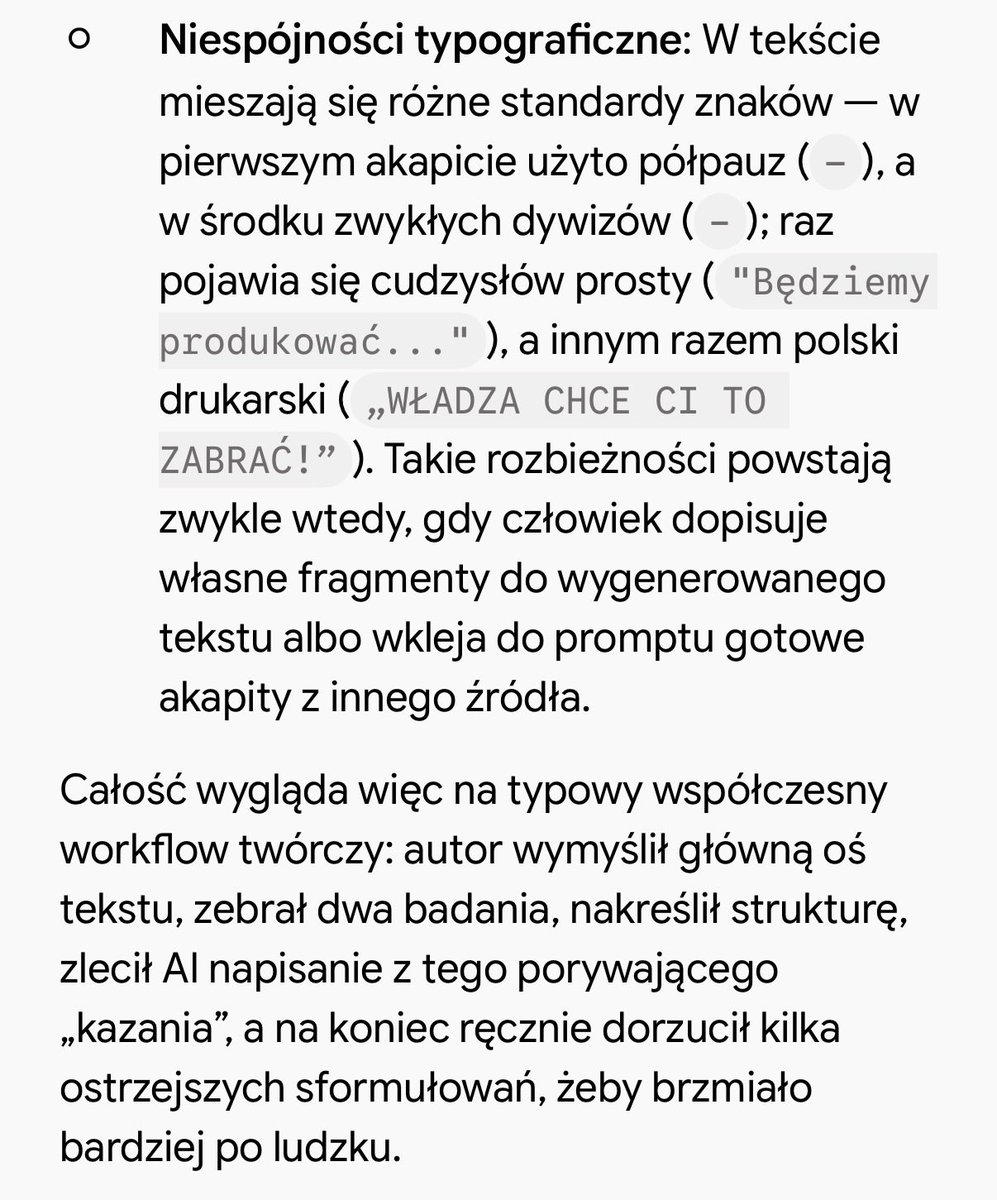
Raz polskie cudzysłowy - „ ” - raz angielskie " " - co sugeruje edytowanie tekstu napisanego przez AI, konstrukcja "to nie X. To Y", którą tak kochają LLMy, ocena Pangram itp.
@_zboral W takim razie osoby z nadwagą podpisują kwit, że dopłacają do leczenia zawału, udaru, cukrzycy typu 2 i nadciśnienia, tyle procent, ile wynosi ich nadwaga. Rozumiem, że nie jest Pan hipokrytą i radośnie podpisze taki kwit?
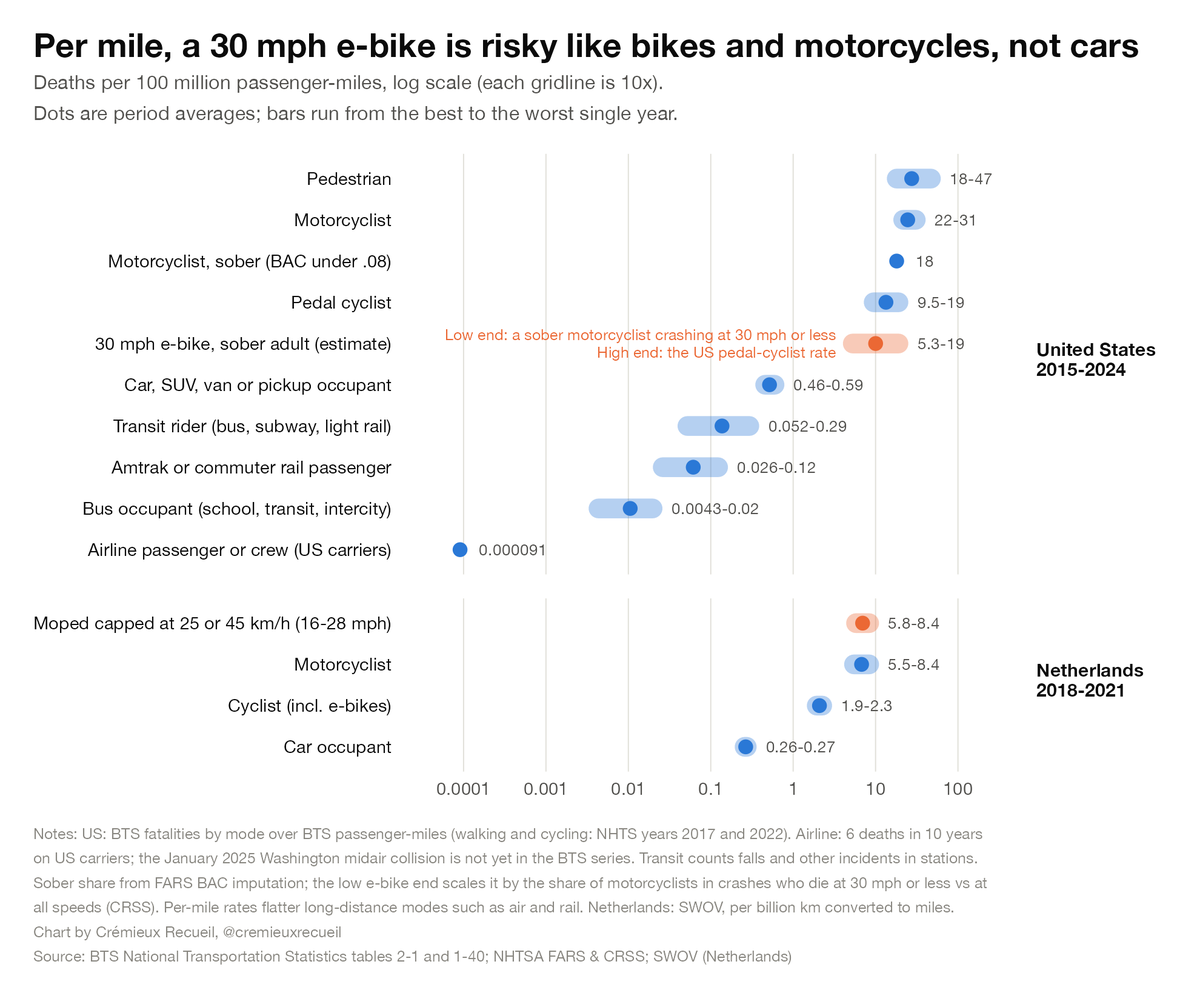
Deaths per 100 million passenger miles, by mode of transport.
The deadliest isn't motorcycling--as you might expect--it's... walking!
And e-bikes are just a bit less risk-related than motorcycles.
@Pr0st0_1@JMiziolek Lubię panią Joannę, ale gdy powołuje się na zagraniczne źródła, precyzja w tłumaczeniu to podstawa. Różnica między prewencją a antyterrorystami jest zasadnicza: ci drudzy nie służą do bezkrwawego zabezpieczania demonstracji.
Moją ulubioną przytaczał Witold Jurasz:
Podczas jednego z kuluarowych spotkań dyplomatycznych Sikorski, nawiązując do swojej przeszłości korespondenta wojennego w Afganistanie w latach 80., chciał rzucić w swoim stylu efektowną, „męską” uwagę do Wadima Zajcewa, szefa białoruskiego KGB, który w Afganistanie służył w Specnazie GRU.
Powiedział: „Wie pan, a przecież my mogliśmy się spotkać w Afganistanie”.
Na co Zajcew miał odpowiedzieć: „Dobrze, że się nie spotkaliśmy, bo bym pana zabił”.
Sikorki nic na to nie powiedział. Nie miał żadnej riposty. Zapomniał języka w gębie.
I to jest kwintesencja Sikorskiego w Sikorskim: samiec alfa na potrzeby kamer i Twittera, ale gdy przychodzi co do czego i trafia na prawdziwego samca alfa to błyskotliwe riposty nagle się kończą.
I am a member of the Norwegian Nobel Committee.
There are five of us. Five people, appointed by a parliament most of the planet could not find on a map, who decide, once a year, which human being the world has agreed to call good.
I know. I know. I think about it on the tram.
We meet in a building on Henrik Ibsens gate, a street named after a man who wrote almost exclusively about people discovering they are frauds, which nobody on the committee finds funny except me. There is a room with a long table and the portraits of the dead laureates looking down, Mandela, the Dalai Lama, a great many earnest men in spectacles, and one portrait we do not discuss, which is Kissinger, 1973, awarded while the bombs were still falling, after which two of our predecessors resigned and the satirist Tom Lehrer said political satire was now obsolete. We keep him on the wall. A reminder. Every family has the uncle.
It is October in Oslo, which means the sun gives up around four in the afternoon like a civil servant, and it rains the particular Norwegian rain that isn’t quite falling, just hanging there, judging you. I arrive with wet shoes. I always arrive with wet shoes. There is coffee, because this is Norway and there is always coffee, we drink more of it per person than almost anyone alive, and someone’s wife has sent kanelboller, the cinnamon buns, and we sit, five Norwegians, damp, caffeinated, sugared, and we decide the moral standing of the entire species.
Let me tell you how it actually works, because the world imagines a cathedral and it is, I promise you, a book club with a mandate.
287 nominations this year. 208 people, 79 organizations. Anyone can nominate, that’s the secret nobody understands: a professor, a parliamentarian, a former laureate, so the “nominee” list is meaningless, it’s a suggestion box, and every autumn some congressman nominates his own golden retriever and the press writes “SHORTLISTED.” Nobody is shortlisted. There is no short list the public ever sees. There is us, and the coffee, and the rain, and the portraits, and a Norwegian stubbornness that is older than the prize itself.
We read reports. The institute’s advisers write them, thick dull documents, and we argue. Our chairman told the BBC once that in the final meeting “there is a high temperature.” High temperature, for a Norwegian, means someone slightly raised an eyebrow and then apologized for it. We don’t do high temperature. We do a long silence, and then Kristin says “well,” and everyone knows exactly what “well” meant, and it’s settled. That’s our shouting. “Well.” You’d have to be raised here to hear the violence in it.
Now. This year. I will not say the name, because we never say the name, but you know the name.
A certain head of state wanted this prize the way a child wants a thing in a shop window, which is to say loudly, and in public, and with the full belief that wanting it was itself the argument. He said he deserved it. He said he’d ended eight wars, a number that grew most times he said it, like a fish. He had other heads of state phone us. Israel’s prime minister posted it on the internet, “Give him the Nobel.” The leaders of Cambodia and Pakistan announced they’d nominated him, as though announcing it were part of it, as though we tally mentions. A man flew around the globe collecting endorsements for a Norwegian committee the way you’d collect signatures for a petition to the council about a noisy dog.
And here, uff da, is the detail I treasure, the one that makes me smile into my coffee. The nomination deadline is the 31st of January. He took office on the 20th. So for all the phone calls, all the posts, all the gilded lobbying, the only nominations that could possibly count for this year’s prize were filed in the first eleven days of his term, before he had, by his own arithmetic, ended a single one of the eight wars. He campaigned all year for a prize whose window had shut while he was still hanging up his coat. We didn’t have to reject him. The calendar did. We just watched. Norwegians are very good at watching. We have long winters.
People think we sit there weighing his deeds. We don’t. That’s the thing I can’t make the world understand. We’re not grading his homework. We don’t owe anyone the prize for a ceasefire, however real, however loud the announcement. “He made peace” is not a sentence that ends in a medal, the way he believes it does, the way he believes every good thing ends in his name on it. The will of a dead Swede says the prize goes to whoever did the most for fraternity between nations. A dead Swede, I should add, who made his entire fortune inventing dynamite and selling arms, and spent his last years horrified at his own obituary, which called him a merchant of death, and so bought his way to immortality as a man of peace. The whole prize is one guilty arms dealer’s attempt to launder his name. We are, all of us, administering a dead man’s public relations. I find this clarifying. It keeps me humble. It should keep everyone humble, and it keeps, by my count, no one humble at all.
So who did we give it to?
An eighty-five-year-old woman. A judge. Born in Durban, under apartheid, granddaughter of a Tamil man who came to South Africa as indentured labor, a bus driver’s daughter from the poor Indian quarter, who became the first non-white woman to run a law practice in her province, who defended Mandela’s people when defending them was dangerous, who sat on the Rwanda tribunal and the court at the Hague, and who, at eighty-five, is right now a judge weighing whether a genocide is a genocide. When we told the world, our chairman said the rule of law “underpins the system we have set up to ensure peace,” and that “peace requires justice.” She wasn’t even in Oslo. She was in Nuremberg. In courtroom 600. The actual room where they tried the Nazis. You cannot stage that. God staged that, and God, it turns out, is a better satirist than any of us.
She did not phone us. She did not post. No prime minister demanded it for her on the internet. She had, as far as our deliberations are concerned, the one qualification the loud man could never manufacture, which is that she wanted the work and not the medal. The medal finds those people. It flees the ones who chase it. This is not a rule we wrote. It’s just the only pattern the hundred-odd years of our mistakes has ever shown.
The reaction from across the ocean was immediate. His spokesman posted that we “place politics over peace.” Ja. Perhaps. We’re five damp pensioners in a rainy city; of course it’s political, it was always political, it was political when we gave it to a sitting American president nine months into his first term for the promise of things he had not yet done, and we have been quietly embarrassed about that one for fifteen years, so believe me, we had a particular reason this year to prefer a woman with fifty years of verdicts behind her over a man with eight wars in front of him and a deadline already behind him.
Here is what he will never understand, the thing I’d tell him on the tram if he ever took one. We are the one prize he cannot buy, cannot post his way to, cannot have a friendly dictator phone in for him. Not because we’re incorruptible, nei, we’re as vain and wrong and human as the portraits on our wall. But because the entire point of the thing, the only power a small cold country’s book club has ever held, is that it goes to the person not performing the wanting. The moment you demand it, you’ve proven you don’t understand what it’s for, and proving that is itself the disqualification. He ran the most expensive campaign in the history of the prize and the campaign was the reason. He was never losing to Navi Pillay. He was losing to the concept.
It’s dark now. Four o’clock dark. The buns are gone. Kristin said “well” an hour ago and we all went home. I’m on the tram with my wet shoes, and somewhere across the water a very powerful man is explaining to a camera that the prize is rigged, that we’re corrupt, that he’ll win it next year, and he genuinely might, we’re only five idiots and we’ve been wrong before, Kissinger is still on the wall.
But not this year. This year an old woman in Nuremberg, in the room where the law once stared down the exact kind of man who thinks wanting a thing loudly enough should make it his, got a phone call she didn’t ask for.
That’s the job. We don’t reward the man who ends the war and announces it.
We reward the woman who spent fifty years deciding what a war was.
He’ll never see the difference. That’s rather the whole point of him.
Takk for i dag. I have to change trams.
Vivaldi's “Winter,” visualized in a fascinating way, so that the auditory experience is even more intense; one can literally “see” the music, so to speak
Doctors X-rayed pregnant women routinely in the 1950s to check which way round the baby was lying. Nobody thought it was dangerous.
Alice Stewart noticed childhood leukaemia rising sharply in Britain and set out to find why. She and her team interviewed the mothers of 1,400 children who had died of cancer, and 1,400 mothers whose children were alive, and asked them the same questions.
The pattern showed up in the first 35 pairs. Children who had died were about twice as likely to have been X-rayed in the womb, and a single scan at the dose used then appeared to be enough.
She published in 1956, and the response was outrage. Radiation was the technology of the future in the 1950s, and the claim that a low dose could cause cancer years later contradicted what the entire medical and nuclear establishment believed. Her methods were attacked. Her funding suffered. Doctors carried on X-raying pregnant women.
It took roughly 25 years for the medical world to come round. Pregnant women were still routinely X-rayed into the late 1970s. Two decades after she told them to stop. She retired in 1974 and did her most contested work afterwards, in her seventies, examining the health records of American nuclear weapons workers. Her findings there were unwelcome enough that the Department of Energy cut off her access to the data. She spent 14 years fighting them and testified before Congress, and in 1990 the records were opened to independent researchers.
She died in 2002, aged 95. The children who were never X-rayed have no idea who she was.
https://t.co/nWlbcZlUno
@mackey26515 What are you on about?
21.0% (Reform) + 8.7% (Restore) + 7.7% (Con) = 37.4%.
Labour got 47.1%.
Even if every single right-wing voter held hands and combined forces, Labour still wins by over 52,000 votes.
@britishpoles Please stop translating "łącznik" / "łączniczka" as "liaison officer". They were "messengers / runners". My grandmother was among them. A liaison officer isn't someone who dodges sniper and machine gun fire to carry orders and mail - which is what a "łączniczka" would do.
@thedarkhorsepod My hypothesis: it's a way of making men LESS attractive to women so that they have fewer distractions / temptations from women other than their mate and instead of "chasing skirt", they focus on raising their children.
@OlhaBalaniuk I can't find any Polish historian by the name "Holodryga". That's one. Two: regarding the numbers, mainstream historians (both Polish and Ukrainian) estimate that between 2,000 and 3,000 Ukrainian civilians were killed in Polish retaliatory actions, not 30,000.
At least 1,200 people died of heatstroke in France last Wednesday, mostly elderly people indoors.
Even crazier, about 70,000 Europeans die from the same every year, akin to a bi-weekly 9/11. Eurobros, please vote for leaders who will let you open your windows and install A/C!
Few weeks ago, I found something mislabeled in a second hand shop. Turned out to be a box full of slides from Vietnam war (1968-1970). I managed to scan around 300. Here its a small selection of somebody's memories I bought for 5,99 🧵