Introducing HyperQuant: A new Lattice-based compression algorithm that significantly improves LLM key-value cache memory over TurboQuant and OCTOPUS, and with higher accuracy!
But it gets better - we apply the same compression technique to weights, outperforming Higgs!
Finally, (for the first time ever?), we show how to compress video DiT weights. demo on LTX-2.
Easy to integrate: we release a reference kernel code with the paper, under MIT license. This is a calibration-free, post-training quantization. Disclaimer: performance will get much better in next releases.
Links and key results in next tweet.
@sergey_nog@OmerShlomovits That's a good question. I think the number of samples you'll need increases exponentially with the bit length of the WM but It's definitely something to look into
@RenaudDUBOIS10@OmerShlomovits Meta's stable signature model discusses the robustness of the watermark. You'll have to distort the image by quite a lot to remove it as long as the decoder/extractor networks remain private
This is T2 tower field
T2~ F2[x,y]/(x^2+x+1,y^2+xy+1)
Represent each number as a multilinear polynomial in x,y where the coefficients are the binary representation of the number.
So 1~1, 2~x, 4~y, 8~xy
This gives 6~x+y, and 2*6~x*(x+y)=x^2+xy=1+x+xy~1+2+8=11
2 + 2 = 0
2 * 6 = 11
3 / 5 = 9
3² + 8² = 11²
420 * 61779 = 1
It's the new math. If you use it, it becomes much easier to make proofs of things.
If you know, you know.
@prasincs@kobigurk Actually no. Since this is a field it can't have 0 divisors so 2*6 is definitely not 0. Usually in GF(2^4) 2*6=12 (just look up galois field calculator), but I guess tower field representation is different than the standard one so it could be 11
We have successfully closed $21M in seed funding 🥳
The round was led by @IOSGVC, @walden_catalyst and @__geometry__
This is an important step on our mission to democratize #ZKPs by enhancing their speed, scalability, and cost-effectiveness, making them accessible to all
1/3
@Antalpha_Labs Nice to hear that you found my write up useful! I considered adding Lasso, but I'm currently working on other projects and couldn't find the time
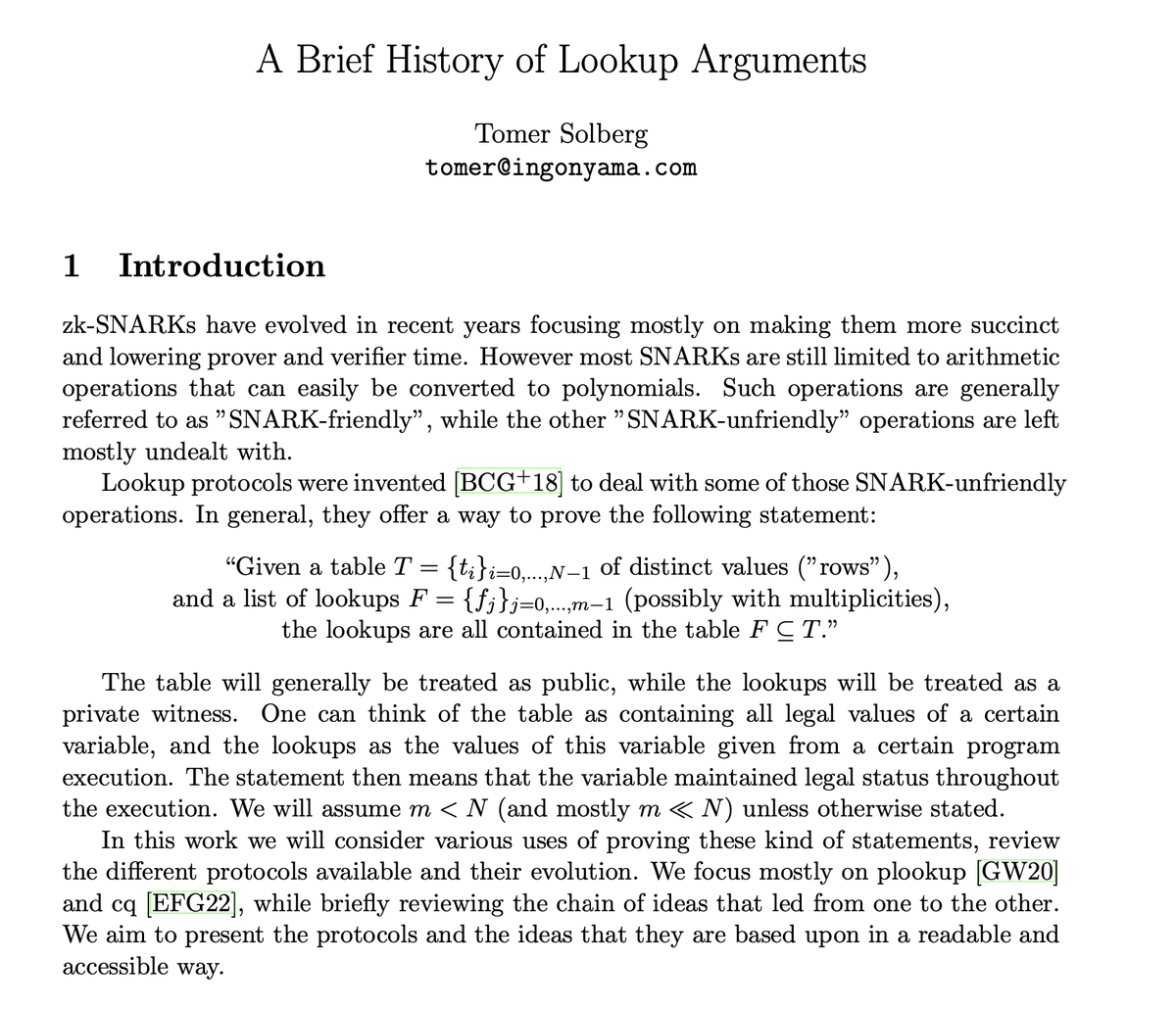
A Brief History of Lookup Arguments -
A new review paper!
1) uses of lookup protocols
2) plookup
3) cq, LIKE YOU HAVE NEVER SEEN BEFORE
4) evolution from plookup to cq
https://t.co/K4M6V0PQHn