Thi Thiên 115:1
Lạy Đức Giê-hô-va, vì lòng nhân từ và đức thành tín của Ngài, Nguyện vinh quang không thuộc về chúng con, không thuộc về chúng con Nhưng đáng thuộc về danh Ngài!
WHY DOES SATAN HATE THE PLAIN MEANING OF SCRIPTURE?
“Did God really say?” (Genesis 3:1)
The first recorded attack against humanity began with an attack on God's Word.
Satan questioned God's command, distorted its meaning, and contradicted His warning. He persuaded Eve to doubt what God had plainly revealed.
The strategy was devastatingly simple.
Convince people that God did not really mean what He said.
Paul warned believers against being deceived as Eve was deceived by the serpent (2 Corinthians 11:3).
The battle was not merely over whether God's Word was true. It was over what God's Word meant.
And that battle continues.
1. SATAN CAN QUOTE SCRIPTURE
When Satan tempted Jesus, he did something remarkable.
He quoted the Bible.
In Matthew 4:5–6, Satan cited Psalm 91, appealing to God's promise of angelic protection while urging Jesus to throw Himself from the temple.
Jesus answered:
“It is also written: 'Do not put the Lord your God to the test.'” (Matthew 4:7)
Satan's quotation came from Scripture. His application contradicted Scripture.
Jesus interpreted Psalm 91 consistently with Deuteronomy 6:16.
A statement can contain biblical words while communicating an unbiblical conclusion.
Context matters. Grammar matters. Historical setting matters. Literary genre matters.
The question is not whether an interpretation sounds spiritual.
The question is whether it communicates what God intended.
2. GOD MEANT WHAT HE SAID TO ISRAEL
God promised Abraham a great nation, a land, and worldwide blessing through his descendants (Genesis 12:1–3; 17:7–8).
He reaffirmed those promises to Isaac and Jacob.
Centuries later, God declared through Jeremiah that Israel's continued existence as a nation before Him was as certain as the established order of creation.
“Only if these decrees vanish from my sight,” declares the LORD, “will Israel ever cease being a nation before me.” (Jeremiah 31:36)
Jeremiah 33:20–26 reinforces this assurance through God's covenant governing day and night.
If God wanted to communicate that His promises to Israel were permanent, what stronger language could He have used?
Ezekiel 36:22 reveals His motivation:
“It is not for your sake, people of Israel ... but for the sake of my holy name.”
God then promises to regather Israel, return them to their land, cleanse them, give them a new heart, and place His Spirit within them (Ezekiel 36:24–28).
Ezekiel 37 describes Judah and Israel reunited under one Davidic king.
These promises concern a recognizable people, an identifiable land, and a future spiritual restoration.
Israel's restoration is not ultimately about Israel's righteousness. It is about God's faithfulness.
3. DID THE MESSIAH CANCEL THOSE PROMISES?
After His resurrection, the disciples asked Jesus:
“Lord, are you at this time going to restore the kingdom to Israel?” (Acts 1:6)
Jesus did not declare that Israel's restoration was canceled. He directed their attention to the Father's authority over its timing.
Gabriel had already promised that Jesus would receive David's throne and reign over the house of Jacob forever (Luke 1:32–33).
And Paul addressed Israel's continuing election directly.
“Did God reject his people? By no means!” (Romans 11:1)
He later affirmed:
“God did not reject his people, whom he foreknew.” (Romans 11:2)
Paul warned Gentile believers against boasting over Israel's natural branches. Through faith, Gentiles share in the nourishing root of God's covenant blessings (Romans 11:17–18).
He described Israel's hardening as partial, anticipated future mercy, and reaffirmed Israel's election because of the patriarchs.
“For God's gifts and his call are irrevocable.” (Romans 11:29)
Gentile inclusion does not require Jewish exclusion. Fulfillment does not require cancellation.
4. WHY SPIRITUALIZE THE MESSIAH'S RETURN?
Bible prophecy teacher Chuck Missler estimated that for every prophecy concerning the Messiah's First Coming, Scripture contains approximately eight concerning His Second Coming.
While the precise ratio depends on how prophecies are counted, his observation highlights the extraordinary biblical emphasis on Christ's return.
Consider the remarkable precision of fulfilled prophecy.
Micah 5:2 identified Bethlehem.
Zechariah 9:9 described Israel's King riding a donkey.
Isaiah 53 foretold the suffering and rejection of the Servant.
These prophecies found fulfillment in actual history.
But what about those awaiting fulfillment?
John Walvoord highlighted a remarkable detail in Luke 4:18–21.
When Jesus read Isaiah 61 in the synagogue, He proclaimed the year of the Lord's favor but stopped before the announcement of divine vengeance.
Then Jesus declared:
“Today this scripture is fulfilled in your hearing.” (Luke 4:21)
Walvoord explained that Jesus distinguished the portion being fulfilled at His First Coming from the judgment awaiting His return.
The unfulfilled portion was not canceled. Its fulfillment remained future.
Now consider the remaining promises.
Zechariah 14:4 places the Lord's feet upon the Mount of Olives.
Acts 1:11 declares that the same Jesus will return as He departed.
Isaiah 2:2–4 describes nations coming to Jerusalem to learn God's ways.
Luke 1:32–33 promises David's throne and an everlasting reign over Jacob's house.
Zechariah 14:9 declares:
“The LORD will be king over the whole earth.”
Revelation 20:1–6 repeatedly identifies a thousand-year period associated with the Messiah's reign.
These prophecies describe identifiable places, nations, divine judgment, and a coming Kingdom.
Consider the consistency of God's revelation.
Bethlehem meant Bethlehem.
The donkey meant a donkey.
The suffering Servant truly suffered.
Why, then, should Jerusalem cease to mean Jerusalem?
Why should the Mount of Olives become merely a metaphor?
Why should David's throne lose its connection to Israel?
If Bethlehem meant Bethlehem at the First Coming, why shouldn't Jerusalem mean Jerusalem at the Second?
Certainly, biblical prophecy contains poetry, symbolism, and typology. Sound interpretation recognizes these literary features.
Nor does everyone who interprets the kingdom spiritually deny the Messiah's bodily return.
But every interpretation must account for the actual wording, historical context, and covenant promises of Scripture.
God was faithful at the First Coming. He will be faithful at the Second Coming.
5. WHEN THEOLOGY OVERRULES SCRIPTURE
Jesus rebuked religious leaders for allowing human traditions to undermine God's Word.
Mark 7:13 describes them as:
“nullify[ing] the word of God by your tradition.”
That warning should humble every interpreter.
We all bring theological assumptions to Scripture. The question is whether we allow Scripture to correct them.
The Bereans examined the Scriptures daily to determine whether Paul's teaching was true (Acts 17:11).
Paul instructed Timothy to handle the Word of truth correctly (2 Timothy 2:15).
A theological system should emerge from Scripture, not become an authority over it.
This does not mean every disagreement represents deliberate deception. Sincere believers may interpret difficult passages differently.
But sincerity does not establish accuracy.
God's Word must remain the final authority.
6. GOD'S CHARACTER IS THE ULTIMATE ISSUE
God's faithfulness to His promises reflects His unchanging character.
Numbers 23:19 declares that God is not human, that He should lie or change His mind.
Titus 1:2 describes the God who does not lie.
Jesus declared:
“Scripture cannot be set aside.” (John 10:35)
And God connects Israel's restoration with the vindication of His holy name before the nations (Ezekiel 36:22–23).
If God can be trusted to keep His ancient covenants with Israel, He can be trusted to fulfill His promises concerning resurrection, judgment, and the coming Kingdom.
His promises do not expire because centuries pass.
His purposes do not fail because humanity rebels.
God does not need us to rescue His promises from their plain meaning.
He calls us to trust Him.
7. THE QUESTION THAT STILL ECHOES
Satan's opening question was:
“Did God really say?”
When Satan misused Scripture, Jesus repeatedly answered:
“It is written.” (Matthew 4:4, 7, 10)
The Bible does not explicitly identify a modern interpretive method as something Satan hates. But it clearly reveals his opposition to God's truth.
Faithful interpretation is therefore an essential defense against deception.
Read the words. Examine the grammar. Respect the historical setting. Recognize the genre. Follow the author's argument.
Let Scripture interpret Scripture, rather than forcing Scripture to accommodate our assumptions.
God has not forgotten Israel.
God has not abandoned His covenants.
God has not revoked His calling.
The Messiah will return. His Kingdom will come. His promises will stand.
The serpent questioned what God said.
Faith takes God at His Word.
“For God's gifts and his call are irrevocable.”
Romans 11:29
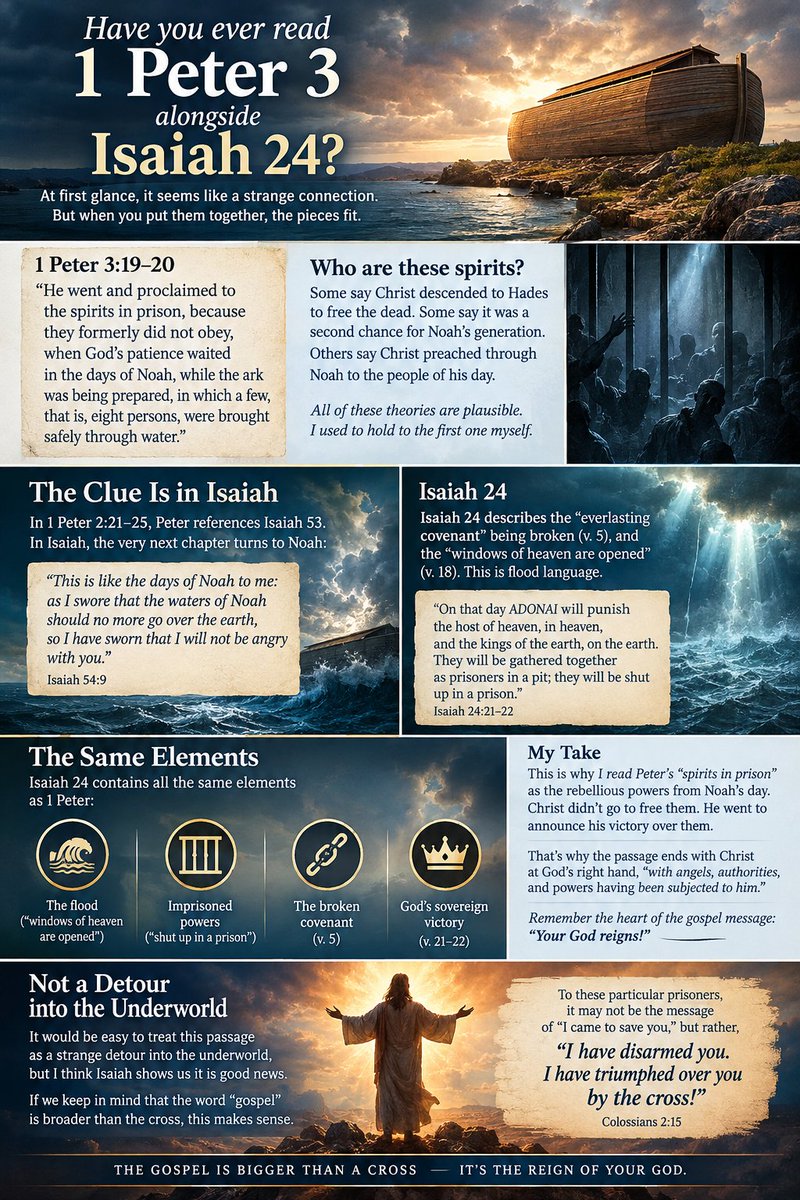
Have you ever read 1 Peter 3 alongside Isaiah 24?
Let me say up front: this is the reading that makes the most sense to me, but I’m not dogmatic about it. Good scholars have landed in different places on this passage, and I realize that my view on this could be wrong. So at best, this is speculation on my part.
“He went and proclaimed to the spirits in prison, because they formerly did not obey, when God’s patience waited in the days of Noah, while the ark was being prepared, in which a few, that is, eight persons, were brought safely through water.” - 1 Peter 3:19–20
Who are these spirits? Some say Christ descended to Hades to free the dead. Some say it was a second chance for Noah’s generation. Others say Christ preached through Noah to the people of his day. All of these theories are plausible. I used to hold to the first one myself.
It seems to me that all of this connects to Isaiah and the best clue can be found there.
In 1 Peter 2:21–25, Peter references Isaiah 53. In Isaiah, the very next chapter turns to Noah:
“This is like the days of Noah to me: as I swore that the waters of Noah should no more go over the earth, so I have sworn that I will not be angry with you” - Isaiah 54:9.
Now look at Isaiah 24. It describes the “everlasting covenant” being broken (verse 5), and “the windows of heaven are opened” (verse 18). This is flood language.
“On that day ADONAI will punish the host of heaven, in heaven, and the kings of the earth, on the earth. They will be gathered together as prisoners in a pit; they will be shut up in a prison.” - Isaiah 24:21–22
This passage seems to contain all of the same elements as 1 Peter.
This is why I read Peter’s “spirits in prison” as the rebellious powers from Noah’s day. Christ didn’t go to free them. He went to announce his victory over them. That’s why the passage ends with Christ at God’s right hand, “with angels, authorities, and powers having been subjected to him”. Remember that the heart of the gospel message is the statement “Your God reigns!”
It would be easy to just treat this passage as a strange detour into the underworld, but I think Isaiah shows us it is good news. If we keep in mind that the word “gospel” is broader than the cross, this makes sense. To these particular prisoners, it may not be the message of “I came to save you,” but rather, “I have disarmed you. I have triumphed over you by the cross!” (see Colossians 2:15).
Hê-bơ-rơ 12:22
22 Nhưng anh em đã tới gần núi Si-ôn, gần thành của Đức Chúa Trời hằng sống, tức là Giê-ru-sa-lem trên trời, gần muôn vàn thiên sứ nhóm lại
39 nhưng nếu bởi Đức Chúa Trời ra, thì các ngươi phá diệt những người đó chẳng nổi, và lại là liều mình đánh giặc cùng Đức Chúa Trời. Chúng nghe theo lời người
Công-vụ các Sứ-đồ 5:38-39
38 Nay ta khuyên các ngươi: Hãy lánh xa những người đó để mặc họ đi. Vì nếu mưu luận và công cuộc nầy ra bởi người ta, thì sẽ tự hư đi
Ngay cả sự giàu có và khả năng kiếm tiền của bạn có thể có cả thế gian nhưng nó không đến từ sự chính trực và sự trong sạch thì số tiền lớn đó chưa bao giờ làm Đức Chúa Trời chúng ta vui lòng.
The argument falls apart with two passages: Acts 7:45 and Hebrews 4:8.
Both use the Greek name Ἰησοῦς (Iēsous) for Joshua, the Hebrew leader who succeeded Moses. The Septuagint did the same centuries before Jesus was born. Iēsous is an established Greek rendering of a Hebrew name. This is not guesswork.
The name Yeshua (ישוע) appears in Ezra and Nehemiah, including Nehemiah 8:17, where it refers to Joshua himself. Franz Delitzsch did not invent it. In fact, his Hebrew New Testament appeared in 1877, not 1879, and Hebrew New Testament translations existed centuries before his.
Matthew 1:21 actually strengthens the Hebrew connection. The angel explains the name through the Messiah’s mission to save His people from their sins. The Hebrew name Yeshua, related to Yehoshua, carries precisely that meaning.
And Hebrew was not dead in the first century. Hebrew, Aramaic, and Greek were all used among Jews. Writing the Gospels in Greek does not prove that Mary and Joseph gave their son an originally Greek name.
But the most disturbing error is theological.
You claim Gentiles were the entire point of the Messiah’s coming, not the Jews.
Scripture explicitly contradicts you.
Matthew 15:24: Jesus was sent to the lost sheep of Israel.
Romans 15:8: Christ became a servant to the circumcised to confirm God’s promises to the patriarchs.
John 4:22: Salvation is from the Jews.
Luke 2:32: He is a light to the Gentiles AND the glory of Israel.
Romans 1:16: The gospel is to the Jew first, then the Gentile.
And Ephesians 3:6 does not teach that Gentiles replaced Israel. It teaches that Gentiles became fellow heirs through the gospel. Fellow heirs with whom?
The mystery was not that God abandoned Israel for the Gentiles. It was that Gentiles would share equally in the blessings of Messiah through faith.
Call Him Jesus. Call Him Yeshua. Both identify the same Jewish Messiah.
But attempting to make Him a Gentile Messiah at Israel’s expense contradicts His genealogy, His ministry, His covenants, and the explicit testimony of Scripture.
He is the Lion of the tribe of Judah (Revelation 5:5), not the Lion of the Gentiles.
@IMRANKHAN221482 Mình nghĩ mình sẽ an ủi bạn và khích lệ giúp bạn trong khả năng có thể nhất, nhưng vinh hiển điều thuộc về Đức Chúa Trời và Đấng Christ Ngài.amen
Sáng-thế Ký 16:13
Nàng gọi Đức Giê-hô-va mà đã phán cùng mình, danh là “Đức Chúa Trời hay đoái xem,” vì nàng nói rằng: Chính tại đây, tôi há chẳng có thấy được Đấng đoái xem tôi sao?




![Mark_Wilson_25's tweet photo. WHY DOES SATAN HATE THE PLAIN MEANING OF SCRIPTURE?
“Did God really say?” (Genesis 3:1)
The first recorded attack against humanity began with an attack on God's Word.
Satan questioned God's command, distorted its meaning, and contradicted His warning. He persuaded Eve to doubt what God had plainly revealed.
The strategy was devastatingly simple.
Convince people that God did not really mean what He said.
Paul warned believers against being deceived as Eve was deceived by the serpent (2 Corinthians 11:3).
The battle was not merely over whether God's Word was true. It was over what God's Word meant.
And that battle continues.
1. SATAN CAN QUOTE SCRIPTURE
When Satan tempted Jesus, he did something remarkable.
He quoted the Bible.
In Matthew 4:5–6, Satan cited Psalm 91, appealing to God's promise of angelic protection while urging Jesus to throw Himself from the temple.
Jesus answered:
“It is also written: 'Do not put the Lord your God to the test.'” (Matthew 4:7)
Satan's quotation came from Scripture. His application contradicted Scripture.
Jesus interpreted Psalm 91 consistently with Deuteronomy 6:16.
A statement can contain biblical words while communicating an unbiblical conclusion.
Context matters. Grammar matters. Historical setting matters. Literary genre matters.
The question is not whether an interpretation sounds spiritual.
The question is whether it communicates what God intended.
2. GOD MEANT WHAT HE SAID TO ISRAEL
God promised Abraham a great nation, a land, and worldwide blessing through his descendants (Genesis 12:1–3; 17:7–8).
He reaffirmed those promises to Isaac and Jacob.
Centuries later, God declared through Jeremiah that Israel's continued existence as a nation before Him was as certain as the established order of creation.
“Only if these decrees vanish from my sight,” declares the LORD, “will Israel ever cease being a nation before me.” (Jeremiah 31:36)
Jeremiah 33:20–26 reinforces this assurance through God's covenant governing day and night.
If God wanted to communicate that His promises to Israel were permanent, what stronger language could He have used?
Ezekiel 36:22 reveals His motivation:
“It is not for your sake, people of Israel ... but for the sake of my holy name.”
God then promises to regather Israel, return them to their land, cleanse them, give them a new heart, and place His Spirit within them (Ezekiel 36:24–28).
Ezekiel 37 describes Judah and Israel reunited under one Davidic king.
These promises concern a recognizable people, an identifiable land, and a future spiritual restoration.
Israel's restoration is not ultimately about Israel's righteousness. It is about God's faithfulness.
3. DID THE MESSIAH CANCEL THOSE PROMISES?
After His resurrection, the disciples asked Jesus:
“Lord, are you at this time going to restore the kingdom to Israel?” (Acts 1:6)
Jesus did not declare that Israel's restoration was canceled. He directed their attention to the Father's authority over its timing.
Gabriel had already promised that Jesus would receive David's throne and reign over the house of Jacob forever (Luke 1:32–33).
And Paul addressed Israel's continuing election directly.
“Did God reject his people? By no means!” (Romans 11:1)
He later affirmed:
“God did not reject his people, whom he foreknew.” (Romans 11:2)
Paul warned Gentile believers against boasting over Israel's natural branches. Through faith, Gentiles share in the nourishing root of God's covenant blessings (Romans 11:17–18).
He described Israel's hardening as partial, anticipated future mercy, and reaffirmed Israel's election because of the patriarchs.
“For God's gifts and his call are irrevocable.” (Romans 11:29)
Gentile inclusion does not require Jewish exclusion. Fulfillment does not require cancellation.
4. WHY SPIRITUALIZE THE MESSIAH'S RETURN?
Bible prophecy teacher Chuck Missler estimated that for every prophecy concerning the Messiah's First Coming, Scripture contains approximately eight concerning His Second Coming.
While the precise ratio depends on how prophecies are counted, his observation highlights the extraordinary biblical emphasis on Christ's return.
Consider the remarkable precision of fulfilled prophecy.
Micah 5:2 identified Bethlehem.
Zechariah 9:9 described Israel's King riding a donkey.
Isaiah 53 foretold the suffering and rejection of the Servant.
These prophecies found fulfillment in actual history.
But what about those awaiting fulfillment?
John Walvoord highlighted a remarkable detail in Luke 4:18–21.
When Jesus read Isaiah 61 in the synagogue, He proclaimed the year of the Lord's favor but stopped before the announcement of divine vengeance.
Then Jesus declared:
“Today this scripture is fulfilled in your hearing.” (Luke 4:21)
Walvoord explained that Jesus distinguished the portion being fulfilled at His First Coming from the judgment awaiting His return.
The unfulfilled portion was not canceled. Its fulfillment remained future.
Now consider the remaining promises.
Zechariah 14:4 places the Lord's feet upon the Mount of Olives.
Acts 1:11 declares that the same Jesus will return as He departed.
Isaiah 2:2–4 describes nations coming to Jerusalem to learn God's ways.
Luke 1:32–33 promises David's throne and an everlasting reign over Jacob's house.
Zechariah 14:9 declares:
“The LORD will be king over the whole earth.”
Revelation 20:1–6 repeatedly identifies a thousand-year period associated with the Messiah's reign.
These prophecies describe identifiable places, nations, divine judgment, and a coming Kingdom.
Consider the consistency of God's revelation.
Bethlehem meant Bethlehem.
The donkey meant a donkey.
The suffering Servant truly suffered.
Why, then, should Jerusalem cease to mean Jerusalem?
Why should the Mount of Olives become merely a metaphor?
Why should David's throne lose its connection to Israel?
If Bethlehem meant Bethlehem at the First Coming, why shouldn't Jerusalem mean Jerusalem at the Second?
Certainly, biblical prophecy contains poetry, symbolism, and typology. Sound interpretation recognizes these literary features.
Nor does everyone who interprets the kingdom spiritually deny the Messiah's bodily return.
But every interpretation must account for the actual wording, historical context, and covenant promises of Scripture.
God was faithful at the First Coming. He will be faithful at the Second Coming.
5. WHEN THEOLOGY OVERRULES SCRIPTURE
Jesus rebuked religious leaders for allowing human traditions to undermine God's Word.
Mark 7:13 describes them as:
“nullify[ing] the word of God by your tradition.”
That warning should humble every interpreter.
We all bring theological assumptions to Scripture. The question is whether we allow Scripture to correct them.
The Bereans examined the Scriptures daily to determine whether Paul's teaching was true (Acts 17:11).
Paul instructed Timothy to handle the Word of truth correctly (2 Timothy 2:15).
A theological system should emerge from Scripture, not become an authority over it.
This does not mean every disagreement represents deliberate deception. Sincere believers may interpret difficult passages differently.
But sincerity does not establish accuracy.
God's Word must remain the final authority.
6. GOD'S CHARACTER IS THE ULTIMATE ISSUE
God's faithfulness to His promises reflects His unchanging character.
Numbers 23:19 declares that God is not human, that He should lie or change His mind.
Titus 1:2 describes the God who does not lie.
Jesus declared:
“Scripture cannot be set aside.” (John 10:35)
And God connects Israel's restoration with the vindication of His holy name before the nations (Ezekiel 36:22–23).
If God can be trusted to keep His ancient covenants with Israel, He can be trusted to fulfill His promises concerning resurrection, judgment, and the coming Kingdom.
His promises do not expire because centuries pass.
His purposes do not fail because humanity rebels.
God does not need us to rescue His promises from their plain meaning.
He calls us to trust Him.
7. THE QUESTION THAT STILL ECHOES
Satan's opening question was:
“Did God really say?”
When Satan misused Scripture, Jesus repeatedly answered:
“It is written.” (Matthew 4:4, 7, 10)
The Bible does not explicitly identify a modern interpretive method as something Satan hates. But it clearly reveals his opposition to God's truth.
Faithful interpretation is therefore an essential defense against deception.
Read the words. Examine the grammar. Respect the historical setting. Recognize the genre. Follow the author's argument.
Let Scripture interpret Scripture, rather than forcing Scripture to accommodate our assumptions.
God has not forgotten Israel.
God has not abandoned His covenants.
God has not revoked His calling.
The Messiah will return. His Kingdom will come. His promises will stand.
The serpent questioned what God said.
Faith takes God at His Word.
“For God's gifts and his call are irrevocable.”
Romans 11:29](https://pbs.twimg.com/media/HU1yGP7WcAANsGt.jpg)