I am a qualified and experienced English teacher and the owner of Tonbridge Education Centre which offers expert English and maths tuition from ages 7 to 18.
When you want to start hating on High Court Judges please take a breath, pause, then listen to this gentleman. One of the most measured yet powerful judgements you will ever have the privilege of listening to
“When I was ten, I read fairy tales in secret and would have been ashamed if I had been found doing so. Now that I am fifty I read them openly. When I became a man I put away childish things, including the fear of childishness and the desire to be very grown up.” C. S. Lewis
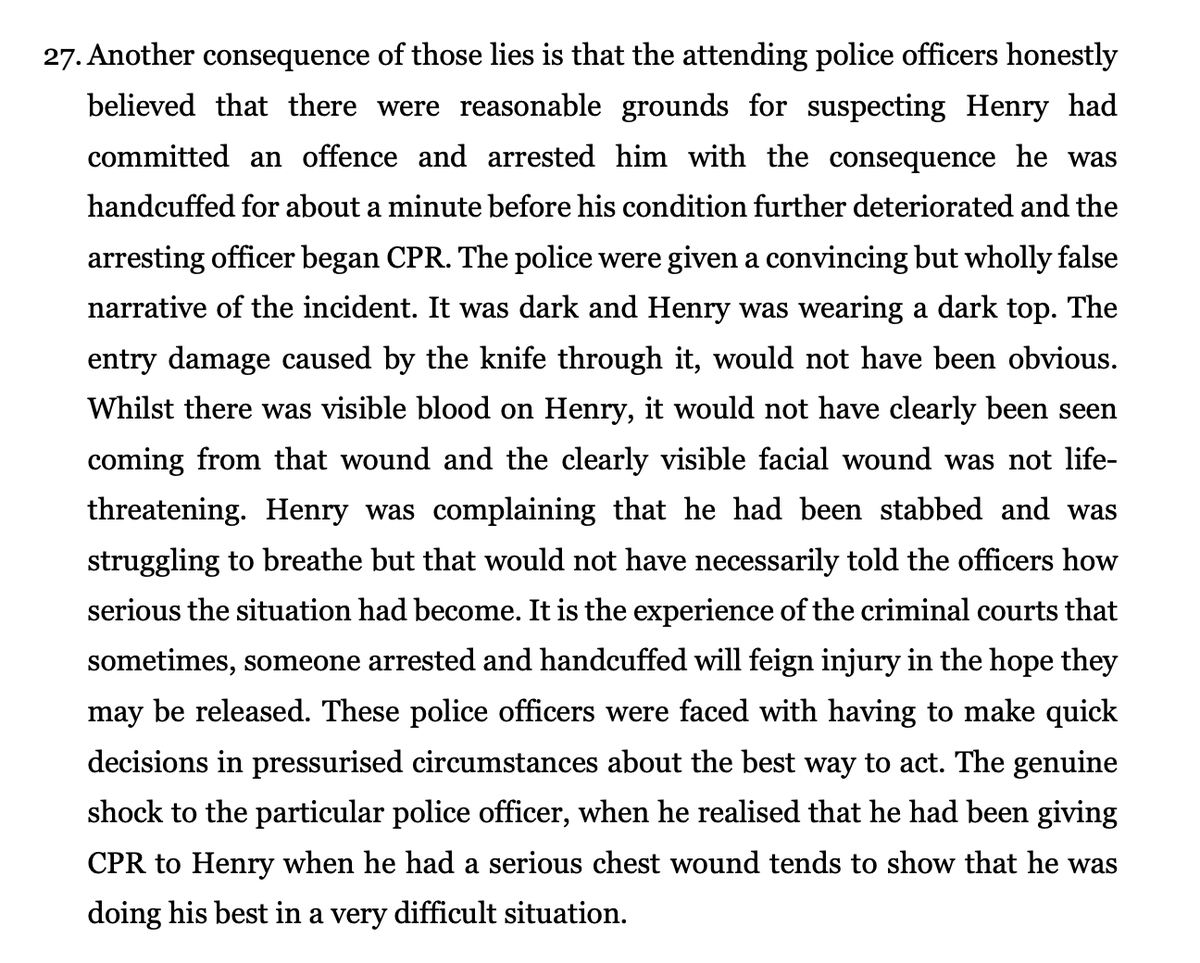
On the murder of Henry Nowak by Vickrum Singh Digwa, it is worth reading this paragraph, below, of Judge William Mousley KC's sentencing remarks.
While we await the investigation, the judge probably has the most complete view of what happened - and the impact of Digwa's lies:
Peter Mandelson, Michelle Mone and Andrew Mountbatten Windsor all prove that the rich and powerful are exempt from the laws that apply to the rest of us
Britain has the dirtiest rivers, the most expensive energy, the least reliable trains, the most overcrowded prisons, the worst access to healthcare and the widest gap between rich and poor in all of Europe. If you want a verdict on 40 years of neoliberalism, there it is.
Can someone explain to me why the so called civilized world can't bring itself together to stop russia from bombing the biggest country in Europe after over 4 years of full-scale war? Wtf is more important than stopping this?
Some of you have forgotten that only three years ago you were perfectly capable of writing an essay, writing a eulogy, telling a bedtime story to a child, and it should worry you that powerful companies have convinced us we can’t do things we’ve been doing for 5,000 years.
The Black Death arrived in England in 1348. Within two years, somewhere between a third and a half of the population was dead.
The peasants who survived noticed something within a generation.
There was nobody left to work the fields. The labour shortage was so severe that landlords, for the first time in English history, had to bid for workers. The peasants, suddenly possessed of leverage, demanded payment partly in meat. Beef, mutton, and bacon began appearing in the manorial accounts of agricultural labourers' wages.
Skeletal records from English burials in the late 1300s and 1400s, set against pre-plague remains, show measurable increases in average adult height. Bone density improves. Dental health improves. Iron-deficiency markers decline.
The peasants got taller. The peasants got stronger. The peasants started causing political problems on a scale they had previously been too undernourished to attempt.
In 1351 Parliament passed the Statute of Labourers, attempting to cap wages back at pre-plague levels. The peasants noticed. In 1381, well-fed, the same peasants marched on London in the largest popular uprising in medieval English history.
The nobility, in the centuries that followed, expanded the Forest Laws. Killing a deer in a royal forest was a capital offence. The Game Laws of the 1600s and 1700s extended the principle. Meat available to the peasant shrank back toward what it had been before the plague.
By 1850, the average British army recruit from the industrial slums was so short and so undernourished that the height minimum for enlistment had to be lowered repeatedly to keep the regiments staffed.
The single greatest improvement in working-class height and health in English history was caused by a plague that made meat affordable for two generations.
The single greatest decline was caused, in significant part, by a political decision to make it expensive again.
You can see the whole sequence in the skeletons.
The skeletons are in the museums. Go and look.
"Billionaire Trump donor in line to make millions from Thames Water bid."
Meet who is now the de facto owner of Thames Water. It's a tragedy in 3 acts and it does not end well. 👇👇👇
https://t.co/UsYap0AaiG
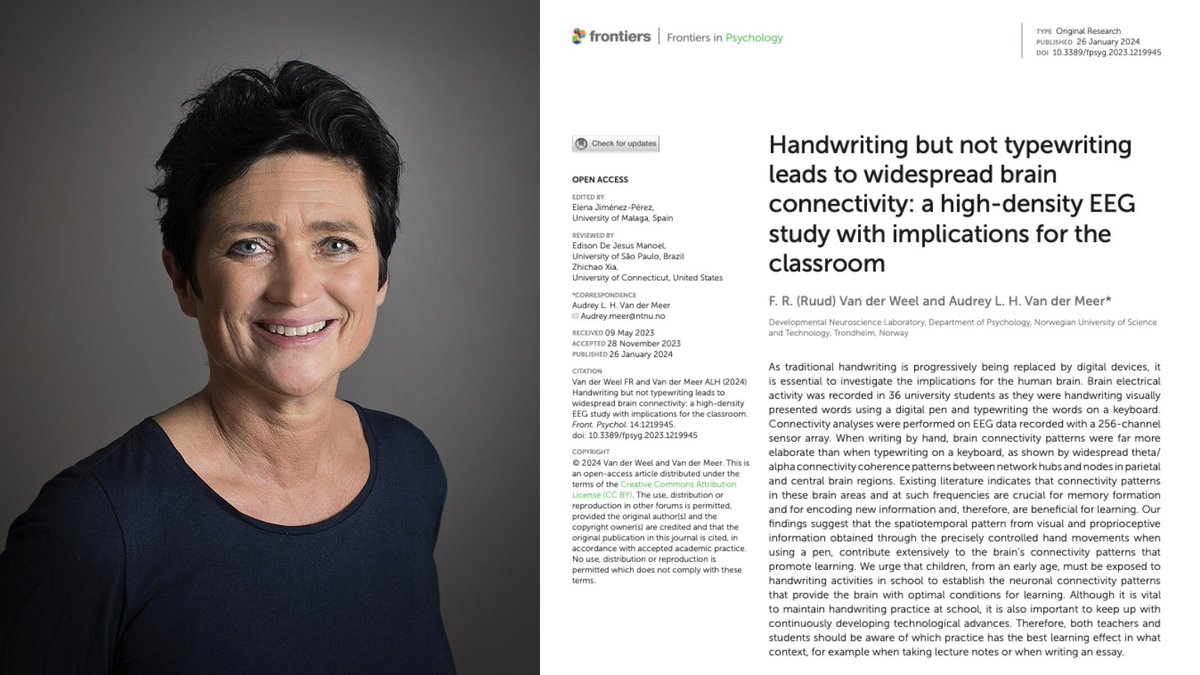
A Norwegian neuroscientist spent 20 years proving that the act of writing by hand changes the human brain in ways typing physically cannot, and almost nobody outside her field has read the paper.
Her name is Audrey van der Meer.
She runs a brain research lab in Trondheim, and the paper that closed the argument was published in 2024 in a journal called Frontiers in Psychology. The finding is brutal enough that it should have changed every classroom on Earth.
The experiment was simple. She recruited 36 university students and put each one in a cap with 256 sensors pressed against their scalp to record brain activity. Words flashed on a screen one at a time.
Sometimes the students wrote the word by hand on a touchscreen using a digital pen, and sometimes they typed the same word on a keyboard. Every neural response was recorded for the full five seconds the word stayed on screen.
Then her team looked at the part of the data most researchers had ignored for years, which is how different parts of the brain were communicating with each other during the task.
When the students wrote by hand, the brain lit up everywhere at once.
The regions responsible for memory, sensory integration, and the encoding of new information were all firing together in a coordinated pattern that spread across the entire cortex. The whole network was awake and connected.
When the same students typed the same word, that pattern collapsed almost completely.
Most of the brain went quiet, and the connections between regions that had been alive seconds earlier were nowhere to be found on the EEG.
Same word, same brain, same person, and two completely different neurological events.
The reason turned out to be something nobody had really paid attention to before her work. Writing by hand is not one motion but a sequence of thousands of tiny micro-movements coordinated with your eyes in real time, where each letter is a different shape that requires the brain to solve a slightly different spatial problem.
Your fingers, wrist, vision, and the parts of your brain that track position in space are all working together to produce one letter, then the next, then the next.
Typing throws all of that away. Every key on a keyboard requires the exact same finger motion regardless of which letter you are pressing, which means the brain has almost nothing to integrate and almost no problem to solve.
Van der Meer said it plainly in her interviews.
Pressing the same key with the same finger over and over does not stimulate the brain in any meaningful way, and she pointed out something that should scare every parent who handed their kid an iPad.
Children who learn to read and write on tablets often cannot tell letters like b and d apart, because they have never physically felt with their bodies what it takes to actually produce those letters on a page.
A decade before her, two researchers at Princeton ran the same fight using a completely different method and ended up at the same answer. Pam Mueller and Daniel Oppenheimer tested 327 students across three experiments, where half took notes on laptops with the internet disabled and half took notes by hand, before testing everyone on what they actually understood from the lectures they had watched.
The handwriting group won by a wide margin on every question that required real understanding rather than surface recall.
The reason was hiding in the transcripts of what the two groups had actually written down.
The laptop students typed almost word for word, capturing more total content but processing almost none of it as they went, while the handwriting students physically could not write fast enough to transcribe a lecture in real time, which forced them to listen carefully, decide what actually mattered, and put it in their own words on the page.
That single act of choosing what to keep was the learning itself, and the keyboard had quietly skipped the choosing and skipped the learning along with it.
Two studies. Two countries. Same answer.
Handwriting makes the brain work. Typing lets it coast.
Every note you have ever typed instead of written went into your brain through a thinner pipe. Every meeting, every book highlight, every idea you captured on your phone instead of on paper was processed at half depth.
You did not forget those things because your memory is bad. You forgot them because typing never woke the part of the brain that would have made them stick.
The fix is the thing your grandmother already knew.
Pick up a pen. Write the thing down. The slower road is the faster one.
Rayner has been cleared, but the media ran 30 front pages in total, averaging 4 front pages a day during the peak of the story.
Farage's £5 million gift has had two front page stories.
Why would there be such a difference in reporting standards for the two?
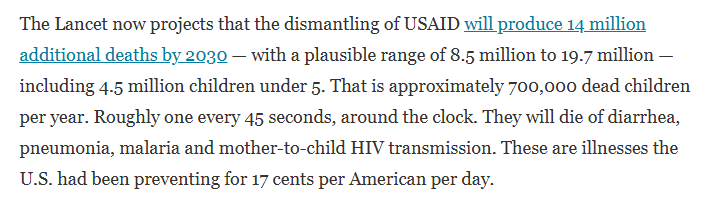
Can't stop thinking about Elon Musk, the wealthiest man alive worth $828 billion, spending $290 million to elect Trump, becoming $563 billion richer since Trump was elected and ending humanitarian aid that will lead to the deaths of 4.5 million of the poorest kids on the planet.