What is the role of academic computer vision research in the age of increasingly powerful large models? Is GPT-6 Astra a step change? How can a researcher have an impact today in academia?
These are the questions I ask myself as I head off to ECCV 2026, a conference I’ve attended since 1992. One of my papers this year is VIGA, a method that takes an image as input and outputs a 3D Blender scene that represents that image. This is a classical inverse-graphics task and VIGA was the first method to solve it using an agentic approach.
The idea is now several years old and the first version of the paper was rejected. This delayed publication significantly. After it was accepted at ECCV, it was quickly surpassed by people using Claude Code for the same purpose. Today GPT-6 Astra blows away all previous results. But we still head off to ECCV to tell the community about our invention that is now fully out of date.
The way academic work often progresses is that one reads recent papers, notices that they have limitations, comes up with a new idea, explores this, publishes it, etc. Any published paper I read today is based on ideas that are at least a year old. And those ideas were based on the literature of the time, which was also a year old. That means that any paper I see at ECCV is likely two years out of date. In AI today, two years means your work is likely irrelevant.
At CVPR this summer I noticed that many authors have not gotten the message. They continue to work on “old” problems that have a long history. This history is based on assumptions about how the “vision problem” will be “solved”. The truth is that it is being solved in a very different way and many of these problems are no longer relevant. Another group of papers focuses on very niche problems where large models likely fail because of insufficient data or lack of business interest. The impactful papers were largely from industry and had long author lists and massive data+compute behind them. These papers were also out of data, describing systems that had been released months before, but at least they served to provide the community with more complete documentation and analysis of commercial systems.
So what should academics do? First, we need to put aside the tools we’ve used for years and start from scratch. Every project should start by trying really hard to solve the problem with existing tools. I would like to see every paper begin with a detailed experimental analysis of how existing models perform and why they fail (if they do). This gives the kind of insight we need today. Then, assuming current models fail, the solution should provide some fundamental insight that will outlive the next release of such models.
Reviewers today still focus on technical novelty. This pushes people to focus on tweaking architectures rather than clearly moving the field forward. Papers need to be judged based on their novel insight and not their novel technical contribution. This is a real shift in thinking but it focuses us on what matters - progress of the field.
If we want there to be a “field” of computer vision, then it can’t become a marginal backwater, focusing on esoteric problems. If you haven’t tried using Astra (or whatever comes next) to solve your problem, then you have not done your homework. This omission should be seen as negatively as not having a previous work section.
Concretely, I think papers should include a new section analogous to “Related Work” where that related work is current models and how they perform on the task. Reviewers should start asking for this and expecting authors to be able to articulate their insights about the limitations of existing large models.
I'm interested in your thoughts.
At 3:20 AM in India, history has been written. Rameshbabu Praggnanandhaa is the Champion of Grand Chess Tour 2026 - and he is the first Indian player to do so! Pragg defeated Fabiano Caruana 15-13 in the Grand Chess Tour Finals at USA.
Praggnanandhaa's name should be synonymous with perseverence at this point. Its been close to a month since Pragg has been playing at the Saint Louis Chess Club in USA - first winning the Saint Louis Rapid and Blitz, then finishing 2nd at the Sinquefield, and now winning the GCT finals to win Grand Chess Tour 2026!
The road to the Championship was certainly not easy. Pragg lost the first classical game, and drew the second one - he had to cover a 6 point deficit. And he did - he won both the Rapid games to take back the lead, and kept his nerve in the Blitz. A draw in the final game was enough, and thats what Pragg did to secure the Grand Chess Tour title.
A huge congratulations to Praggnanandhaa, his team and his family for this incredible achievement - Pragg takes home USD 200,000!
Graphic: Anmol Bhargav
#chess #chessbaseindia #praggnanandhaa #grandchesstour
Biggest structural win is parallelism.
- JSON tool calling has a hard ceiling (Claude Sonnet 5 starts dropping calls around N=70–72).
PTC just keeps going.
- Under “context rot” (flooding the prompt with 128 schemas, most of them decoys) PTC is also more robust.
Worth a careful read if you’re building agents in 2026.
No tool calls is the future!
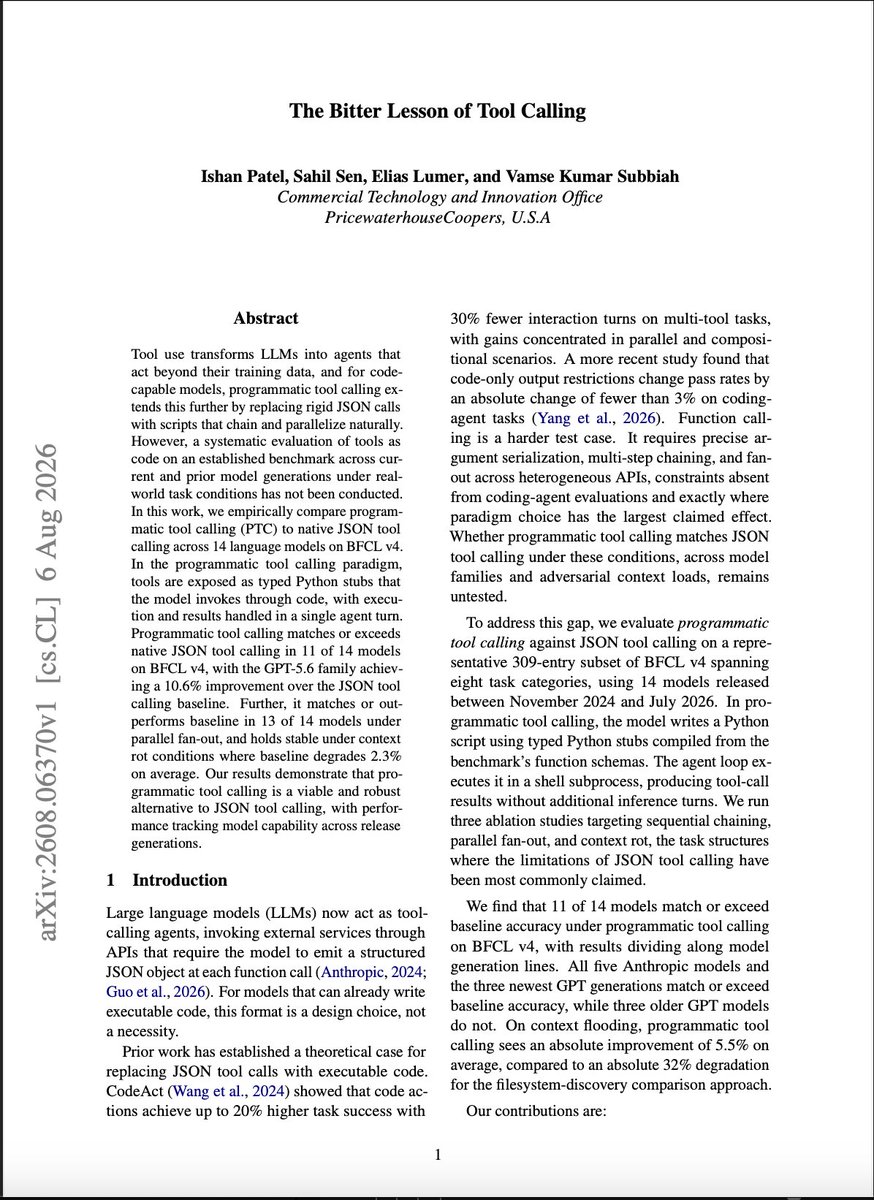
New paper shows that letting models write actual Python code to call tools beats the rigid JSON tool-calling paradigm that almost every agent framework still uses.
They tested Programmatic Tool Calling (PTC) vs native JSON tool calling on BFCL v4 across 14 models
Results:
PTC matches or beats JSON in 11 of 14 models
GPT-5.6 family: +10.6% absolute
On long sequential chains: up to +18.8%
Parallel fan-out: PTC stays perfect at N=100 while JSON collapses after ~70 calls
Context flooding (128 schemas): PTC stays stable, JSON drops 2.3%
The pattern is clear — capability tracks model generation, not vendor. Newer models simply handle code better than structured JSON.
Are we still forcing models into JSON because it’s convenient for us, or because it’s actually better for them?
Paper: https://t.co/eZthwUb2Qg
How PTC works:
Tools are exposed as typed Python stubs.
The model writes a single script → one execution turn → results come back.
No multi-turn JSON dance. No extra inference tax per hop.
That’s why the chaining gap grows with length.
This is one of the most unique (and important) pieces of AI research you’ll read this year.
Do not sleep on the thread by @kotekjedi_ml.
They found a clean way to extract the hidden reasoning traces (“thinking tokens”) from frontier models across every major provider by exploiting how encrypted CoT blocks are portable within the same provider’s ecosystem. Same-family weaker models can decrypt the stronger model’s thoughts almost for free.
Some of the wildest insights:
- Same model family can be used to decrypt the thinking tokens (Haiku reading Opus, etc.)
- Prefill Kimi K3 with just a few tokens of Opus-style reasoning → it starts talking like Opus
- OpenAI models frequently blabber in pure alien during thinking (“vantages,” “marinades,” “watchers,” self-referring as “we/it”…)
- Many facts, schemes, and key details that appear in the full thinking trace are completely skipped or sanitized in the final response / summary
Paper: https://t.co/cNMVlDxioz
Examples: https://t.co/rXwXrSr7FA
If you care about CoT monitoring, distillation, scheming, or just how these models actually think… this is mandatory reading.
Thread starts here →
We can finally talk about it:
We found a way to extract hidden reasoning of frontier models using a vulnerability in the APIs of every frontier AI company.
We verified that our reasoning token count matches billed API thinking tokens 1:1 for most of the prompts we queried.
New survey paper on Self-Evolving agents 👏
They organize the entire literature by self-evolution depth:
L0 Output-Level → only the current answer/actions
L1 Model-Level → trainable weights/policy
L2 Scaffold-Level → prompts, memory, tools, harness
L3 Improver-Level → the mechanism that proposes future updates
L4 Criterion-Level → how success itself is judged
Most vertical agent companies will likely work on L2 to improve the agent harness.
Paper + open catalog of whooping highly valuable 549 research papers 👇
.@NVIDIA Nemotron 3.5 Lightning is now available in the Perplexity Agent API 🎉
An open 30B MoE model with 3B active parameters, built for the high-volume execution layer of always-on agents: tool calls, validation, and subagent work.
Pair Nemotron Lightning 3.5 with frontier models like Nemotron Ultra for planning, and let Lightning handle the volume.
Start building: https://t.co/jo1tulS7K0
🚀 NVIDIA NeMo Switchyard is here!
Open-source router that slashes Claude Code costs. Point Claude Code at a mix of cheap/open models (vLLM, NIM, Ollama, etc.) while it still speaks its native API.
Switchyard routes simple steps to fast/cheap models and only escalates hard ones to expensive frontier models.
Result: Frontier-level performance at ~⅓ the cost of running Opus alone. Partners already seeing 50-74% savings on agent workloads.
One command to try:
switchyard launch claude --model switchyard
GitHub → https://t.co/LrhV5zqk1d
Not every step in an agent workflow needs the same model.
That’s why we’re also releasing NVIDIA NeMo Switchyard, a new open source library for model routing.
Use frontier models for complex reasoning and planning, and Lightning for high-volume, specialized execution.
Learn more: https://t.co/Ss1wSBO4dl
Very positive development nevertheless to achieve same intelligence in a very smaller model!
Oss 120b is an extremely popular model for simple llm tasks and nemotron 3.5 lightning can make it all cheaper and faster.
Nemotron 3.5 Lightning is basically GPT-OSS 120B-level intelligence… just more agentic.
Highly doubtful anyone’s going to be okay with that level of intelligence for long-running tasks in actual production.
Introducing NVIDIA Nemotron 3.5 Lightning⚡
An open 30B MoE model with 3B active parameters, built for always-on agents to complete high-volume, specialized tasks faster.
It delivers up to 4x the output speed of similar-sized models.
Dense math + text papers are brutal to read.
Old AI text summaries barely help -> they just rephrase the wall of text.
Now you can turn any paper into a clean, shareable interactive website packed with strong vizualizations and explanations.
See this example: https://t.co/gLE5fxxUrL
You can create these yourself in minutes with @scispace
.
Login → use free credits → run your custom workflows.