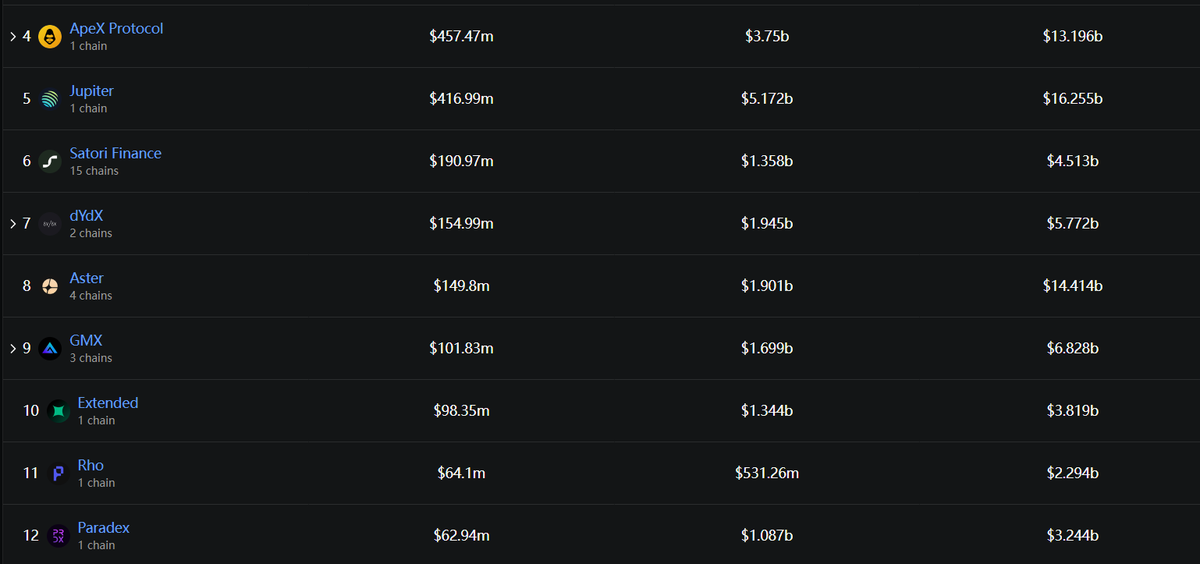
So now we’re at the point where people seriously argue that @HyperliquidX is “inefficient” because it sends almost all revenue to buybacks.
Didn’t expect we’d get here, honestly.
At the start of the year, any project doing buybacks was almost unheard of. It was a flex. A signal. A rarity.
Now suddenly the narrative is: “they’re wasting money, they should spend it better - marketing, incentives, growth, whatever.”
But let me ask a simple question:
do you genuinely believe you’d manage this better than @HyperliquidX managers ?
I get it. Everyone wants to allocate millions. Everyone feels like they’d be a better capital allocator. Most people truly believe that.
Statistically, they’re almost always wrong.
Crypto as an industry isn’t famous for capital efficiency.
It’s famous for scams, rugs, bloated teams, useless marketing spend, incentive farms, and quietly extracting value from token holders.
Even @aave - literally the #1 lending protocol in DeFi recently showed how even top-tier projects still try to squeeze extra value from their community.
And that’s the best case. Smaller projects don’t even pretend.
Now compare that to Hyperliquid.
- From day one, they made a very clear decision:
the priority is making the community wealthy.
- Not “engaged.”
- Not “active on Discord.”
Actually wealthy.
Most projects call 200 angry users in Discord a “community.”
Hyperliquid built something different.
Their real edge isn’t buybacks alone.
It’s consistency.
A small team.
Relentless focus on product quality.
No flashy spend.
No narrative flips.
No sudden “strategy updates.”
They chose community and operational efficiency as their moat - and they’ve stuck to it.
You can disagree with that choice.
But calling it inefficient says more about crypto’s broken expectations than about Hyperliquid.
Consistency is rare.
And in this industry, it’s one of the most valuable things you can have.
Insilico Terminal Podcast Episode 7 - @rf_extended Founder of @extendedapp
00:00 Intro, Ruslan’s background, founding Extended, and vision for a self-custody exchange
06:11 Leaving Revolut to build independently, benefits of a small agile team
13:09 What sets Extended apart - unified margin, multi-asset collateral, and long-term roadmap
18:42 Why they chose Starknet, trustless design, and Ethereum ecosystem integration
24:59 Deep dive into multi-asset margin mechanics, liquidation logic, and risk handling
33:46 Why others don’t build this yet, technical complexity, and future competition
39:18 Exchange stability, recent crash lessons, and how Extended handled downtime
45:56 Sustainable growth, token plans, long-term goals, and closing remarks
Extended is now live on Starknet
Both StarkEx and Starknet instances are fully live and operational. Existing StarkEx users can migrate at any time.
Note that all points rewards are now on Starknet. For Epochs 16 & 17 the points pool has been doubled — up to 2.4M points will be distributed each week to traders on Starknet.
https://t.co/UhuMzUAS1v
Got questions? We’re hosting an AMA tomorrow.
Extended is migrating from StarkEx to Starknet to build toward a more composable, trustless, and capital-efficient financial system, with unified margin at its core.
StarkEx enabled fast, isolated perpetuals. But our product scope has outgrown its architecture. As we expand into unified margin, the lack of composability on StarkEx becomes a structural limitation. Unified margin, by design, requires more than just execution performance — it needs a settlement layer capable of supporting multi-asset collateral, native borrowing and lending, and shared state across applications.
Starknet can provide that. This migration will enable Extended to introduce a natively integrated lending and borrowing layer. Users will be able to post any supported asset — including yield-bearing ones — as collateral, and earn yield while trading. A user depositing wstETH and incurring a negative PnL on a USDC-settled perp is, in effect, borrowing USDC — with interest flowing directly to USDC lenders. Capital efficiency becomes a structural feature of the system.
Next, we’ll introduce spot markets — enabling unified margin to span perps, lending, and spot within a single cross-asset collateral engine. The result is a trading system where users manage one account, not several, and all their assets contribute to a unified margin pool — maximizing available capital and reducing fragmentation.
From a user perspective, this transition will be seamless. Starknet will serve purely as the settlement layer — abstracted from the user experience. EVM users will be able to deposit and withdraw instantly across six major chains without needing to interact with Starknet directly. Native Starknet users will also be supported.
But the long-term vision goes further.
While many perps DEXs are now pivoting toward general-purpose chains, Extended is taking a fundamentally different approach: building an EVM-compatible network on top of Starknet, where unified margin logic is embedded directly into the base layer and exposed as an ERC-20 token accessible to all applications on the network. Margining, borrowing, and liquidation are handled by the network itself — not by individual applications.
This architecture enables shared liquidity across apps, global access to margin, and unified risk management. From the user’s perspective, all activity contributes to a single global margin account that can be used across dApps. Just one composable, trustless margin system designed for scale.
We’re migrating to Starknet to unlock this roadmap.
ICYMI
Last week, we unveiled the initial NFT collection, K1, for our loyal Karakians: high-performance, high-stakes superkar drivers who spread the holy word of Karak in lands far and near 🏎️🍊
If you haven't already, access now: https://t.co/6rVnapXapj
g(dp)m🍊
We're excited to launch the initial NFT collection, K1, for our loyal Karakians
K1 is for high-performance, high-stakes superkar drivers who spread the holy word of Karak in lands far and near
Access now: https://t.co/ojr7YwnIAB
Now tracking @extendedapp on @ethereum
Extended, built by an ex-Revolut team, is a self-custody exchange offering on-chain trade settlement and full transparency, currently live with perps
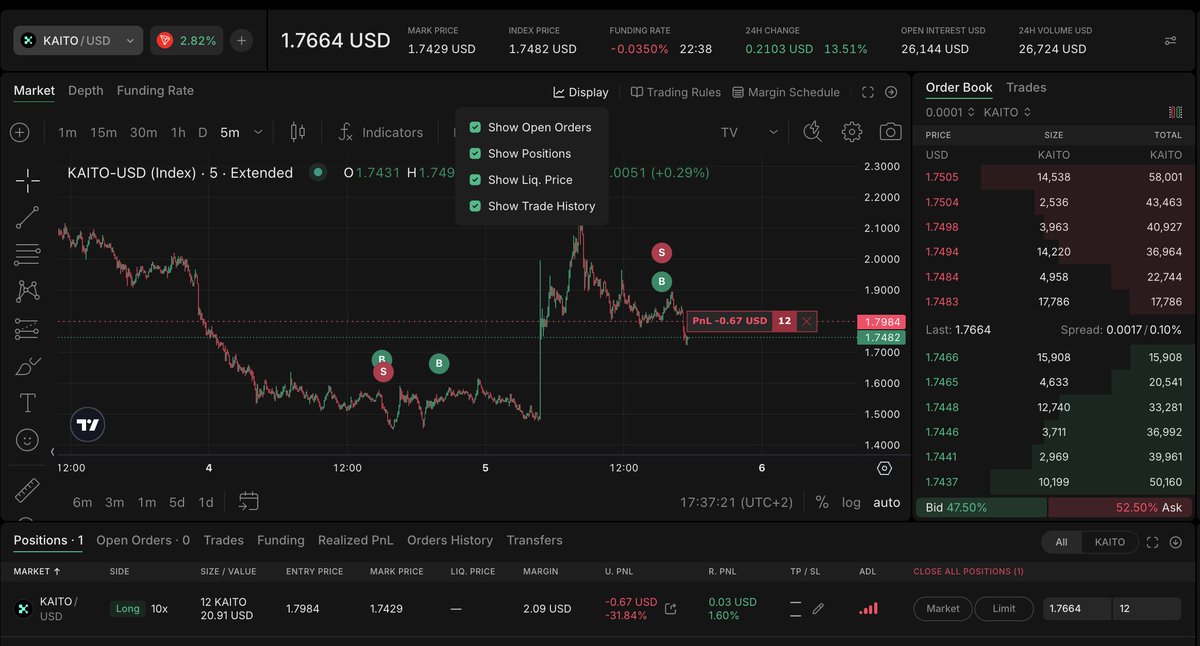
Trade Info Display on Charts is Live
We’ve just released the ability to see your open orders, positions, liquidation price, and trade history directly on the chart.
Position closing from the chart is already available, and order editing is coming soon.
Extended’s #15 Bi-Weekly Update
Product Development:
- The redesign is nearly complete, with every page and trading screen being updated.
- Enhanced the Markets page with new analytics, including top volume, biggest gainers & losers, and recently added assets. Added a margin schedule and trading rules data for each market.
- EUR/USD perpetual is now live on Testnet and will be deployed to production soon.
Community:
- Dropped points for Early Participation with Season 1 later to follow: https://t.co/rT7vrgV1WG
- Recorded a podcast with the founder: https://t.co/WcV9ZxasYM
Listings:
- $JUP: https://t.co/cjczA2wGzj
- $KAITO: https://t.co/wy9be6cwaZ
As the next big iteration of the product, the team at @extendedapp will be adding unified margin with a lending market and spot order books to the existing perpetuals offering. Here’s a quick overview of how it works and why it’s useful: