Hi all, I have a new result I'm excited to share. It turns out that *all existing implementations* of softmax and cross-entropy (that's JAX, PyTorch, textbooks, etc) have a subtle bug --- two bugs, actually. A simple rewrite fixes both, and eliminates "slingshots" when grokking:
🚀 Where does intelligence reside?
The paradigm in modern AI suggests: scale up a single model, train it on more data, and general intelligence may emerge. Yet Society of Mind proposed another possibility: intelligence may emerge from interactions of less intelligent agents.
As we keep scaling up a few generalist agents shared by everyone, can we scale up societies of decentralized agents that work together and collectively achieve more than any one of them could alone?
We introduce MPT: Market-based Post-Training, a framework to train such societies of agents by jointly learning agent policies and self-orchestration in a decentralized manner.
🚀 RAX now supports DeepSeek Harness and Kimi Code as agent harnesses!
We’ve also added direct support for self-hosted DeepSeek-V4.1-Flash, so you can run RAX with local inference.
On the DexJoCo benchmark, RAX + DeepSeek-V4.1-Flash outperforms π0.5 and Fast-WAM by more than 10% with just 3 demonstrations. At API pricing, it costs roughly 1/20 as much as Claude Opus 5.5!
Try it out! 🤖
🌐 Project + sessions:
https://t.co/yS0mTf7T96
📄 Paper:
https://t.co/BSRB3PQjLb
💻 GitHub:
https://t.co/XGLeyZaz5v
🧩 Skill library:
https://t.co/tcbFIherKu
🤗 Dataset with full robot logs and sessions:
https://t.co/wXsHJ3TVfp
@deepseek_ai@Kimi_Moonshot
#Robotics #EmbodiedAI #AIAgents #OpenSource #DeepSeek #RobotLearning #LLM
Robotics has spent years scaling demonstration data and model size. What happens when we scale EXPLORATION for robot agents?
We're incredibly excited to share RAX, an agentic robotics system that learns by scaling online exploration.
A coding agent connects directly to the robot’s perception and control APIs, learns from feedback, and builds programs that perceive, plan, and act. The model stays frozen. As exploration scales, the agent improves its programs and builds up reusable skills.
The results:
• ZERO teleoperation or action demonstrations on real robots—from insertion with 0.1 mm clearance and air-fryer manipulation to deformable objects and long-horizon mobile whole-body control.
• +37 percentage points on average over leading learned policies across five simulation benchmarks: RoboDojo, BEHAVIOR-1K, HumanoidArena, DexJoCo’s bimanual tasks, and LIBERO-Pro.
• One framework spanning single-arm, bimanual, dexterous, humanoid, and mobile robots, with new embodiments connected through APIs.
The craziest part: on each real-world embodiment, going from scratch to mastering the tasks took roughly two hours. No teleop. No model finetuning.
We’re open-sourcing the full framework AND every experiment session. We can’t wait to see what people build with it!
Project + sessions: https://t.co/O04Z5PUgqY
Paper: https://t.co/sd66qnYZWB
GitHub: N
Project fully led by @RunhanH and @xczhangxx who are absolutely awesome.
How it works, experiments, and robot videos below 🧵
(1/N)
Been seeing a lot of Astra for real2sim, but what you need for robotics: physics and affordance.
Our SOTA recipe specifically solves for:
• Affordance: model object details that convey functionality.
• Physics: calibrate simulation dynamics against real-world observations.
Our agent has the action space of a “full-stack simulation engineer” and jointly considers geometry, materials, colliders, articulation, and physics. It automatically calibrates physics against real trajectories and matches task-specific dynamics.
Simulation environments is useful only if it can provide meaningful policy level signals. Methods, comparisons, and results below.
🚀 Honeycomb: constant-size scene memory for video world models
🐝 Six fixed-size planes with recurrent read/write.
🔁 Better revisit consistency
💾 Constant storage
⚡ ~13 ms updates
📃 https://t.co/XaXY3MQIZw
@Harvard@NUSingapore@MIT#AI#ComputerVision#VideoGen
Introducing OM-1, our first robot foundation model, zero-shot generalizing to any robot: table-top arms, industrial arms and humanoids.
- learned directly from human manipulation data
- no teleop/robot data
- close to human-level dexterity and efficiency
- multi-robot collab
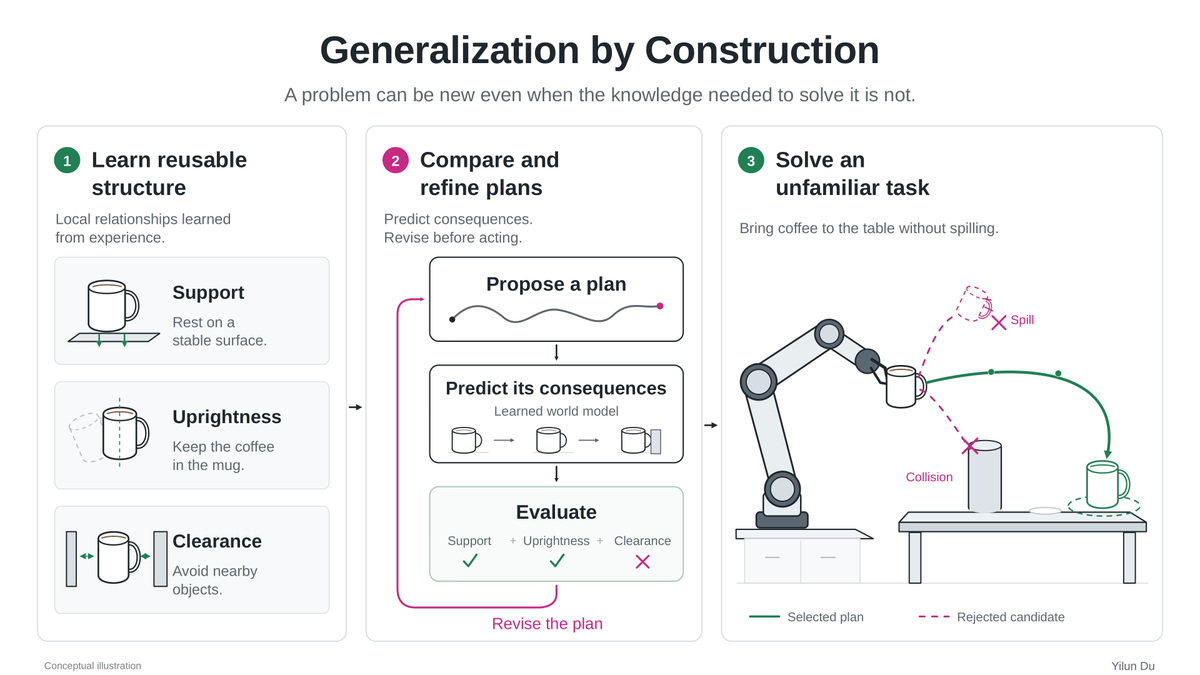
How can we improve robot generalization beyond collecting more demonstrations?
A robot can use inference to work out how to solve tasks it was never explicitly trained to perform. With learned models of the world, we can plan our future actions and goals before acting.
I wrote a research perspective, Generalization by Construction, on how learning can be combined with inference for flexible generalization.
https://t.co/MfNWubAp4l
We are happy to announce the list of accepted NeurIPS 2026 workshops: https://t.co/qiBOZgP6Ao
The workshops will take place on:
- Fri Dec 11 and Sat Dec 12, 2026 – Sydney
- Sat Dec 12 and Sun Dec 13, 2026 – Paris and Atlanta
We want to thank everyone who submitted a proposal and look forward to hosting the accepted workshops!
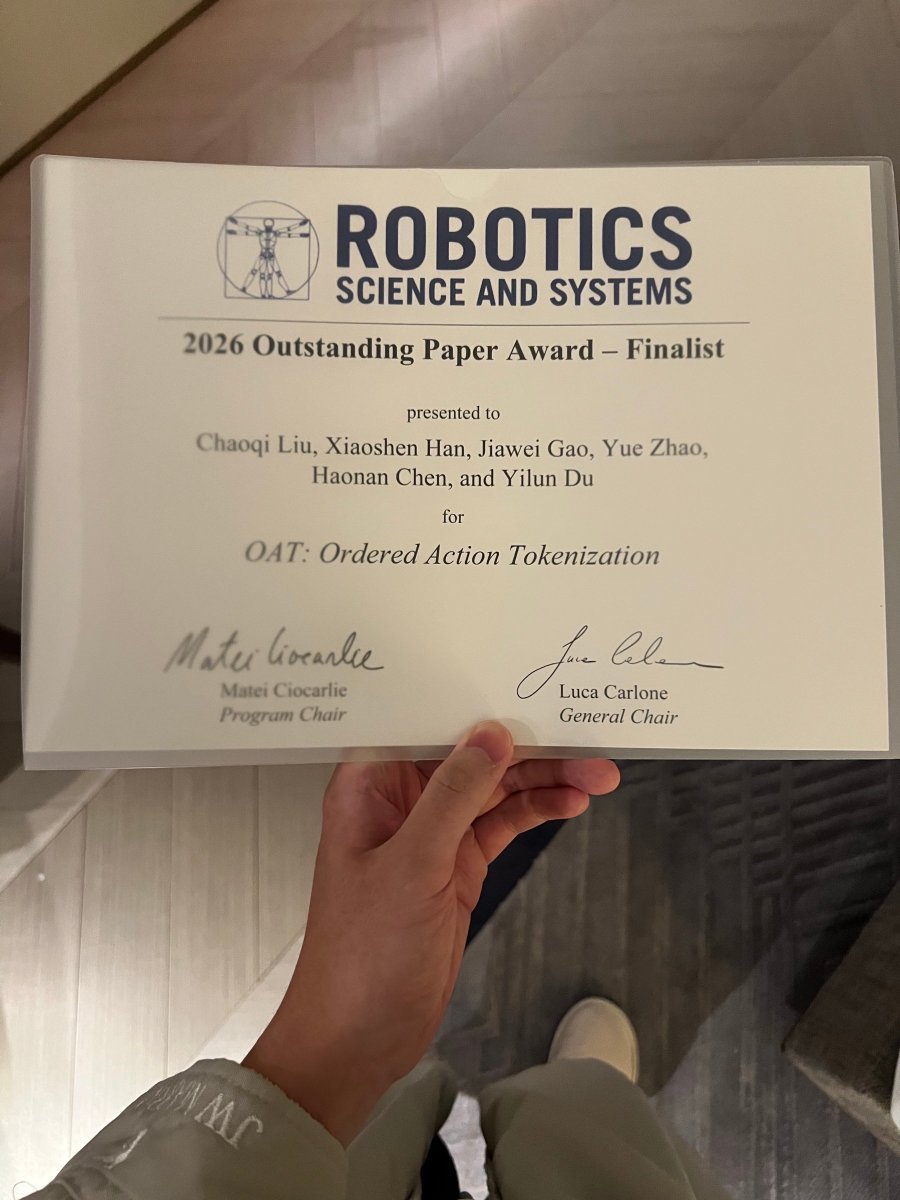
OAT was named an @RoboticsSciSys 2026 Outstanding Paper Award Finalist! 🏆
Now we’re taking OAT much further: 2 prevailing VLA paradigms. 3 policy backbones. 6 tokenizers. 60+ tasks spanning 5 simulation benchmarks and real robots.
1/🧵
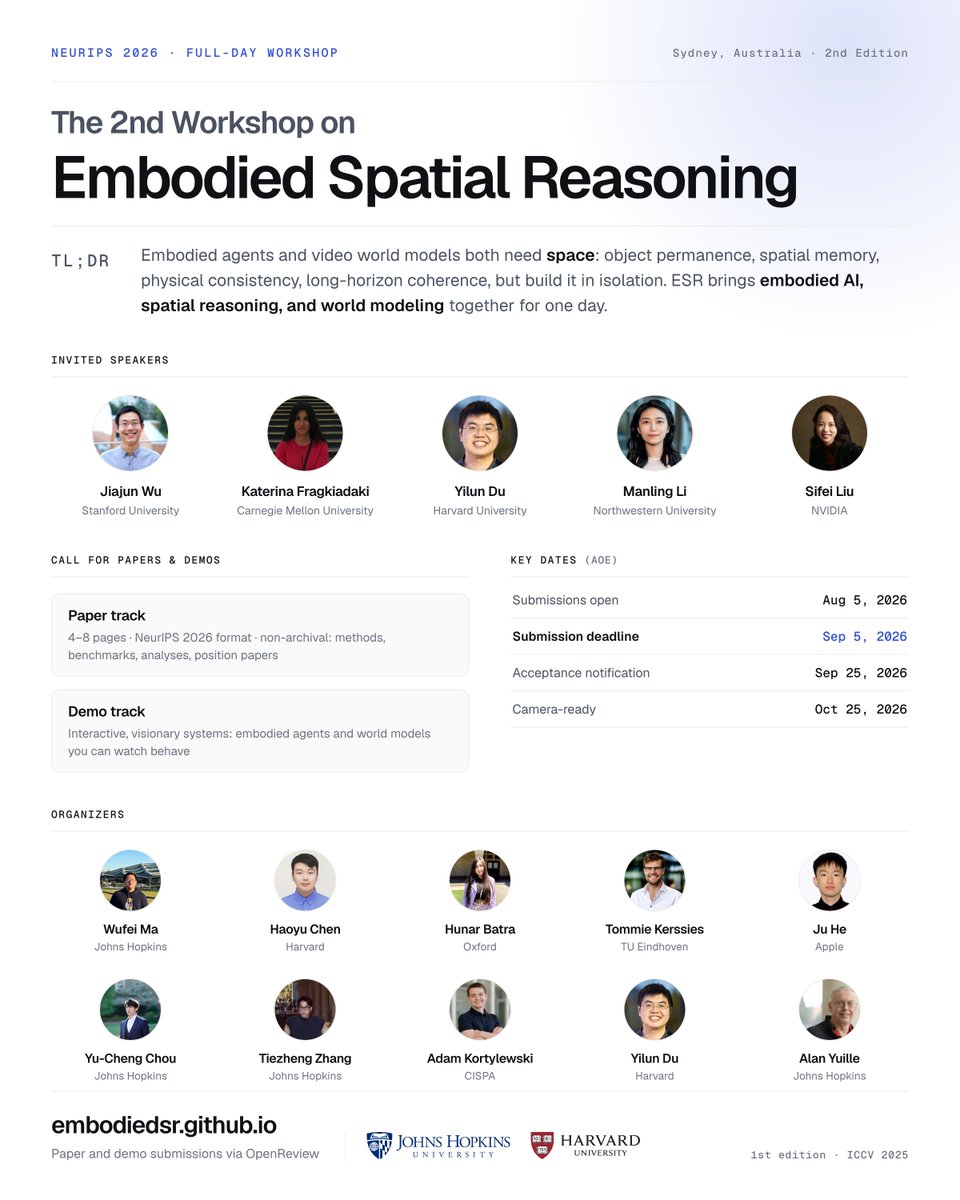
Excited to announce the 2nd Embodied Spatial Reasoning (ESR) Workshop at #NeurIPS2026!
As a co-organizer, I'm excited to invite submissions on embodied AI, world models, spatial reasoning, robotics, and physical reasoning.
📄 Paper & 🤖 Demo tracks are now open, deadline is September 5th. Hope to see your work in Sydney!
#NeurIPS @NeurIPSConf
🧑🚀 Embodied agents and world models both rely on space: object permanence, spatial memory, physics that still holds a thousand frames later.
🌟 The 2nd Embodied Spatial Reasoning (ESR) Workshop at #NeurIPS2026 in Sydney brings embodied AI, spatial reasoning, and world modeling together for one day.
Paper + demo tracks. Deadline Sep 5, 2026.
🌏 Website: https://t.co/rVDu45rpJt
📢 Call for Papers: https://t.co/3xjWxUCkaX
📢 Call for Demos: https://t.co/wEDsfvJwot
Perception, physics, and action in one room.
#NeurIPS @NeurIPSConf
A Harvard team has developed an AI-based robotic control system called Diffusion-MPC that allows legged robots to adapt their movements to new tasks and terrains without retraining. They presented this work at @icra in June.
https://t.co/ZGhCe50RAn
Excited to share MemoBench, our ECCV 2026 benchmark for evaluating visual memory in dynamic world modeling.
When objects disappear from view, can video/world models recover their updated states when they reappear?
Paper: https://t.co/j6lVBAsZd9
Project/code/data/leaderboard: https://t.co/f72bU1XpLY
#ECCV2026 #WorldModels #VideoGeneration