@habibitrades_ Anybody who gives you specifics is being silly, in my opinion. A 2000 player will be a 90%+ favorite against a 1500 - there isn't one thing that's causing this. They're going to be better at everything, roughly equally.
Just a timely reminder (😁) that some time in early 2027 there will be a totally free, open source alternative to Chessbase available for anyone who wants to work on their own chess, maintain their own database files, etc. If you like the way lichess looks, you will like Tabiya.
Over the last 8 months, I have been pseudo-secretly working on an open-source, cross platform, chess database/analysis tool I'm calling Tabiya. I am letting a few testers in over the coming weeks to iron out the kinks. Consider this quick demo a teaser: https://t.co/BRXulAZHJj
@GMAlexColovic Crazy that you only have 10k subs! YouTube is a weird place - what you have to do to be popular doesn't always correspond to great chess content in the ways you'd think! 👏🏻💪🏻
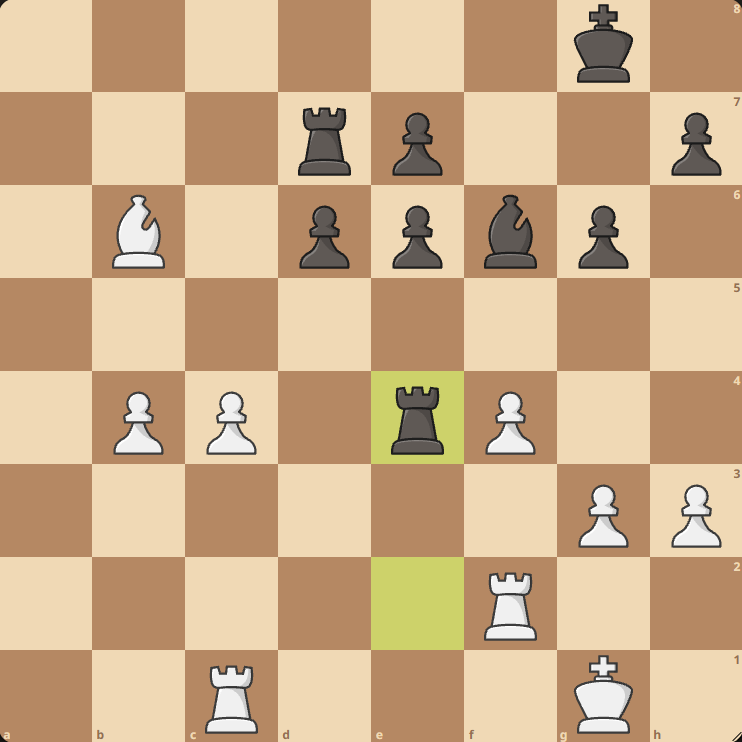
From a quick blitz game on lichess - I played 1.Rd2?! in this position, intending to get slick with it after 1...Rb7 2.c5 Bd4+ 3.Rxd4 Rxd4 4.c6 Rxb6 5.c7, but what did I miss? What's better?
My new podcast with Lichess COO Theo Wait (@cynophi) is out! How does Lichess compare to ChessCom? Does free chess hurt the game? We also discuss the Hans Niemann report and where Theo disagrees with Danny Rensch about Take Take Take. Don’t miss it👇
Finally, Strategic Balance is online.
Part One, a 26-hour video course, is now available for the first time.
An in-depth presentation of revisited theoretical foundations, complemented by extensive practical exploration.
Discover more at https://t.co/9NaYbVTC7y
ok... uh so I'm making a game... it's like if GTA & Apple Maps v1 had a baby
And that baby was a custom built engine that streams in OpenMapTiles (plus some other public domain mapping data) to render the entire earth as a playable open world game
Engine is all C++ with Metal (and Vulcan) renderer - which means this thing runs on ALL Apple platforms... yes even that one (ok not the watch... yet)
Right now it's just a sandbox world. No "game" - just layers and layers of systems. Earth scale procedural weather systems (rain, storms, clouds, wind, KpI, tornadoes, hurricanes, etc) which means you can see them coming from the distance and travel across the landscape in a timelapse. And every building has a procedurally generated interior.
There's also tons of vehicles, skateboarding (with skateparks), snowboarding (with ski resorts & lifts)
Also a photography mode with all sorts of fun goodies
The whole thing is a bit mad. Work's been insane right now and I wind down before bed by going through all of the work Claude has done that day, playtesting, writing up new project plans, and then kicking off the next day's projects across my 3 Macs in my house wirring on this all day with Opus 5.5 (maybe save that explainer for another crazy person Twitter screed)
Anyway, curious what you think. Now I can post my little updates here instead of blowing up all my group chats with the weird ideas I'm trying next.
@oscarwilde1875@fins0905@chessdojo did a podcast on this topic not TOO long ago. David Pruess was (presumably) self-diagnosed with aphantasia but certainly would beat both of us in a blindfold game! 😁
@oscarwilde1875@fins0905 Possibly a confounder but unlikely the full explanation. I literally don't see anything, i.e. couldn't describe what my pieces or board look like, but could tell you f5 is a light square and if I wanted the g-knight to head over there it'd be g1-e2-g3-f5, g1-f3-d4-f5, etc.
@oscarwilde1875@fins0905 I actually calculate better not looking at the board - many players are like this. Not all, but I think visualization in chess is sort of overrated, at least in the most commonly associated sense of the word.
@oscarwilde1875@fins0905 I'm not world class at all, around 2300-2500 online & solid blindfolded & I'll freely admit I don't "see" anything. I have built up the pattern recognition and chunking necessary to track all the pieces, and their movements are basically tiny math abstractions.