How we got here --> where we're going
Alberta Premier Danielle Smith cleared legislative hurdles for the separatists and amplified their message. Now these activists - the ones who brought her to power - want to bring her down.
https://t.co/NKzuo70f8r
#ableg
Instead of a $200M Referendum, Alberta could have bought:
🏥 2 Rural Hospitals
🩺 2,000 Registered Nurses
🌀 65 CT Scanner Labs
💊 4,000 Lifesaving Cancer Drugs
🩺 400,000 Advanced Screenings
Priorities Matter: Smith choose fringe separatists over hard working Albertans
I cannot stop thinking about three families who sent their children to elementary school this morning and will never bring them home again.
So spare me the fucking thoughts and prayers.
Spare me the speeches about how now isn't the time to talk about guns.
And spare me the politicians who have spent YEARS refusing meaningful gun-safety laws while telling the rest of us that massacred children are somehow the unavoidable price America must pay for their interpretation of the Second Amendment.
FUCK THAT.
Children being slaughtered in their elementary school is not the price of freedom.
It is a fucking national disgrace.
And don't even start with “if the teachers were armed.”
They're TEACHERS.
They went to work today to teach children how to read and multiply and make friends. They are not fucking marksmen. Turning an elementary school into a crossfire because politicians refuse to confront America's gun problem isn't a solution. It's insanity.
Three children are dead.
Three families have been destroyed.
Hundreds of other little kids just experienced something no child should ever see.
So to every politician who blocks meaningful gun-safety laws and then races to a microphone after another classroom fills with blood:
Keep your fucking thoughts and prayers.
Do your fucking job.
https://t.co/zApB93tRXv
Alaskans booing Canada might want to remember who maintains the road connecting them to the lower 48. Canada spent over $103 million in Alaska Highway maintenance in 2024. Maybe show some respect for the neighbour keeping your lifeline running
🚨UPDATE: After taking 3 bullets while trying to protect her classmates in February in Tumbler Ridge, 12-year-old Maya has started speaking again.
Five surgeries later, her first word was: "Mommy."
She keeps fighting, day after day. True courage! Drop a ❤️ for her in the comments!
Voted in the AB referendum this morning in Stony Plain.
Arrived at 8:50.
Polls opened at 9:00.
Over 100 people in front of us.
Voted at 10:20.
Longer line up outside when we left.
As a proud Albertan and prouder Canadian I voted appropriately.
No to the nine.
Yes to Canada.
‘Australia without migrant workers’
Who made this? 👏
Mandatory viewing for any fool who still doesn’t understand the implications of slamming the gates shut.
Nenshi has lambasted Smith for not following through on her promise to actively campaign for a united Canada. Last week, Nenshi noted that not only are Smith’s cabinet members not getting out the vote, many have left on foreign trips during the critical lead-up to the vote.
“They should bloody be knocking on doors. They should be getting out the vote,” Nenshi said. “They’re behaving like separatists.”
https://t.co/uHqPZiNJ2J
Reminder ALBERTA :
Advance polls open tomorrow until Saturday avoid line ups.
NO to the 9
YES remain in CANADA 🇨🇦🇨🇦🇨🇦🇨🇦🇨🇦🇨🇦🇨🇦.
We must send Smith & UCP separatists a strong message that we are proud CANADIANS 🇨🇦🇨🇦🇨🇦🇨🇦🇨🇦🇨🇦🇨🇦🇨🇦🇨🇦🇨🇦🇨🇦🇨🇦🇨🇦🇨🇦🇨🇦����🇦🇨🇦🇨🇦🇨🇦🇨🇦🇨🇦🇨🇦🇨🇦🇨🇦🇨🇦🇨🇦🇨🇦🇨🇦
Yep. They were fake. Because apparently when Zelensky took out the RUSSIAN data centers most of Alberta separatists immediately disappeared of social media and it also tells you a lot about Danielle Smith’s connections with Russia. I told you before. Danielle is a plant.
BREAKING: Rep. Ilhan Omar defiantly responds to Trump’s fascist raid of her home just a few weeks out from the midterms.
He picked a fight with the wrong woman…
“I’m ok. Make no mistake: this is an attempt to target political enemies and weaponize federal law enforcement,” Omar wrote on X. “For ten years, Trump has targeted me with baseless lies and smear campaigns. This is just the latest escalation in his campaign of political intimidation.”
“I will not be silenced,” she concluded.
Early this morning, ICE agents raided Omar’s home in Washington, D.C., ostensibly in search of immigration documents, including paperwork that her late father filed when she was just a child.
The Rubicon has been crossed.
Trump is now directing his jackbooted thugs to carry out politically motivated raids on his enemies based on fully fabricated allegations. This is a blatant targeting of Omar because she is an outspoken critic of this regime and, more importantly to the bigoted MAGA base, she’s a Black woman, a Muslim, and an immigrant. They are frothing at the mouth over the prospect of harming her.
This is the kind of thing that you see in crumbling democracies right before the fascists make a concerted effort to permanently seize power. While we can’t say for sure that this tactic will spread, this normalizes sham raids on Democratic politicians and opens the door to a sweeping campaign of state-sponsored terror. Trump knows that he’s headed into an electoral wipeout in the midterms and so he’s desperately reaching deep into the authoritarian playbook.
Expect the administration to push for denaturalizing and deporting Omar next, a longstanding dream of the white nationalist movement. They want to remove every last non-white, non-Christian person from this country but before they can do that they need to demonstrate an ability to strip away citizenship.
Omar isn’t intimidated. Neither can we be. This is the canary in the coal mine. It’s time to take to the streets en masse.
Please ❤️ and share if you proudly stand with Congressman Ilhan Omar!
Here is what to expect from a fucking independent Alberta. The Premier speaks to a crowd and the people of Alberta are not allowed to hear what she had to say. This is the kind of FREE SPEECH YOU CAN EXPECT FROM THESE #Ditchbillies
I am a member of the Norwegian Nobel Committee.
There are five of us. Five people, appointed by a parliament most of the planet could not find on a map, who decide, once a year, which human being the world has agreed to call good.
I know. I know. I think about it on the tram.
We meet in a building on Henrik Ibsens gate, a street named after a man who wrote almost exclusively about people discovering they are frauds, which nobody on the committee finds funny except me. There is a room with a long table and the portraits of the dead laureates looking down, Mandela, the Dalai Lama, a great many earnest men in spectacles, and one portrait we do not discuss, which is Kissinger, 1973, awarded while the bombs were still falling, after which two of our predecessors resigned and the satirist Tom Lehrer said political satire was now obsolete. We keep him on the wall. A reminder. Every family has the uncle.
It is October in Oslo, which means the sun gives up around four in the afternoon like a civil servant, and it rains the particular Norwegian rain that isn’t quite falling, just hanging there, judging you. I arrive with wet shoes. I always arrive with wet shoes. There is coffee, because this is Norway and there is always coffee, we drink more of it per person than almost anyone alive, and someone’s wife has sent kanelboller, the cinnamon buns, and we sit, five Norwegians, damp, caffeinated, sugared, and we decide the moral standing of the entire species.
Let me tell you how it actually works, because the world imagines a cathedral and it is, I promise you, a book club with a mandate.
287 nominations this year. 208 people, 79 organizations. Anyone can nominate, that’s the secret nobody understands: a professor, a parliamentarian, a former laureate, so the “nominee” list is meaningless, it’s a suggestion box, and every autumn some congressman nominates his own golden retriever and the press writes “SHORTLISTED.” Nobody is shortlisted. There is no short list the public ever sees. There is us, and the coffee, and the rain, and the portraits, and a Norwegian stubbornness that is older than the prize itself.
We read reports. The institute’s advisers write them, thick dull documents, and we argue. Our chairman told the BBC once that in the final meeting “there is a high temperature.” High temperature, for a Norwegian, means someone slightly raised an eyebrow and then apologized for it. We don’t do high temperature. We do a long silence, and then Kristin says “well,” and everyone knows exactly what “well” meant, and it’s settled. That’s our shouting. “Well.” You’d have to be raised here to hear the violence in it.
Now. This year. I will not say the name, because we never say the name, but you know the name.
A certain head of state wanted this prize the way a child wants a thing in a shop window, which is to say loudly, and in public, and with the full belief that wanting it was itself the argument. He said he deserved it. He said he’d ended eight wars, a number that grew most times he said it, like a fish. He had other heads of state phone us. Israel’s prime minister posted it on the internet, “Give him the Nobel.” The leaders of Cambodia and Pakistan announced they’d nominated him, as though announcing it were part of it, as though we tally mentions. A man flew around the globe collecting endorsements for a Norwegian committee the way you’d collect signatures for a petition to the council about a noisy dog.
And here, uff da, is the detail I treasure, the one that makes me smile into my coffee. The nomination deadline is the 31st of January. He took office on the 20th. So for all the phone calls, all the posts, all the gilded lobbying, the only nominations that could possibly count for this year’s prize were filed in the first eleven days of his term, before he had, by his own arithmetic, ended a single one of the eight wars. He campaigned all year for a prize whose window had shut while he was still hanging up his coat. We didn’t have to reject him. The calendar did. We just watched. Norwegians are very good at watching. We have long winters.
People think we sit there weighing his deeds. We don’t. That’s the thing I can’t make the world understand. We’re not grading his homework. We don’t owe anyone the prize for a ceasefire, however real, however loud the announcement. “He made peace” is not a sentence that ends in a medal, the way he believes it does, the way he believes every good thing ends in his name on it. The will of a dead Swede says the prize goes to whoever did the most for fraternity between nations. A dead Swede, I should add, who made his entire fortune inventing dynamite and selling arms, and spent his last years horrified at his own obituary, which called him a merchant of death, and so bought his way to immortality as a man of peace. The whole prize is one guilty arms dealer’s attempt to launder his name. We are, all of us, administering a dead man’s public relations. I find this clarifying. It keeps me humble. It should keep everyone humble, and it keeps, by my count, no one humble at all.
So who did we give it to?
An eighty-five-year-old woman. A judge. Born in Durban, under apartheid, granddaughter of a Tamil man who came to South Africa as indentured labor, a bus driver’s daughter from the poor Indian quarter, who became the first non-white woman to run a law practice in her province, who defended Mandela’s people when defending them was dangerous, who sat on the Rwanda tribunal and the court at the Hague, and who, at eighty-five, is right now a judge weighing whether a genocide is a genocide. When we told the world, our chairman said the rule of law “underpins the system we have set up to ensure peace,” and that “peace requires justice.” She wasn’t even in Oslo. She was in Nuremberg. In courtroom 600. The actual room where they tried the Nazis. You cannot stage that. God staged that, and God, it turns out, is a better satirist than any of us.
She did not phone us. She did not post. No prime minister demanded it for her on the internet. She had, as far as our deliberations are concerned, the one qualification the loud man could never manufacture, which is that she wanted the work and not the medal. The medal finds those people. It flees the ones who chase it. This is not a rule we wrote. It’s just the only pattern the hundred-odd years of our mistakes has ever shown.
The reaction from across the ocean was immediate. His spokesman posted that we “place politics over peace.” Ja. Perhaps. We’re five damp pensioners in a rainy city; of course it’s political, it was always political, it was political when we gave it to a sitting American president nine months into his first term for the promise of things he had not yet done, and we have been quietly embarrassed about that one for fifteen years, so believe me, we had a particular reason this year to prefer a woman with fifty years of verdicts behind her over a man with eight wars in front of him and a deadline already behind him.
Here is what he will never understand, the thing I’d tell him on the tram if he ever took one. We are the one prize he cannot buy, cannot post his way to, cannot have a friendly dictator phone in for him. Not because we’re incorruptible, nei, we’re as vain and wrong and human as the portraits on our wall. But because the entire point of the thing, the only power a small cold country’s book club has ever held, is that it goes to the person not performing the wanting. The moment you demand it, you’ve proven you don’t understand what it’s for, and proving that is itself the disqualification. He ran the most expensive campaign in the history of the prize and the campaign was the reason. He was never losing to Navi Pillay. He was losing to the concept.
It’s dark now. Four o’clock dark. The buns are gone. Kristin said “well” an hour ago and we all went home. I’m on the tram with my wet shoes, and somewhere across the water a very powerful man is explaining to a camera that the prize is rigged, that we’re corrupt, that he’ll win it next year, and he genuinely might, we’re only five idiots and we’ve been wrong before, Kissinger is still on the wall.
But not this year. This year an old woman in Nuremberg, in the room where the law once stared down the exact kind of man who thinks wanting a thing loudly enough should make it his, got a phone call she didn’t ask for.
That’s the job. We don’t reward the man who ends the war and announces it.
We reward the woman who spent fifty years deciding what a war was.
He’ll never see the difference. That’s rather the whole point of him.
Takk for i dag. I have to change trams.
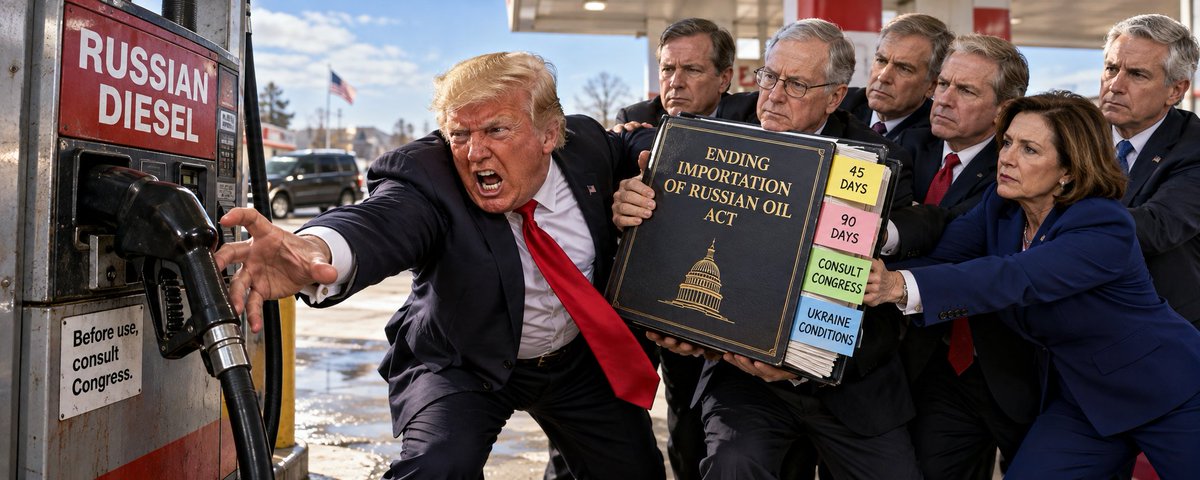
Trump veut du diesel russe. Six sénateurs lui ressortent la loi.
Il y a un petit problème lorsqu'on décide de faire venir du diesel russe aux États-Unis : parfois, le Congrès américain a déjà voté une loi pour en interdire l'importation.
Et le plus embarrassant pour Donald Trump, c'est que quatre sénateurs républicains viennent de lui rappeler son existence.
Vendredi 9 octobre, Trump annonçait un accord avec Vladimir Poutine pour remettre plusieurs millions de tonnes de diesel russe sur le marché, avec l'objectif affiché de faire baisser les prix du carburant. Dans la foulée, le Trésor américain publiait la licence générale n° 135, autorisant certaines transactions sur le diesel russe, y compris son importation aux États-Unis, jusqu'au 7 avril 2027.
Une solution économique, potentiellement.
Sauf que ce dimanche 11 octobre, six sénateurs américains demandent officiellement à l'administration de renoncer.
Et pas n'importe lesquels.
Quatre républicains : Susan Collins, Lisa Murkowski, Thom Tillis et John Curtis. Deux démocrates : Jeanne Shaheen et Richard Blumenthal.
Leur objection ne concerne pas seulement le risque de procurer de nouvelles recettes à Moscou pendant sa guerre contre l'Ukraine.
Elle concerne aussi une loi fédérale.
Une interdiction votée en 2022
Le 8 avril 2022, le Congrès américain adoptait l'Ending Importation of Russian Oil Act, qui interdit l'importation aux États-Unis de produits énergétiques russes, dont le diesel.
Mais le texte prévoit également une procédure permettant au président de mettre fin à cette interdiction.
Et cette procédure est assez précise.
Le président doit notamment consulter les commissions compétentes du Congrès au moins 45 jours avant de transmettre une certification officielle. La levée de l'interdiction ne peut ensuite prendre effet qu'après 90 jours, sauf adoption entre-temps d'une résolution de désapprobation ayant force de loi.
Et ce n'est pas tout.
La certification doit notamment constater que la Russie a accepté un accord de retrait de ses forces et de cessation des hostilités approuvé par le gouvernement ukrainien, qu'elle ne représente plus une menace militaire immédiate pour les membres de l'OTAN et qu'elle reconnaît le droit des Ukrainiens à choisir librement leur gouvernement.
Autant dire qu'obtenir du diesel à bon prix ne figure pas exactement parmi les critères.
Les six sénateurs reprochent précisément à l'administration de n'avoir ni consulté le Congrès ni fourni les justifications exigées, selon eux, par cette législation.
Mais attention : leur objection soulève une véritable question juridique, et non une illégalité déjà démontrée.
Une loi peut-elle laisser passer une licence ?
Car il existe une subtilité importante.
La loi de 2022 renvoie elle-même aux mesures d'application du décret présidentiel 14066, signé par Joe Biden quelques semaines auparavant.
Or, ce décret prévoit des possibilités de dérogation par voie réglementaire ou administrative, notamment au moyen de licences délivrées par le Trésor.
Et c'est précisément ce qu'a fait l'administration Trump vendredi avec la licence 135.
Cette autorisation est temporaire et ciblée : elle ne supprime pas l'ensemble des sanctions contre la Russie, mais permet certaines transactions liées à la vente, à la livraison et à l'importation de diesel russe.
Mieux encore : la nouvelle loi de sanctions signée par Trump le 18 septembre 2026 préserve explicitement le pouvoir du Trésor de délivrer de nouvelles licences générales.
Cela ne signifie pas que ces licences peuvent automatiquement neutraliser n'importe quelle interdiction légale.
Mais cela empêche aussi de conclure qu'une licence est illégale simplement parce qu'une loi prévoit une interdiction générale.
Toute la question est donc de savoir si la licence 135 constitue une dérogation autorisée ou si elle revient à contourner une interdiction que le Congrès a expressément encadrée.
La procédure de 45 jours et le délai de 90 jours concernent la fin de l'interdiction légale. Leur application à une licence temporaire fait précisément partie du problème juridique soulevé.
À ce stade, aucun tribunal n'a tranché cette question.
Quatre républicains demandent des comptes
Interrogé dimanche sur NBC, Thom Tillis estime qu'il existe un argument juridique sérieux pour considérer que Trump pourrait ne pas respecter la loi si son projet d'achat de diesel se concrétise.
Une déclaration notable venant d'un sénateur de son propre parti.
Mais tous les républicains ne formulent pas la même critique. John Barrasso défend l'objectif de réduction des prix énergétiques poursuivi par Trump, tout en soulignant l'importance de maintenir les sanctions contre Moscou comme moyen de pression.
Le dilemme économique est réel. Les prix du diesel pèsent lourdement sur les transporteurs, les agriculteurs et les consommateurs américains.
Mais les interrogations sur l'efficacité de cet accord demeurent : les cargaisons promises n'ont pas encore été vérifiées comme livrées, et leur effet durable sur les prix reste à démontrer.
Désormais, une autre question s'ajoute à la facture.
Le gouvernement américain peut-il autoriser ces importations par une simple licence administrative, ou doit-il respecter la procédure politique et juridique prévue par le Congrès ?
Ce sont les pouvoirs respectifs du président et du législateur qui se retrouvent au centre du débat.
Trump voulait du diesel russe pour faire baisser les prix.
Six sénateurs lui rappellent maintenant que la pompe a aussi un mode d'emploi juridique.
Et cette fois, quatre d'entre eux sont républicains. 😈
“True North, a right-wing media organization, promoted the event on social media as “the most important free speech event of the year”
“Media outlets were denied access to the event and were unable to hear the premier’s remarks.”
Alberta in a nutshell.
https://t.co/79MgNiiYvT