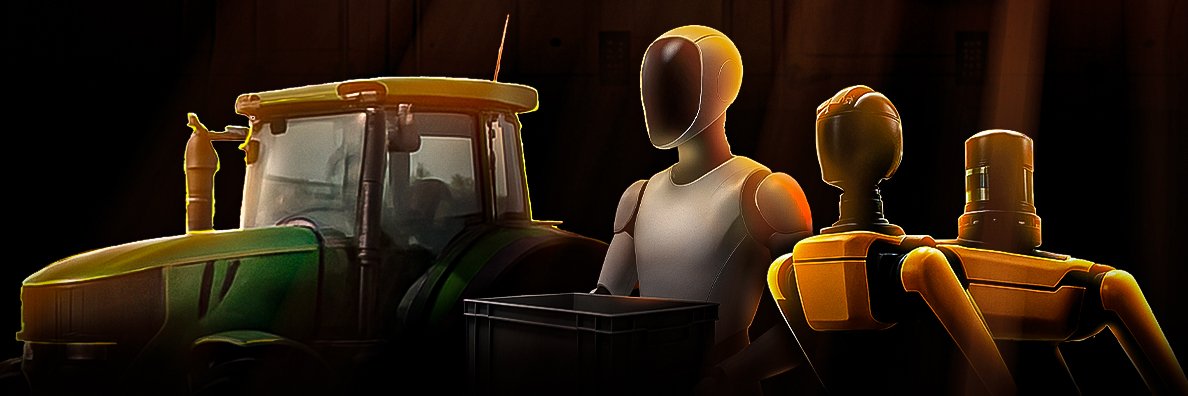
Stop the demo loop. The $10 trillion question for every CEO, CTO, and Robotics Builder is this:
How do we move beyond brittle models that look great in a controlled lab but break down the moment they hit the real world?
Learn how in our How To Build Physical AI Blueprint 👇🔗
Had a lovely time talking to @TorqueAGI founder @AshutoshSaxena_ about building foundation models for robotics. Please checkout the full episode here https://t.co/xZi4zTs2Qm
Most AI demos look good in controlled environments.
Production is where things break.
On the Scaling Robotics podcast, Dr. @AshutoshSaxena_ shares what it actually takes to reach 99.99% uptime in physical AI systems.
Thanks to @vedantnair__ for the great conversation.
In the new age of Physical AI, we must rethink how we define our data pipelines.
Previously, all that mattered was volume. This mattered because they required at least 1,000 examples of a specific task just to get started.
Now what matters is the ability to collect diverse and high-quality data.
(With Ashutosh Saxena of @TorqueAGI )
What package handling teaches us about Physical AI.
Robotic reliability isn’t incremental. Failure compounds.
And when logistics works, it unlocks value across global systems: airports and freight networks, medicine distribution, e-commerce fulfillment, and beyond.
Had fun sitting down with Ashutosh Saxena, Founder and CEO of @TorqueAGI .
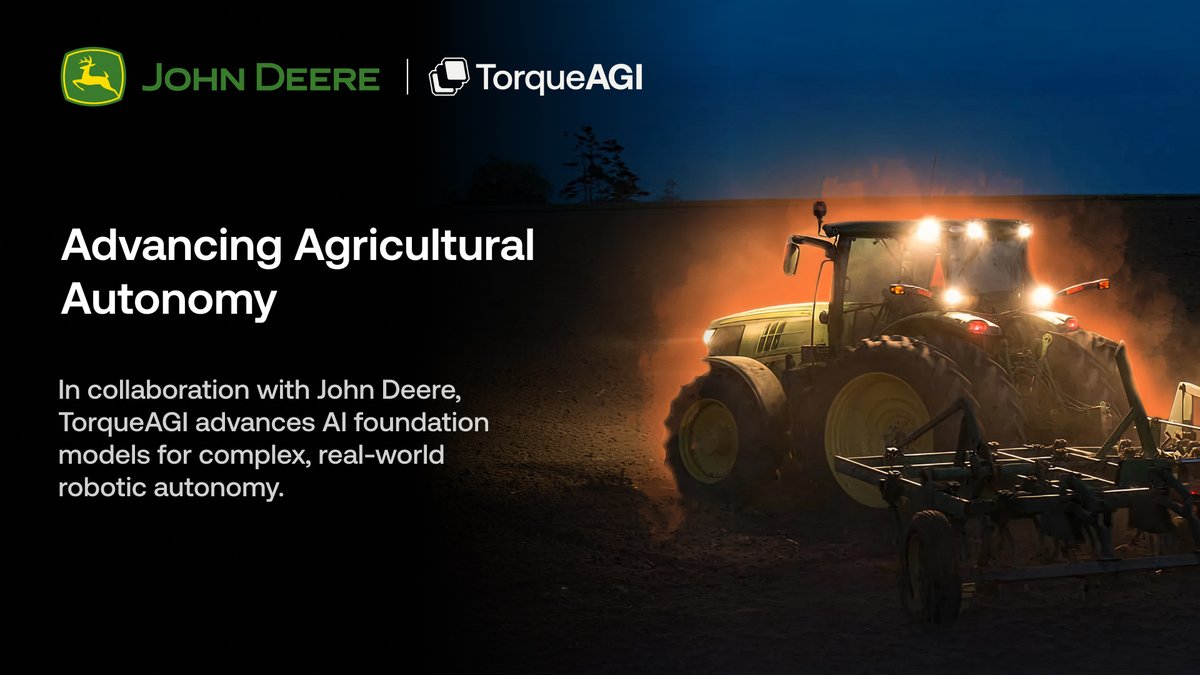
Torque builds robotics foundation models for F100 companies like John Deere.
Previously, Ashutosh took a company public and completed his PhD under Andrew Ng at Stanford.
https://t.co/SAZePmZyFE
Through our partnership with John Deere, we look forward to advancing AI foundation models for the next generation of intelligent agricultural autonomy built for production, not just prototypes. 👉 Full press release: https://t.co/g4KYoQMg09
At TorqueAGI, we are building physics-informed foundation models deployed at the edge, AI designed to generalize across machines while operating reliably in dynamic, harsh environments.
Today, we’re excited to announce that we’ve raised more than $935M in Series A funding with a $520M Series A-X extension round, bringing our total capital raised to nearly $1B.
This milestone is a powerful vote of confidence in our mission: building AI-powered humanoid robots designed to work alongside humans.
With this new funding, we’ll be able to:
- Ramp production of #Apollo
- Expand global commercial and pilot deployments
- Build next-generation facilities for robot training and data collection
- Accelerate real-world impact across manufacturing, logistics, and beyond
We’re proud to be backed by an incredible group of repeat and new investors, including @BCapitalGroup, @Google, @MercedesBenz, @ATT Ventures, @JohnDeere, QIA, and more.
The future of embodied #AI is happening now, and Apollo is just the beginning.
- Read the full announcement: https://t.co/uwiAFxivhX
- Explore open roles: https://t.co/xmGrG9IyBS
My first interview with @EdwardMehr, Co-Founder & CEO of @MachinaLabs_.
0:46 Creating a sculpture of Tesla’s Chief Designer
3:28 What went wrong with early prototypes
5:56 How the metal forming process works
9:01 Rapid design iteration
13:48 The limiting factor in creating more Elons
16:18 Building the first prototype on $300k
22:22 The importance of naiveté & having fun
24:17 What it was like working at SpaceX in 2012
29:57 Celebrating customers
40:36 Focusing on the biggest risks
45:35 Designing the system to fit inside a shipping container
47:25 Early mistakes
52:22 Finding 10 champions
1:06:42 Selling systems, parts, vs finished assemblies
1:10:39 Hardware companies require complex capital structures
This is . . . how to build a humanoid.
We went to @foundation_robo and hung with @sankaet and shot the process of making a humanoid in stunning detail. Full episode right here - https://t.co/Tr3HE9cxcX
We worked with @Ginkgo to connect GPT-5 to an autonomous lab, so it could propose experiments, run them at scale, learn from the results, and decide what to try next. That closed loop brought protein production cost down by 40%.
One 3D vision system for the entire warehouse! 👁️🗨️
@zividlabs and @mujin just demonstrated three critical warehouse tasks with a single vision platform, proving you don't need multiple vendors to automate end-to-end operations.
Depalletizing with the Zivid 3 at a very high distance. The challenge here is keeping both 3D and 2D data sharp when the camera is mounted far from the pallet. Most vision systems lose precision at range, but Zivid 3 maintains the depth accuracy needed for reliable pick points even from extended working distances.
Robot picking bins is harder than it looks. Most robots can't pick totes reliably because you need extremely good 3D data to see the edges of the bin clearly, plus a gripping system that can grab the side with just a few millimeters of clearance.
Zivid 3 handles large working volumes, letting the robot see the whole scene from afar and plan precise edge grips without getting too close. 🗼
And last but not least: parcel handling with speed and precision using the Zivid 2+ R-series. The robot picks parcels of different sizes, shapes, and materials stacked on top of each other. This is the chaos of real logistics: no standardization, mixed SKUs, overlapping objects.
One vendor, three tasks, full warehouse coverage. Depalletizing, bin handling, and parcel sorting all use the same vision platform with different configurations.
That means unified software, consistent data formats, and no integration headaches between multiple 3D camera vendors.
Also, great to see @ABBRobotics in action! 🦾
~~
♻️ Join the weekly robotics newsletter, and never miss any news → https://t.co/GoA3ZuwoPB