In all the years I have been in the markets, there has always been a vocal bearish camp, without fail, that sings the symphony of the latest fear (be it yield curve inversions, a repeat covid crisis, or even the fall of our financial system)
But they are on the clock to be right; eventually, this noise always gets silenced, only to be replaced by a new, different narrative
There is always a reason to exit; if your reason to cut your investments is due to you being overwhelmed by the bearish symphonies, you are likely to regret it
Fear and doom sells; but they very rarely pay
This is basically where I land.
There’s a legitimate opportunity-cost argument after the rerating, particularly for shorter-term momentum investors. But that’s very different from saying the memory cycle has already rolled over.
Spot pricing is rising, ASPs are moving higher and revenue, earnings and FCF estimates are still climbing. The stocks may need time to consolidate while fundamentals catch up, but the underlying thesis clearly hasn’t broken.
I’d rather watch pricing and estimate revisions than how bearish the X timeline feels.
I get the point, but hindsight is doing some work there too. The reason these names were cheaper in 2025 was because there was far less visibility around demand, capacity and earnings.
I definitely wouldn’t load the boat indiscriminately after a 5–10x move. Some names are clearly priced for perfection.
But price appreciation alone doesn’t mean the thesis is finished. Every 10x was once already up 3x and 5x.
The real question is whether the fundamentals and earnings estimates are still moving faster than the share price.
This is the key point for me: you don’t even need to underwrite the full $6B run-rate or give it a 40x multiple for the current valuation to work.
I’d only distinguish between installed capacity and realised revenue. Utilisation, customer qualifications, pricing and execution still matter.
But demand is already exceeding supply by 20–40%, so this isn’t capacity being built into a vacuum. Even if AAOI delivers materially below the top-end framework, the earnings power could still be far above what the market was pricing only recently.
Long $AAOI.
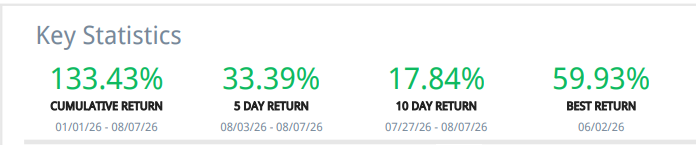
Just thought to share some receipts.
+133.43% YTD as of Friday.
I’m not posting this to pretend the journey was smooth or that I’ve somehow solved investing. It wasn’t, and I haven’t.
These returns came from running a concentrated, high-beta portfolio and being willing to size heavily when I thought the market was materially mispricing a theme. That has produced some outsized gains, but also some very uncomfortable drawdowns along the way.
The way I think about it: position sizing is an amplifier, not an edge by itself. When you’re right, it makes the idea matter. When you’re wrong, it exposes every weakness in your process.
The aim with this account is to share the research before the outcome, update when the facts change and be equally open about the ideas that don’t work.
Plenty of people post the thesis after a stock has doubled.
I’d rather let the timeline be the receipts.
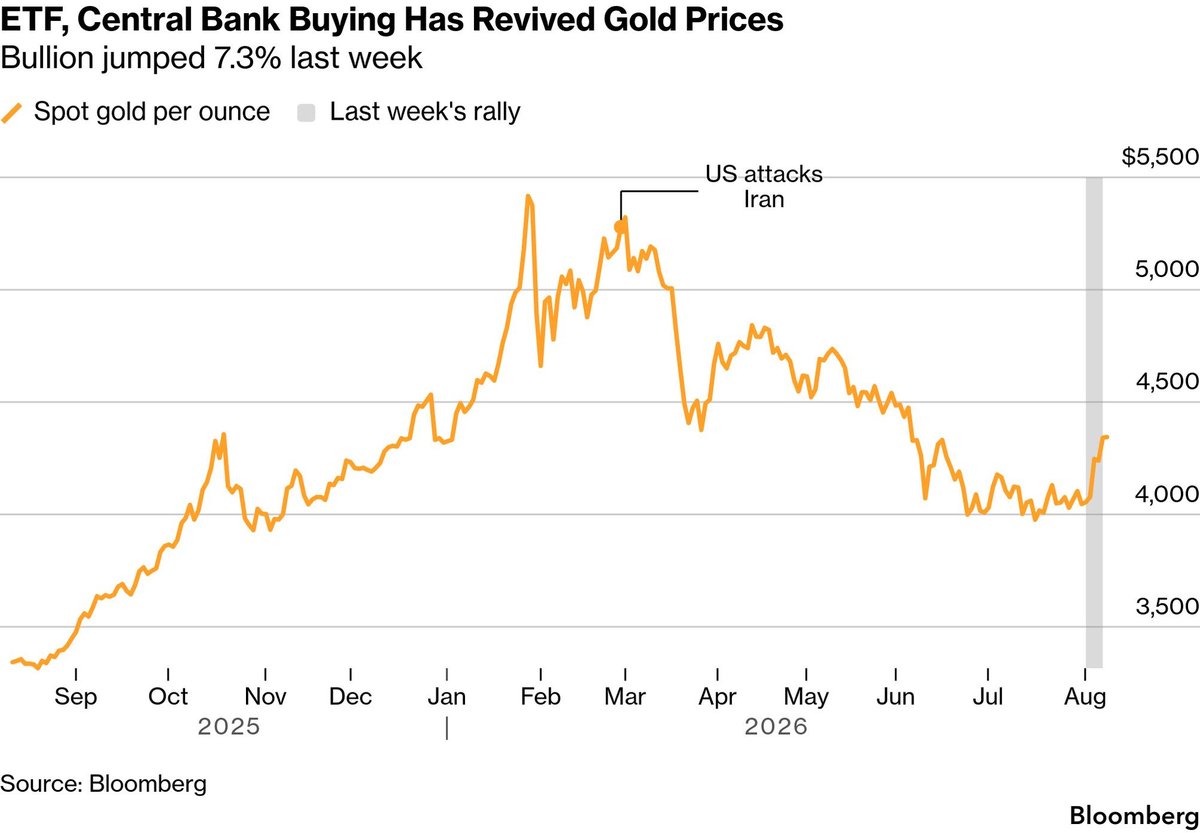
I think $xauusd gold looks interesting again.
It rallied 7.3% last week, its best week since January, while US gold miners had their strongest week in a decade.
But the bit that interests me isn’t just the price move. It’s who’s buying.
Gold ETFs have added 24 tonnes since July 20, the fastest pace since early April. Central-bank buying had already picked up, but gold only really came back to life once ETF flows returned.
The weaker jobs data and progress around the Strait of Hormuz also make another Fed hike less likely, which removes one of the biggest recent headwinds.
But my view is broader than one jobs report or the next Fed meeting.
The same structural reasons for owning gold are still there: huge government debt, persistent deficits, growing private-credit risk, plenty of leverage and geopolitical uncertainty.
Gold is also still well below its January peak above $5,400, so this doesn’t feel like buying into the same speculative frenzy we saw earlier this year.
𝗧𝗵𝗲 𝗴𝗼𝗹𝗱 𝘁𝗵𝗲𝘀𝗶𝘀 𝗻𝗲𝘃𝗲𝗿 𝗿𝗲𝗮𝗹𝗹𝘆 𝘄𝗲𝗻𝘁 𝗮𝘄𝗮𝘆. 𝗧𝗵𝗲 𝗺𝗮𝗿𝗴𝗶𝗻𝗮𝗹 𝗯𝘂𝘆𝗲𝗿 𝗱𝗶𝗱.
Central banks helped put in the floor. If ETF demand keeps returning, I think the next leg may already be starting.
Naturally, that would also be supportive for my silver thesis $AG , where I prefer the higher-torque exposure.
15/15
What I’m watching on Wednesday:
• AI cloud revenue growth
• Progress toward $7B–$9B ARR
• Connected capacity
• Q3 ramp commentary
• Capex and cash requirements
• Cloud EBITDA margins
• Any new major customers
This is exactly the kind of high-torque setup I like: huge demand, scarce infrastructure and visible operating leverage.
But at this valuation, the market isn’t paying for the ambition anymore. It’s paying for Nebius to deliver it.
The big question: is $NBIS becoming a genuine AI hyperscaler, or is the market pricing the destination too early?
I think it's the former. Long $NBIS.
1/15
I’ve been looking closely at $NBIS ahead of earnings on Wednesday.
The stock has already more than doubled YTD, so this clearly isn’t an undiscovered idea.
But I think the market may still be thinking about Nebius too narrowly as another company renting out GPUs.
Here’s the thesis 👇
14/15
The valuation already assumes a lot goes right.
At roughly $188, I get a basic market cap of around $48B.
That’s approximately 15x the midpoint of 2026 revenue guidance, or around 5–7x the company’s year-end ARR target.
ARR is also a run-rate calculation, not recognised annual revenue or backlog.