What if waste wasn't waste?
Millions of tonnes of pineapple leaves are discarded each year.
Now they're being transformed into sustainable leather alternatives.
Less waste
More value
New materials
The future may depend on how well we use what we already have.
🎥 Ru Yi Teh
What if waste became a resource?
Plastic doesn't disappear; it accumulates.
That's why recovery, reuse, and circular design matter.
Less pollution
More value creation
Smarter systems
🎥 Credit: @garybencheghib/ Sungai Watch
#CircularEconomy#PlasticPollution#WasteInnovation
What if floods didn't stop food production?
In Bangladesh, farmers build floating gardens from water hyacinths and organic materials.
No soil
No irrigation
Natural fertilizer
Adapts to flooding
A powerful lesson in climate resilience and local innovation.
#ClimateAdaptation
This almost looks AI-generated.
But orangutans really are extraordinary.
~97% DNA shared with humans
Tool users
Advanced problem-solvers
Critical seed dispersers that help regenerate forests
Protecting orangutans means protecting ecosystems.
🎥TenGolf
Happy #WorldOceansDay!
🌊 The ocean produces around 50% of the oxygen we breathe and absorbs vast amounts of carbon, helping to protect our planet.
🐟 But a crisis is unfolding beneath the waves: overfishing is emptying our oceans 💔 disrupting the balance of ocean ecosystems. If we lose fish, we risk damaging life far beyond the sea - including our own.
HELP save our seas. Say NO to corporate overfishing, choose responsibly-sourced seafood options and demand stronger ocean protection policies. 🐙
On #WorldOceansDay, remember:
Healthy oceans begin with healthy water systems everywhere.
This rural innovation uses simple engineering to cultivate land and move water without fuel or electricity.
Innovation isn't always high-tech.
Sometimes it's practical.
#Agriculture
The ocean sustains life on Earth, regulating the climate, supporting biodiversity, and providing food and livelihoods for billions of people.
This #WorldOceansDay, let's commit to protecting our oceans from pollution, overexploitation, and climate change.
What if the future of textiles grew on a farm?
Bananatex® uses Abacá banana fibers to create durable, biodegradable fabric.
The science:
Plant-based fibers
Circular design
Less plastic pollution
Innovation isn't always inventing more.
Sometimes it's rediscovering nature.
Safe food saves lives.
On this #WorldFoodSafetyDay, we call for greater awareness and action to ensure that food remains safe from farm to fork.
Food safety protects health, strengthens food security, and supports sustainable development.
Safe Food Today, Healthy Tomorrow.
What if plastic waste became a resource?
Pyrolysis uses heat in low-oxygen conditions to convert certain plastics into fuel and industrial feedstocks.
Opportunities:
Less landfill waste
Resource recovery
Circular economy solutions
The challenge:
Strong environmental safeguards
On this #WorldEnvironmentDay, let's reaffirm our commitment to protecting our planet.
Every action matters: reduce waste, protect biodiversity, plant trees, and embrace sustainable living.
One Earth. One Responsibility.
#BeatPlasticPollution#ClimateAction#TSAEDi
🐔 + 🐟 = a lesson in integrated farming.
This viral clip highlights a key agricultural principle: one farm enterprise can support another.
Smarter farming isn't always about more inputs; it's often about making better use of existing resources.
🎥farmingfeed
This is animal enrichment in action.
Sea otters Mei and Kira collect toys and place them in a bucket, a behavioral exercise that supports learning, problem-solving, and welfare.
Sometimes conservation starts with understanding behavior.
Credit: Toba Aquarium, Japan
What if plastic alternatives were already falling from trees?
In India, fallen areca palm leaves are transformed into biodegradable plates and packaging.
The science:
Clean
Heat press
Reuse
Less waste. Less plastic. More value for farming communities.
🎥Credit: @zonaki_official
Some of the world's most sustainable designs are centuries old.
The Royal Court of Tiébélé in Burkina Faso uses earth, wood, and straw to create naturally cool, durable homes adorned with cultural murals.
Innovation is not always new.
Sometimes it's ancestral knowledge.
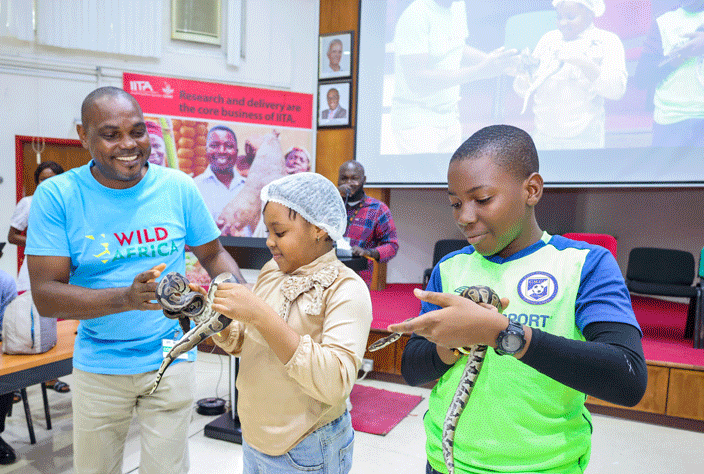
Over 200 children joined the 2026 @RadioIITA Children’s Day Celebration in Ibadan, learning about climate change, food security, wildlife conservation, food safety, nutrition, and sustainable agriculture through tours, cooking, and expert-led sessions.
📺https://t.co/97E7SlJkrU
Nature wastes nothing.
Waste → Resource
Pollution → Productivity
Outputs → Inputs
That's the power of circular economy thinking. For agriculture, conservation, and climate resilience, the real question isn't how much waste we produce, it's how much value we're leaving behind.
Sometimes innovation is not high-tech. It's understanding soil, water, and plant science.
These planting methods use unconventional means to:
Conserve moisture
Reduce weeds
Improve soil conditions
Boost efficiency
Reminds us that climate-smart agriculture starts with simple ideas
What if “farm waste” were actually future income?
In parts of China, maize husks are being transformed into useful commercial products rather than burned or discarded.
The bigger lesson: Innovation is not always about producing more.
Sometimes it’s learning to waste less.
Excited to share that I was selected for the @CJIDAfrica Climate–Agriculture Reporting Project, with funding to produce an in-depth report on how climate change is affecting smallholder farmers in Oyo State, Nigeria.
The field experience has been eye-opening.
#ClimateJournalism