This is animal enrichment in action.
Sea otters Mei and Kira collect toys and place them in a bucket, a behavioral exercise that supports learning, problem-solving, and welfare.
Sometimes conservation starts with understanding behavior.
Credit: Toba Aquarium, Japan
What if plastic alternatives were already falling from trees?
In India, fallen areca palm leaves are transformed into biodegradable plates and packaging.
The science:
Clean
Heat press
Reuse
Less waste. Less plastic. More value for farming communities.
🎥Credit: @zonaki_official
Some of the world's most sustainable designs are centuries old.
The Royal Court of Tiébélé in Burkina Faso uses earth, wood, and straw to create naturally cool, durable homes adorned with cultural murals.
Innovation is not always new.
Sometimes it's ancestral knowledge.
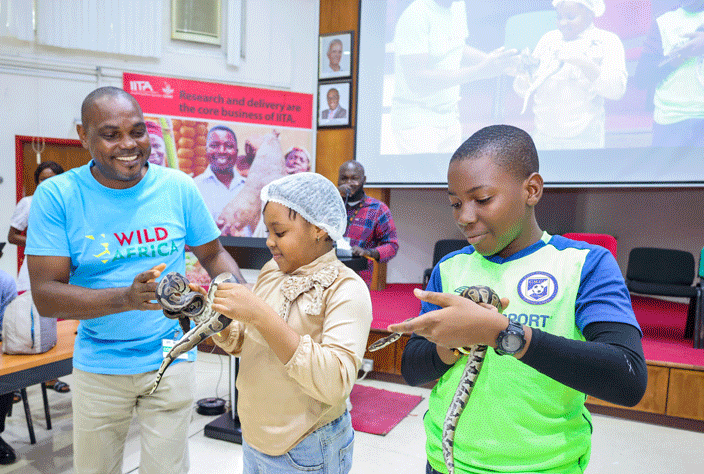
Over 200 children joined the 2026 @RadioIITA Children’s Day Celebration in Ibadan, learning about climate change, food security, wildlife conservation, food safety, nutrition, and sustainable agriculture through tours, cooking, and expert-led sessions.
📺https://t.co/97E7SlJkrU
Nature wastes nothing.
Waste → Resource
Pollution → Productivity
Outputs → Inputs
That's the power of circular economy thinking. For agriculture, conservation, and climate resilience, the real question isn't how much waste we produce, it's how much value we're leaving behind.
Sometimes innovation is not high-tech. It's understanding soil, water, and plant science.
These planting methods use unconventional means to:
Conserve moisture
Reduce weeds
Improve soil conditions
Boost efficiency
Reminds us that climate-smart agriculture starts with simple ideas
What if “farm waste” were actually future income?
In parts of China, maize husks are being transformed into useful commercial products rather than burned or discarded.
The bigger lesson: Innovation is not always about producing more.
Sometimes it’s learning to waste less.
Excited to share that I was selected for the @CJIDAfrica Climate–Agriculture Reporting Project, with funding to produce an in-depth report on how climate change is affecting smallholder farmers in Oyo State, Nigeria.
The field experience has been eye-opening.
#ClimateJournalism
When nature thrives, we can too. 💚
Clean air, fresh water, and the food on our plates all depend on an intricate living system of plants, insects, and animals working in balance. 💧🍲💨
As traditional chef @graciabvute reminds us, “Our lives depend on nature.” Protecting nature secures a future for Africa’s wildlife, wild spaces, and the communities whose livelihoods depend on them.
Here’s how you can do your part:
🚙 Visit national parks as the entrance fees directly fund conservation efforts
📲 Report wildlife crime, including poaching and illegal bushmeat trade
🌳 Protect and restore natural habitats wherever you can
Small choices, made collectively, shape the future of Africa’s wildlife. 🐘
🎥 Filmed at @ZimEllies@ifawglobal@Imire_Zimbabwe
This tower pulls water from thin air.
Inspired by Ethiopia’s Warka tree, it harvests fog, dew & humidity using bamboo and mesh, no electricity needed.
Climate resilience
Water security
Biomimicry
Sometimes nature already has the solution.
Credit: Warka Water
What if wind power worked without giant blades?
This vibrating pole generates electricity through motion + electromagnetic induction.
Cleaner cities
Safer for birds
Potential for farms & rural energy
Sometimes, smarter beats bigger.
🎥 Credit:ASTROZEN
#CleanEnergy#ClimateTech
Fish below.
Vegetables above.
One ecosystem supports both.
This integrated farming system from Bangladesh shows that sometimes innovation means partnering with nature.
@Aquaponics#climatesmartagriculture#ScienceThatTouchesUs
This papaya farming technique aims to reduce excessive upward growth, keeping trees shorter and easier to harvest.
The science relates to disrupting the “apical dominance” plant hormones that control vertical growth.
Simple idea.
Big agricultural conversation.
#Innovation
We are moving from designing buildings → designing perception.
AI, projection mapping, sensors, architecture, and storytelling are merging into immersive environments that respond to humans in real time.
Future cities may become interactive experiences.
#Innovation#AI
The orchid bee collects fragrance as “perfume”… but becomes part of a plant’s pollination strategy without knowing it.
Scent, deception, and co-evolution work together.
Pollinators like this are essential to ecosystems and agriculture.
#Biodiversity#Pollinators#TSAEDi
#Science sometimes looks like a tiny premature baby connected to life-support systems inside a NICU.
Respiratory care, incubators, infection control, and neonatal medicine have transformed infant survival globally.
But the bigger conversation is also about access to care.
This viral clip may be AI-generated, but the Common Tailorbird genuinely stitches leaves together using plant fibers and spider silk to build nests.
A reminder that biodiversity also contains extraordinary engineering, craftsmanship, and intelligence.
#Nature#Biodiversity#AI
Discarded cables turned into human portraits.
A powerful reminder that e-waste never truly disappears. Poor disposal harms soil, water, ecosystems, and agriculture.
Sometimes, environmental science speaks through art.
🎥 Patience Adekunle
It's #WorldBeeDay!
Bees pollinate the plants that feed us, protect biodiversity, and support healthy ecosystems. Yet they face threats from climate change, habitat loss, and pesticides.
Protect the pollinators. Protect our future.
#SaveTheBees#TouchScienceAfrica#Biodiversity