AI has improved massively in 2026 and I use it daily. But it hasn’t improved my trading. I would attribute 0% of my PNL this year to AI.
Yet for years now, I’ve listened to people on social tell me how if I’m not building or using Claude all day, that I’m falling behind. I still don’t see what any of these people have built nor have I seen their trading improve. Same as the OpenClaw saga (LanceBot 1.0 was trash 🤖🗑️).
My biggest issue w funded trader programs are the broken affiliate link incentives that harm the whole trading ecosystem.
Coincidental w today’s video on the subject, the latest fraud is @lanto_trades. Real trading is NOT blowing 800+ accounts and lying about it.
"I think Paris should be a real wake up call to every single young American. France is the dream the left talks about: the liberal safety-net rich Socialist Europe. That dream is the nightmare I left from Chicago. A society that comes down to how much you can take from others, that's not a society that we want to create"
-Ken Griffin, on the lessons young Americans must learn from the recent chaos in France
Automating a trading strategy is 10x harder than manually trading. I’ve tried to build an automated version of my strategy 6 different times in the last few years and every time it ends up in the negative. Don’t know how traders are seeing success with this.
Some day people will realize that financial markets can be manipulated on a massive scale. A firm needs to be able to identify the tails, understand how they interact, and have the power to wag them all.
Jane Street is that firm.
DO TECHNICALS PREDICT THE FUTURE AND “FRONTRUN” NEWS?
Over the last year or two, I think I’ve done a decent job calling out some pivotal moments in the market with a pretty solid hit rate. The top in BTC, the top in quantum/froth, the DRAM crack, among others.
I don’t delete tweets or cherry-pick my calls, and I’m certainly wrong plenty of times and take losses like everyone else. In my course, there’s a full record of my market thoughts, documented in my weekly market prep videos.
So what exactly does that mean? And perhaps more importantly, what doesn’t it mean?
First, no trader knows what’s going to happen. Everything is probabilistic at best and total noise at worst. But there are specific moments in time when the odds can become meaningfully skewed in one direction.
I don’t believe technicals somehow “frontrun” the news. What I believe is that technicals help reveal the prevailing sentiment of the market, and that sentiment is the lens through which new information gets interpreted.
Think about it.
Why did semis sell off alongside SKHY on its earnings? And why did SKHY respond so poorly to its numbers? To some degree, because sentiment was already rolling over, and that deterioration was showing up in the charts.
Why does the market suddenly sell off so aggressively on a hot inflation print? Because investors have grown increasingly concerned about oil prices, persistent inflation, and what those pressures mean for interest rates.
Why aren’t we seeing the same enthusiastic responses to positive AI headlines that we saw previously? Because investor sentiment has shifted. People are growing increasingly skeptical of the enormous spending and whether the eventual returns will justify it.
As a dumb day trader, it’s impossible for me to fully understand any one of these themes, let alone all of them. But what my experience and expertise in technical analysis allow me to do is read the collective footprints of the market’s largest participants, expressed through price action.
Those footprints can reveal changes in positioning, conviction, and risk appetite well before the underlying narrative becomes obvious to everyone else.
And that’s what makes technical analysis so powerful to me.
Price action can tell you that something is changing, even when you don’t fully understand why it’s changing. It can reveal that buyers are becoming less aggressive, that good news is no longer being rewarded, or that sellers are gaining control.
None of those observations guarantees what happens next. But when multiple pieces of evidence begin pointing in the same direction, the odds can become increasingly favorable.
I don’t believe technicals predict the future. I believe they provide a window into changing market sentiment, which influences how the market responds to whatever comes next.
And if you’re able to recognize those subtle shifts before they become obvious, you can sometimes find moments where the probabilities are meaningfully in your favor.
It doesn't really matter what you trade but the thing that does matter is movement, unless you are selling options premium. Why have the ranges and volume fallen?
I have a 2 word answer why, the midterm elections : Ranges Shrink / Volumes Fall
A 2025 academic study examining elections from 1992 through 2024 found unusually low volatility during the weeks immediately preceding elections, even though volatility was elevated during earlier pre-election months.
ScienceDirect https://t.co/YsKrRJqHpw
The Federal Reserve Bank of St. Louis also found that the VIX declined an average of 7.3% around midterm elections, measured from two trading days before to three trading days after.
St. Louis Fed https://t.co/fa45RsMyoB
I have to admit, I never intended to use Ai as much as I do but it's not Ai coming up with the ideas, it's me and there is no way I could pull this type of data on my own.
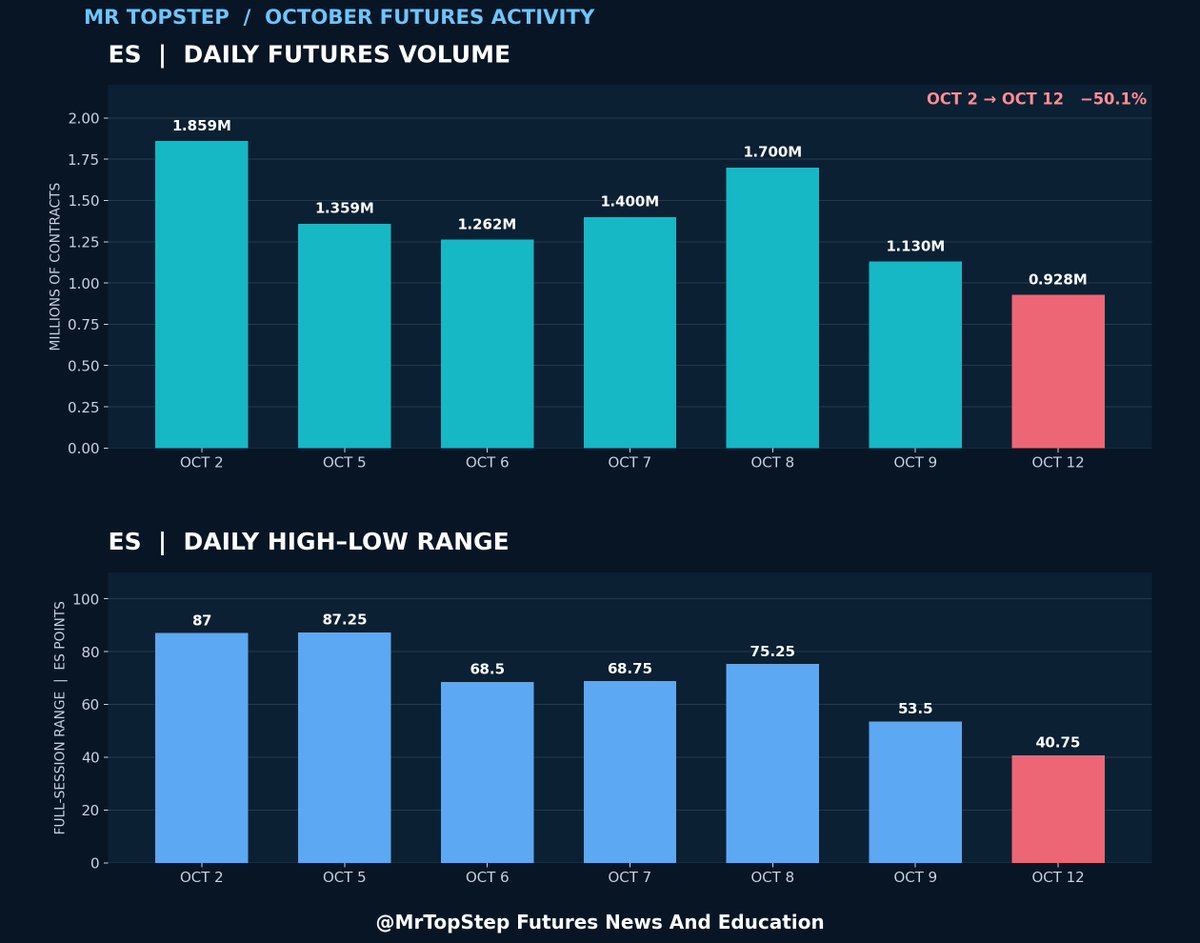
ES Trading Volume and Daily Ranges Fall Sharply in October
October started with strong ES trading volume, with 1.859 million contracts changing hands on October 2. However, participation quickly began to fade, dropping to 1.359 million contracts on October 5 and 1.262 million on October 6. Volume briefly rebounded to 1.700 million contracts on October 8 before falling sharply again, hitting just 927,661 contracts on October 12. That's a 50.1% decline in daily volume from October 2, and the lowest-volume session of the seven shown.
The ES's daily trading ranges followed a similar pattern. On October 2, the ES traded in an 87-point range, followed by 87.25 points on October 5. By October 9, the range had narrowed to 53.50 points, and on October 12 it contracted to just 40.75 points, a 53.2% decline from October 2.
Our View
What stands out is that both trading volume and daily ranges have been contracting at the same time. Over the seven sessions, the ES averaged 1.377 million contracts and a daily range of 68.71 points. But the last two sessions were noticeably weaker, with both volume and volatility falling well below those averages.
The ES has continued trading near its contract highs, but the declining volume suggests participation has thinned considerably. That doesn't necessarily mean the market is ready to sell off, but it does raise questions about the conviction behind the recent rally.
The bottom line: The ES is trading near its highs on significantly lighter volume and in increasingly narrow daily ranges. The question now is whether fresh buying comes back into the market or whether the lack of participation leaves the ES vulnerable to a larger move when volatility returns.
Our Lean
There are 20 days until November 3 midterm elections. There seems to be some type of risk off trade going on and the CPI number could be telling today. Our lean is if volume picks up we could see some type of pull back / sell off. I'm still bullish but I am concerned about the treasury yields. 7820 , 7800 amd 7780 are all key support, under 7780, 7748 could be in play.
@spencerpratt Either the people who keep voting in terrible policies are brain dead. Or the decline is on purpose like a controlled demolition.
Pre 2020 LA was amazing
I’m just going to say the quiet part out loud:
If we ever do see a "Civil War" like the liberals are calling for, it will be Antifa, BLM, and Confused people
VS
Ex Military, Rednecks, Hunters, Bikers, and Sane people
That's an hour we'll never get back.