📉 The "Gold Warning" Playbook: 2013 vs. 2026
Is history repeating itself? Yesterday, PM Modi appealed to the nation to halt gold purchases for a year to protect our forex reserves. The market reacted with a 275-point Nifty gap-down today.
But for those who remember P. Chidambaram’s similar plea in June 2013, there is a clear historical script for how this plays out.
The 2013 Flashback: "Do Not Buy Gold"
On June 13, 2013, then-FM P. Chidambaram famously pleaded: "If I have one wish... it is: do not buy gold."
The Immediate Aftermath:
Panic: The market didn't take it as a request; it took it as a warning of economic distress.
The Crash: The Nifty plummeted from ~6,000 in June to ~5,100 by August—a brutal 15% correction.
The Rupee: It spiraled to a then-record low of 68.80/$.
The Recovery: Pain Before Gain
Did the market recover? Yes, but not overnight.
The Turnaround: It took the arrival of Raghuram Rajan at the RBI in September 2013 to stabilize the Rupee.
The Result: By December 2013, the Nifty had erased all "Gold Plea" losses.
1-Year Return: Investors who bought the "panic" in August 2013 saw the Nifty rally over 20% by May 2014.
2013 vs. 2026: What’s Different?
The Strategy for Investors 🧠
History shows that when the government asks you to stop buying gold, the Stock Market usually sees a 3-to-4 month period of intense volatility.
Jewellery Sector: Expect a "long winter" until import duty clarity or global tensions ease.
Equity Opportunity: In 2013, the "Gold Warning" created one of the best buying opportunities of the decade.
Watch the Rupee: The recovery starts when the currency stabilizes, not when the speeches end.
Bottom Line: The initial "blood on the street" in jewellery and discretionary stocks is often the precursor to a massive recovery once the macro-headwinds clear.
Are you buying the dip or waiting for $100 Crude to cool off? Let's discuss. 👇
#StockMarket #Nifty50 #Gold #Investing #Trading #Economy #IndianEconomy
Now I hope you understand why I exited the US market. Exit when the crowd enters, enter when the crowd leaves.
India will now start to outperform from next week
While the crowd chases the hype, the real gains are made in the execution of a disciplined exit strategy.
I have officially exited my US market positions, locking in a 35% CAGR and 200% absolute returns.
Success in investing isn't just about knowing when to enter—it’s about having the conviction to leave when the math says so, regardless of the noise. Don't let FOMO dictate your portfolio.
Like and Repost if you value calculated moves over crowd sentiment. Let’s prepare for the next rotation together. 📈
#Investing #StockMarket #WealthManagement #MarketStrategy
#StockPortfolio #investing #stockmarket #usmarket
The ultimate David vs. Goliath story:
👥 Population:
🇮🇳 India: 1.47 Billion
🇹🇼 Taiwan: 23 Million (India is 64x larger!)
📈 Stock Market Cap:
🇹🇼 Taiwan: $4.95 Trillion
🇮🇳 India: $4.92 Trillion
Driven by the explosive AI boom, Taiwan's market has officially overtaken India's to become the 5th largest in the world. 🤯 #Finance #AI #Investing
The Great Fuel Paradox: Why Indians Always Lose, From Crude Swings to Ethanol Blends
If you’ve pulled into a petrol pump recently, your wallet has likely felt the sting of yet another price hike. For the Indian consumer, filling up the tank has become an exercise in economic frustration.
But if you look closely at the numbers, the frustration turns into a realization that the system is heavily rigged against the ordinary citizen. We are caught in a double whammy: paying premium prices for fuel even when global costs are low, and paying top rupee for a product that is increasingly diluted.
Here is a breakdown of the two-fold burden Indian drivers are carrying.
1. The Asymmetric Pricing: Heads They Win, Tails We Lose
The fundamental promise of deregulated fuel prices was simple: when global crude oil prices go up, domestic prices go up; when global crude falls, consumers reap the benefits.
Except, that’s not how it works in reality.
When Crude Plummets: When global crude oil prices crashed to historic lows, retail prices at the pump barely budged. Instead of passing the relief to the consumer, the government aggressively hiked excise duties and taxes to mop up the surplus revenue.
When Crude Rises: The moment global oil markets tighten, the cushion vanishes. The price hikes are swiftly and consistently passed on to the consumer, under the banner of "market dynamics."
Essentially, the Indian consumer is treated as a shock absorber for the fiscal balance sheet. We never get the upside of a cheap global market, but we always bear the brunt of an expensive one.
2. The Ethanol Blend: Paying More for Less Efficiency
Adding to this injury is the rapid push toward Ethanol Blended Petrol (EBP). India has aggressively pushed the mandate, with E20 (20% ethanol, 80% petrol) becoming the standard across thousands of pumps, and eyes already on higher blends.
While reducing crude imports and lowering carbon emissions are noble environmental and macroeconomic goals, the execution leaves the consumer holding the short end of the stick:
The Mileage Penalty: Ethanol has a lower energy density than pure petrol. Scientifically, running your vehicle on E20 fuel results in a 6% to 10% drop in fuel economy (mileage). You are literally burning through fuel faster.
The Pricing Irony: Ethanol is significantly cheaper to produce than importing and refining crude oil. Logic dictates that a 20% cheaper blend should mean a lower price at the nozzle. Instead, consumers are paying the highest retail prices in history for a fuel that delivers less distance per liter.
The Bottom Line: We are paying premium, record-high prices for an "adulterated" fuel blend that forces us to visit the petrol pump more frequently.
The Reality Check
The Indian middle class is effectively subsidizing state and central revenues through fuel taxes, while simultaneously acting as the testing ground for green energy transitions without receiving any financial incentives for it.
If we are moving toward a heavily green-blended fuel economy, the pricing must reflect the lower cost of production and the drop in vehicle efficiency. Until then, fuel price deregulation remains a one-way street where the consumer always loses.
What are your thoughts? Are you noticing a drop in your vehicle's mileage lately? Let's discuss in the replies. 👇
#PetrolPrice #FuelHike #EthanolBlending #Economy #MiddleClassIndia
The "Reverse AI Trade" is officially underway. 🔄
Rising US bond yields are triggering a sell-off in hyped AI stocks, with capital rotating back into traditional software. The big winner? Indian IT. Expect a solid macro tailwind as money seeks value and execution. 🚀 #StockMarket #IndianIT #Nifty #Investing
Buying a depreciating asset on EMI to flex on social media isn’t "making it"—it’s a debt trap dressed up as a milestone. 🚗💨
In India, the rush to look successful is often outpacing the actual growth in per capita income. We’re trading long-term wealth for short-term validation, one "Congratulations!" comment at a time.
Financial literacy > Social status. 📉🇮🇳 #FinancialLiteracy #India #WealthGap #Mindset
Post-Market Report | May 14, 2026 📈
The Indian markets staged a powerful comeback today, with the Nifty 50 surging 1.18% to reclaim the 23,689 level.
After a period of high volatility, a "Morning Doji Star" pattern on the daily charts suggests a potential bullish reversal is in play.
📊 Key Market Highlights:
Nifty 50: 23,689.60 (+277.00)
Sensex: 75,398.72 (+789.74)
Nifty Bank: 54,128.95 (+1.26%)
India VIX: Dropped 4.18% to 18.61, signaling cooling nerves.
🚀 Top Performers & Drags:
Gainers: Cipla (+8.09%) led the pack on stellar Q4 results, followed by Adani Enterprises and Hindalco.
Laggards: The IT sector remained the lone outlier, dipping 2% as the "AI disruption" narrative continues to weigh on heavyweights like Infosys (-2.58%) and Tech Mahindra.
💡 Why the rally?
Bond Tax Relief: Sentiment was boosted by reports that the Finance Ministry may cut taxes for foreign bond investors to support the Rupee (which hit a low of 95.96/$).
Global Cues: Positive vibes from the Trump-Xi summit provided a "risk-on" trigger for Asian markets.
Sectoral Rotation: Strong buying was seen in Pharma, Metals, and PSU Banks.
🔭 Technical Outlook:
Nifty has immediate support at 23,450–23,500. A sustained move above the 23,900 resistance could confirm a broader recovery.
#StockMarketIndia #Nifty50 #BankNifty #MarketUpdate #Trading
Nifty snapping its 5-day losing streak! 📈 GIFT Nifty is up ~80 points, pointing to a positive start above the 23,400 mark.
🚀 Key Resistance: 23,500 (The Bull-Bear dividing line).
🛡️ Key Support: 23,200.
Watching the 30-min candle after open for confirmation. Global tech rally providing a good tailwind! 💻✨
#Nifty50 #BankNifty #StockMarketIndia #TradingView
Post-market update for May 13, 2026:
Market Snapshot:
Nifty 50: 23,412.60 (+33.05) 📈
Sensex: 74,608.98 (+49.74) 📈
India VIX: 19.42 (+0.73%) ⚠️
Key Takeaways:
Snapping the Streak: Bulls managed to break a 4-day losing streak today. Market breadth remained positive with 2,328 advances vs 1,690 declines.
Sectoral Heatmap: Metals were the star performers (+3.18%), followed by Oil & Gas and Consumer Durables. IT (-1.13%) and Auto (-1.00%) continued to drag the indices.
Macro Headwinds: The Rupee hit a fresh record low of 95.71 against the USD, while Brent Crude hovered near $107/bbl due to ongoing West Asia tensions.
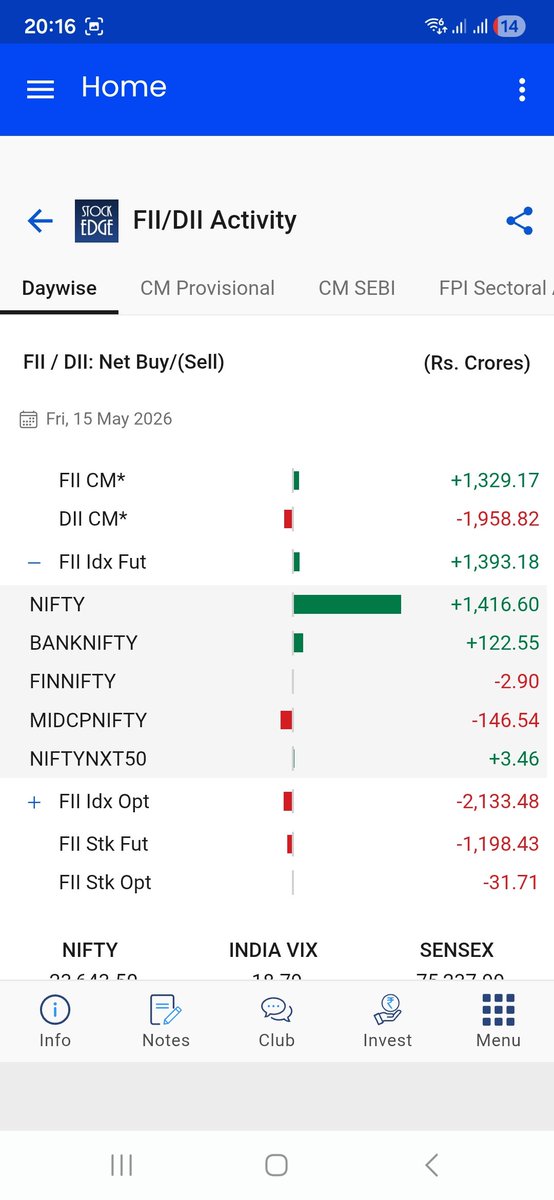
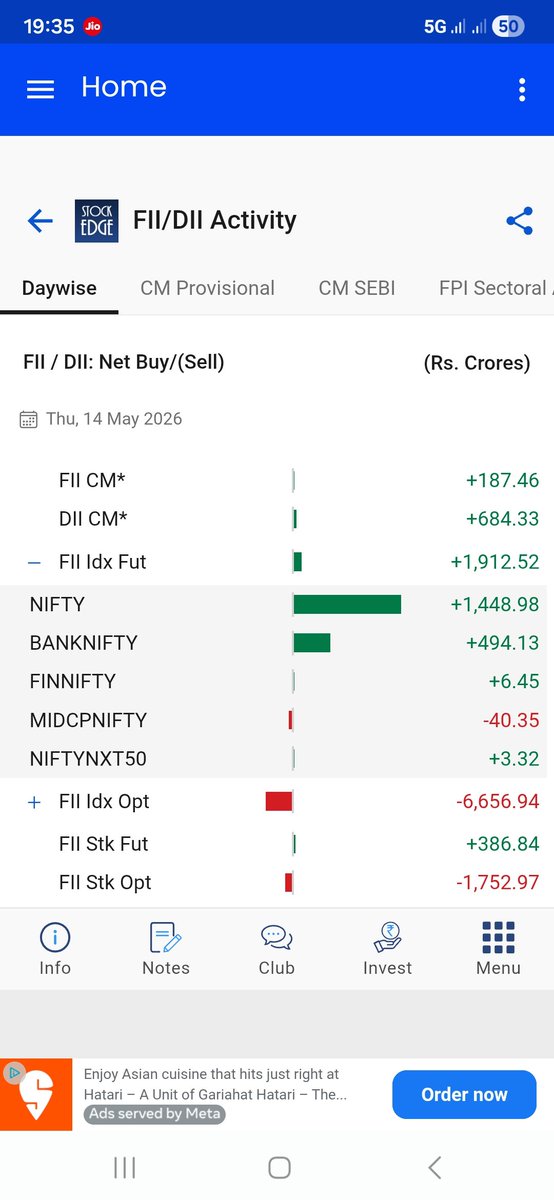
FII Pressure: Foreign investors remained net sellers, offloading nearly ₹1,960 crore in the previous session.
Technical View:
The Nifty reclaimed 23,400 but remains in a "sell-on-rise" structure below the 23,800 gap zone. Support is holding at 23,100–23,300. Watch for follow-up buying tomorrow to confirm if this reversal has legs.
#StockMarketIndia #Nifty50 #Sensex #TradingUpdate #IndianEconomy
"Spot on, Sir! 🇮🇳 The 'SMILE' strategy seems perfectly aligned with the tourism sector—Small in current global share, but Extra-Large in market potential. With the focus on spiritual tourism and infrastructure, this 'untapped goldmine' is finally being excavated. Looking forward to the multibaggers this journey creates