The entry is just a ticket to the game; trade management is how you survive it.
Most traders obsess over what to buy, burning hours searching for the ultimate setup or fundamental catalyst. But the truth is, when you buy matters far more than what you buy, and how you manage the trade once it’s live dictates everything.
A winning system isn't built on predicting the future—it's built on math and behavior:
Cut losses ruthlessly: Keep them small and non-negotiable.
Let winners run: Protect the capital, give the thesis room to breathe, and scale out only when the market tells you to.
Big wins and tightly managed small losses. That is the entire DNA of how swing traders actually build a bigger account. Shift the focus from predicting the next ticker to mastering the execution while you're in it.
@ehrishikesh@ishmohit1 Sharp pullbacks like this usually separate the true structural compounders from the ones riding purely on macro hype. Let's see if the order books and execution hold up, or if this is a deeper cyclical reset for the whole theme.
@stockifiabhijit Exactly. Price and volume are the ultimate leading indicators. Long before the spreadsheet reflects the earnings miss or beat, the internal breadth and how stocks behave at key moving averages give away the big players' hand
At a ~₹10.3 lakh crore valuation, the sheer quantum of capital required to move a mega-IPO like Jio makes massive listing-day pops structurally difficult—just look at how Jio Financial played out. High hype + heavy float usually means institutional digestion over explosive retail gains. Playing it for a quick listing pop might be a stretch; are you looking at it as a long-term compounder instead?
You're spot on that the structural shift toward 0DTE and 24/7 access has weaponized retail attention span and turned parts of the market into a casino. But do you think this hyper-leveraged environment has permanently broken traditional swing trading edges, or is it just creating more violent shakeouts before the real trends take hold?
Makes sense, and fundamental triggers definitely give setups a solid tailwind. But with due respect, even fundamentally stellar stocks with bumper earnings (like Hindustan Zinc or HFCL in the wrong market environment) can still get dragged down when broader breadth turns hostile. Do you wait for the index/breadth to stabilize first, or do you scale in slow and cut quickly if macro overrides the fundamentals?
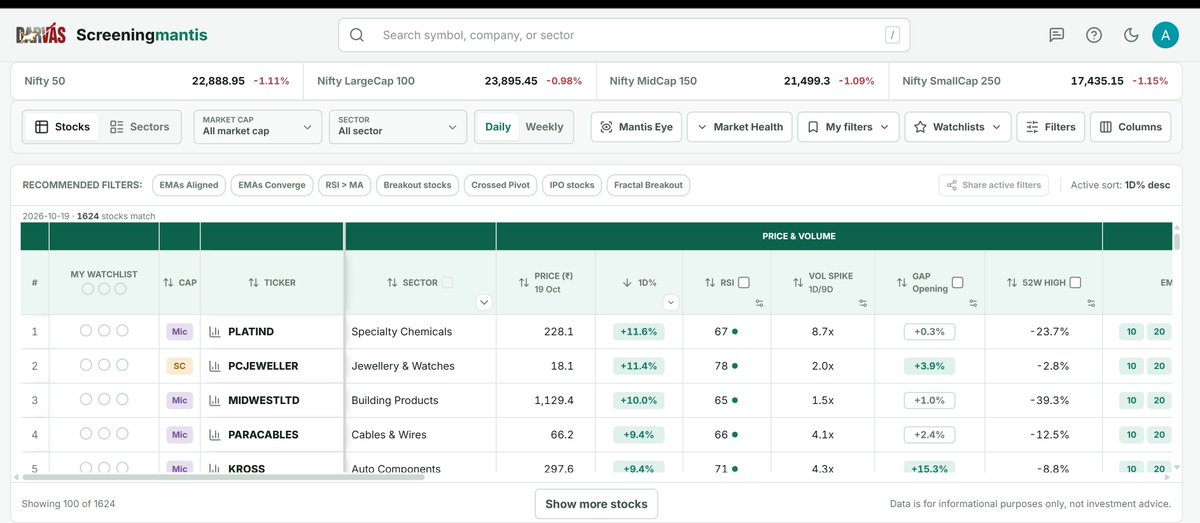
@darvasboxtrader Being able to pull up technical health metrics just by typing the ticker name cuts down screening time massively. Great addition to the platform
@AmeetRai Shoutout to @AmeetRai and @RichardMoglen. TraderLion is the best learning channel out there, and Deepvue is the ultimate platform for research. If anyone want to master swing trading, treat both like a temple and follow them religiously. No two ways about it.
@Mohitsharma202 Treating it like a side hustle is fine as long as your rules are tight. The problem isn't part-time vs full-time; the problem is gambling without a setup. Loss doesn't check your time-table.