ETFSI Principle
Information is what happened.
Evidence is what happened—and was confirmed by price, volume, and time Every day, investors are flooded with headlines, opinions, and breaking news Information alone doesn't justify allocating capital Only when the market confirms that information through price, volume, and time does it become evidence.
Information informs. Evidence allocates capital.
ETFSI Market Recap
July 16, 2026
Today's weakness was concentrated in semiconductors and AI infrastructure rather than the broader market. Financials, healthcare, transportation, and several cyclical groups continued to attract capital despite the Nasdaq's decline.
This remains consistent with what we've been discussing all week: leadership is rotating, not disappearing. The ETFSI Operating System follows where institutional money is moving—not the day's headlines—and today's evidence continues to support that approach.
See today's Leadership Dashboard below.
Disclaimer
ETF Sector Intelligence is provided for educational and informational purposes only and should not be considered investment advice, a recommendation, or a solicitation to buy or sell any security. The views expressed reflect the author's interpretation of market conditions at the time of publication and are subject to change without notice. All investments involve risk, including the possible loss of principal. Historical and backtested performance shown by the ETFSI Operating System is hypothetical and provided for research purposes only. Past performance—whether actual or hypothetical—is not indicative of future results. Readers should conduct their own due diligence and consult a qualified financial professional before making investment decisions.
Coming Soon for Paid Subscribers: ETFSI Premium members will receive complete Model Portfolio updates, including entry prices, initial stops, profit targets, position management, and daily Investment Committee commentary as new positions are initiated.
ETFSI Fact of the Day
Not all commodities provide the same diversification benefits.
In our 168-symbol research universe, UGA (United States Gasoline Fund) exhibited the highest correlation to the S&P 500 among commodity-linked funds at 0.355 That's a reminder that simply adding a commodity doesn't automatically improve diversification The diversification benefit depends on which commodity you own and how it behaves relative to the rest of your portfolio.
Diversification isn't about adding different asset classes—it's about adding assets that truly behave differently.
ETFSI Fact of the Day
Diversification works best when assets don't move together.
Over 21.6 years of data, GLD (SPDR Gold Shares) exhibited a 0.063 correlation to the S&P 500—the lowest of any non-inverse asset in our 168-symbol research universe Statistically, that's almost no relationship at all Low correlation doesn't guarantee higher returns. It means an asset has the potential to behave differently when traditional equity markets come under pressure.
True diversification isn't about owning more investments—it's about owning investments that respond differently to changing market conditions.
Semiconductors remain the area under pressure.
This has become the dominant story. TSMC beat Revenue, beat EPS and investment plans increased. Yet semis are still being sold. That tells me investors aren't questioning AI demand—they're questioning valuation and future returns. That's exactly what we've been writing this week.
@CNBCOvertime@Piper_Sandler@MichaelKantro Markets don't trade today's economy—they trade tomorrow's expectations. Economic data matters because it changes the path investors expect, not because stronger or weaker is inherently bullish or bearish.
ETFSI Fact of the Day
Big drawdowns don't always mean long recoveries.
During the 2008–2009 financial crisis, IJR experienced a 58.9% maximum drawdown Despite the severity of the decline, it recovered to new highs in about two years—significantly faster than the S&P 500, which required roughly four years to fully recover Small-cap stocks can be more volatile during market declines, but history shows they can also recover more quickly when market leadership returns.
Risk isn't defined by the size of the decline alone—it's also measured by the market's ability to recover.
The market is experiencing short-term selling pressure, but the broader evidence remains constructive. Until we see meaningful deterioration in breadth, leadership, or institutional demand, the Operating System continues to view this as normal rotation rather than a structural change in trend.
@TrendSpider This is exactly why I separate information from evidence. The earnings report is information. The market's reaction is evidence. The ETFSI Operating System responds to the evidence.
ETFSI Morning Brief
July 16, 2026
Inflation concerns have eased. Today's focus shifts to the consumer and another wave of earnings. Retail Sales, Jobless Claims, and results from healthcare, industrials, and technology leaders will help determine whether the recent leadership rotation continues to broaden or begins to lose momentum.
Market Environment
U.S. futures are modestly lower following another strong session as investors await this morning's economic data.
Retail Sales and Initial Jobless Claims headline today's calendar, alongside another busy slate of earnings from healthcare, industrials, and technology.
Oil remains near $80 per barrel, but markets appear more focused on earnings and economic data than geopolitical headlines. Treasury yields are little changed, while the VIX remains contained near 16. Futures suggest a cautious open rather than broad-based risk aversion.
Market Structure
The market's leadership continues to rotate rather than deteriorate. One-day leadership shifted toward China Internet, Retail, Bitcoin Miners, Social Media, and Medical.
Weekly leadership remains concentrated in Oil & Gas, China Internet, Retail, Steel, and Bitcoin.
Technology leadership has become more selective. Semiconductor shares are under pressure pre-market following TSMC's earnings, with weakness across ASML, AMD, Applied Materials, Lam Research, and https://t.co/Hb79tVNwTJ this stage, the evidence points to normal rotation within an advancing market—not a structural breakdown in leadership.
Capital Allocation Evidence
Our internal breadth and demand models continue to support the advance. Demand remains firmly in control, participation remains constructive, and we continue to see evidence of institutional rotation rather than wholesale liquidation.
Leadership continues to broaden across multiple sectors, a characteristic typically associated with healthy bull markets rather than narrowing advances.
ETFSI Operating System
Model Portfolio
Current Positions: IJR, MPC, ANET*
ANET originated from the expanded 633-security universe and represents one of the first qualifying stock additions under the expanded ETFSI Operating System.
Immediate Review: IHE, UNH, CIBR, XBI
Next In Line: KBWB, PANW, JETS, BUG
Building: ARKG, AAPL
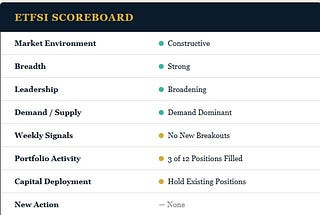
No new Weekly Structural Breakouts have been confirmed since last week's additions. The Model Portfolio currently holds three positions and is operating at 3 of 12 available allocations, leaving significant capacity to deploy additional capital as new Weekly Structural Breakouts are confirmed.
ETFSI Conclusion
Today's economic reports and earnings may influence short-term price action, but they have not yet altered the underlying evidence. Breadth remains constructive, demand remains in control, and leadership continues to rotate rather than deteriorate.
Retail Sales, Jobless Claims, and today's earnings will provide additional evidence throughout the session. Until that evidence changes, the ETFSI Operating System remains committed to following the data—not the headlines.
See the ETFSI Scoreboard below for a snapshot of the Operating System's current status.
Disclaimer
ETF Sector Intelligence is provided for educational and informational purposes only and should not be considered investment advice, a recommendation, or a solicitation to buy or sell any security.
The views expressed reflect the author's interpretation of market conditions at the time of publication and are subject to change without notice. All investments involve risk, including the possible loss of principal.
Historical and backtested performance shown by the ETFSI Operating System is hypothetical and provided for research purposes only. Past performance—whether actual or hypothetical—is not indicative of future results.
Readers should conduct their own due diligence and consult a qualified financial professional before making investment decisions.
Coming Soon for ETFSI Premium Members
Premium members will receive complete Model Portfolio updates, including official entry prices, initial stops, profit objectives, ongoing position management, and our daily Investment Committee commentary as new positions are initiated under the ETFSI Operating System.
Bigger Universe. Same Rules.
We recently expanded the ETFSI universe from 93 ETFs to 633 securities by adding the S&P 500 and Nasdaq-100. More coverage didn't change the process. It simply gives the Operating System more places to find institutional leadership. Better coverage. Same rules. Same discipline
ETFSI Fact of the Day
Betting against the market for long periods has historically been an expensive strategy.
Over the past 20 years, the ProShares Short Dow30 ETF (DOG) produced a -12.0% compound annual return, experienced a 94.1% maximum drawdown, and maintained a -0.95 correlation to the S&P 500 The bigger picture is even more telling. All three inverse ETFs in our 168-symbol research universe lost more than 94% of their value over the same 20-year period that the market they were designed to bet against continued to advance.
Inverse ETFs can serve a purpose as short-term trading tools or hedging instruments. History suggests they're rarely effective as long-term investments.
ETFSI Market Recap
July 15, 2026
Today's session reinforced one of the core principles of the ETFSI Operating System: evidence changes slowly, even when headlines change quickly.
Markets digested another round of inflation data, earnings releases, and continued geopolitical uncertainty. June PPI came in softer than expected, following yesterday's benign CPI report, helping reinforce the view that inflation pressures continue to moderate despite higher energy prices. Treasury yields remained relatively stable throughout the session, while leadership continued to rotate beneath the surface rather than broadening dramatically.
Internally, the market remains constructive. Our Market State Distribution Model continues to show Demand Dominant conditions with strong participation and no meaningful deterioration in breadth. The evidence continues to support a favorable environment for selectively deploying capital rather than becoming defensive.
Operating System Update
Today marks an important milestone for ETF Sector Intelligence.
The ETFSI Operating System now evaluates 633 securities each week using the same objective methodology:
118 ETFs (93 core sector/thematic funds plus 25 leveraged sector funds)
515 U.S. stocks (S&P 500 and Nasdaq-100 constituents, overlapping names removed)
Every symbol is reviewed using our Weekly Structural Breakout process. Portfolio decisions are made only after a confirmed weekly signal and only when they satisfy our portfolio risk rules.
Model Portfolio Update
This week activated two new Portfolio Eligible positions.
ANET (Arista Networks) confirmed a Weekly Structural Breakout for the week ending July 10 and was added to the Model Portfolio at its confirmed entry.
MPC (Marathon Petroleum) confirmed a Weekly Structural Breakout for the same week. Its entry is determined by Monday's closing price following the signal, not by an intraday touch of the level — consistent with how every Operating System entry is filled. MPC has been added to the Model Portfolio at that confirmed entry.
Our current Model Portfolio now consists of:
IJR* (Legacy position)
ANET
MPC
*IJR remains a legacy position established prior to the launch of Version 1.0. It continues to be managed within the Model Portfolio but was not initiated under the current Weekly Structural Breakout methodology.
Consistent with our Model Portfolio Execution Policy, every qualifying Weekly Structural Breakout is added to the portfolio once confirmed, provided portfolio capacity and theme concentration limits are not violated. No discretionary overrides are made based on opinion, news, valuation, or short-term price action — including a reversal in the days immediately following entry. The Operating System is designed to evaluate probabilities over dozens of trades, not individual outcomes.
Market Leadership
Today's leadership continued to favor areas tied to financial services and selected growth themes.
See the Top Five ETFs and Top Five Stocks performance table below.
ETFSI Conclusion
Today's evidence did not materially alter the market's structural outlook. Market environment remains constructive. Breadth remains strong.
Demand continues to dominate supply. Leadership continues to rotate rather than deteriorate.
The Operating System generated two additional portfolio positions while maintaining disciplined risk management. The objective has never been to predict tomorrow's market. The objective is to recognize when the evidence changes — and allocate capital accordingly.
Coming Soon for Paid Subscribers
When ETFSI Premium launches, subscribers will receive the complete execution plan for every new Model Portfolio position, including:
Entry Price
Initial Stop
TP1 Review Level
Position Management Updates
Ongoing Investment Committee Commentary
The free newsletter will continue to publish our market evidence, sector leadership, and Operating System observations. Premium members will receive the complete portfolio implementation process behind every investment decision.
Disclaimer
ETF Sector Intelligence is provided for educational and informational purposes only and should not be considered investment advice, a recommendation, or a solicitation to buy or sell any security. The views expressed reflect the author's interpretation of market conditions at the time of publication and are subject to change without notice. All investments involve risk, including the possible loss of principal.
Historical and backtested performance figures referenced in our content are hypothetical in nature and are based on rules-based simulations. They do not represent actual trading, actual money, or actual investment results. Hypothetical performance has inherent limitations because it is prepared with the benefit of hindsight and does not reflect the impact that material economic or market factors might have had on investment decisions at the time.
Readers should conduct their own due diligence and consult a qualified financial professional before making investment decisions.
ETFSI Fact of the Day
A defensive sector doesn't stay defensive once leverage is added.
The ProShares Ultra Consumer Staples ETF (UGE) carried more than twice the annualized volatility of the Consumer Staples Select Sector SPDR (XLP) (32.8% vs. 15.3%) The impact during market declines was just as dramatic. UGE experienced a 72.2% maximum drawdown, compared with 37.8% for XLP Leverage changes the risk profile of an investment. It doesn't matter how defensive the underlying sector may be.
Before investing, understand not just what you own—but how it's designed to behave.
Earnings Don't Move Stocks. Expectations Do.
IBM vs ASML was the perfect example.
Two companies reported earnings. Two very different outcomes. Markets don't reward good earnings. They reward earnings that exceed expectations already reflected in price. Expectations matter as much as fundamentals.
ETFSI Fact of the Day
Leverage doesn't just amplify winners. It amplifies drawdowns.
Across our 168-symbol research universe, the 25 leveraged "Expansion" ETFs experienced an average maximum drawdown of 77.2% That's deeper than the average drawdown for mega-cap growth stocks and the worst average drawdown of any group we analyzed Leverage can accelerate gains during strong trends, but it also magnifies losses when markets reverse.
The biggest risk isn't volatility—it's the size of the drawdown you have to recover from.
ETFSI Principle
Most days, the honest answer is: no new evidence.
That's not the Operating System failing.
It's doing exactly what it's designed to do Markets produce thousands of headlines every week. Very few of them materially change market structure, institutional sponsorship, or portfolio positioning The discipline isn't acting every day.
The discipline is waiting until the evidence justifies action.
More data shouldn't create more trades. It should create better decisions. Expanding our universe to 633 securities doesn't change the ETFSI Operating System. It simply gives institutional leadership more opportunities to reveal itself. The process stays exactly the same. Evidence first. Capital second.
This is why we spend so much time tracking sector leadership. When semiconductors become nearly 20% of the S&P 500, their earnings influence the index itself. The question for me isn't their size—it's whether leadership is broadening into other sectors or becoming increasingly concentrated.
ETFSI Morning Brief
July 15, 2026
This morning's economic data continues to support the constructive backdrop we've been monitoring. Producer prices came in below expectations for a second consecutive day of inflation data, easing concerns that recent strength in energy prices would immediately feed through into broader inflation. Equity futures are modestly higher, volatility remains subdued, and Treasury yields are little changed following the release.
More importantly, the evidence inside the market continues to reinforce the existing trend.
As today's ETFSI Scoreboard shows, the Operating System remains in a constructive posture. Market breadth is strong, leadership continues to expand, and our Demand/Supply model remains firmly Demand Dominant. These are the conditions that have supported the current advance for several weeks, and this morning's data has not materially altered that picture.
Last week's Weekly Structural Breakout scan generated two new qualifying opportunities from our expanded universe of 633 securities—including 93 ETFs, the S&P 500, and the Nasdaq-100. One of those opportunities, Arista Networks (ANET), has now traded through its system entry price and has been added to the ETFSI Model Portfolio alongside IJR. The remaining qualifying opportunity continues to be monitored under the Operating System.
The most important observation this morning is not that inflation was cooler than expected. It is that the market's internal evidence continues to confirm the trend already in place. Until that evidence changes, our process remains unchanged.
See today's ETFSI Scoreboard below.
Disclaimer
ETF Sector Intelligence is provided for educational and informational purposes only and should not be considered investment advice, a recommendation, or a solicitation to buy or sell any security.
The views expressed reflect the author's interpretation of market conditions at the time of publication and are subject to change without notice. All investments involve risk, including the possible loss of principal.
Historical and backtested performance results are hypothetical, are subject to the benefit of hindsight, and do not represent actual trading. Past performance, whether actual or hypothetical, is not a guarantee of future results. Readers should conduct their own due diligence and consult a qualified financial professional before making investment decisions.