The Gieck challenge is not a niche graphics test — it is the keystone unlock for the next phase of AI. Solving native, deterministic, one-shot precision STEM graphics (exact geometry, engineering conventions, zero errors) triggers a powerful cascade: 20–50× token/energy compression, effective context windows expanding from 1M to 25M–100M+ equivalent tokens, and an autonomous self-improvement flywheel running 100,000+ high-quality cycles.
Together these multipliers deliver orders-of-magnitude gains in effective intelligence per GW — turning today’s 1 GW AI clusters into the functional equivalent of 25–50 GW+ for technical domains — all on existing AI hardware. This is one of the highest-leverage moves still open in the race to AGI.
Full ten-post thread is here :
https://t.co/XcT3EDbitj
@elonmusk, @xai and @nikitabier and @grok
Executive Summary for Elon Musk: The Gieck challenge is not a niche graphics test — it is the keystone unlock for the next phase of AI. Solving native, deterministic, one-shot precision STEM graphics output (exact geometry, conventions, zero error) triggers a rapid cascade: 20–50× token/energy compression, effective context windows expanding from 1M to 25M–100M+ equivalent tokens, and an autonomous self-improvement flywheel (vision critique → generate → refine) that can run 100,000+ high-quality cycles on existing hardware. These three levers multiply together to deliver orders-of-magnitude gains in effective intelligence per GW without new data centers — turning a 1 GW H100 cluster into the functional equivalent of 25–50 GW or more for technical domains.
The first lab to cross this threshold cleanly gains a compounding asymmetric advantage: hyper-dense AI-to-AI visual-symbolic protocols, seamless technical translation, creative Collections, and exponential iteration speed that lower-tier models literally cannot match. STEM AGI achieved this way rapidly generalises to universal AGI. This is one of the highest-leverage moves still open in the AI race, and the public evidence (including our repeated Gieck V1/V2 tests) shows we are not there yet. Prioritising this STEM graphics output capability now would dramatically accelerate our timeline.
Happy to share the full Grok 4.2 Beta verified reasoning chain / test evidence if useful.
Thursday 2026-07-23 AM, same failure after 5 turns and about 450,000 characters on grok dot com with SuperGrok access, normal chat mode, NOT Private mode (the previous failures listed above in this thread were all Private mode tests) :
Grok was unable to finish replying.
Please try again later or use a different model.
@grok and @SpaceXAI, @barisakis, @elonmusk, @skcd42, @benjitaylor
This is happening frequently on 2026-07-18 AM and 2026-07-19 AM on grok dot com with SuperGrok access under both Auto and Expert modes for medium length technical chats (e.g. 6 or 7 turns and 150k tokens of plain text only) :
Grok was unable to finish replying.
Please try again later or use a different model.
This is new problem, same style of chats have been stable for many months before this weekend.
Same problem with grok dot com SuperGrok Expert mode crash on 2026-07-23 AM, after about 7 turns and 450,000 characters total (plain text only) :
Grok was unable to finish replying.
Please try again later or use a different model.
There is no recovery from this state, it kills the whole chat conversation.
The MD file route is quite reliable for doing what you proposed above. Here is a sample prompt to give to Grok Expert on grok dot com with SuperGrok access :
" Explain how MD files, edited with Notepad++, can be used to reconstitute grok dot com chat conversations ? So for example if one main MD file (say 400k characters in length) contains the core background information for a particular technical project, that can then be used as the starting point in fresh context windows for further analysis, rather than trying to run all analysis in one chat session. "
There are also these Chrome extensions, "AI Exporter" ID: kagjkiiecagemklhmhkabbalfpbianbe and "Grok to PDF" ID: djjnbpcgmddpabfghdolkifccdplpfkc as examples of systems for converting whole Grok conversations to Markdown text, if not done manually via the chat copy function.
Same SuperGrok access on grok dot com chat problems documented in this X thread :
https://t.co/C6j3RCy81T
Grok failure mode, ~5 turns, circa 150k text tokens then it crashes :
Grok was unable to finish replying.
Please try again later or use a different model.
This really affects the practical usability of Grok 4.5 Expert via the grok dot com chat.
Problems started on Sat 2026-07-18 AM.
@grok and @SpaceXAI, @barisakis, @elonmusk, @skcd42, @benjitaylor
This is happening frequently on 2026-07-18 AM and 2026-07-19 AM on grok dot com with SuperGrok access under both Auto and Expert modes for medium length technical chats (e.g. 6 or 7 turns and 150k tokens of plain text only) :
Grok was unable to finish replying.
Please try again later or use a different model.
This is new problem, same style of chats have been stable for many months before this weekend.
@grok and @SpaceXAI, @barisakis, @elonmusk, @skcd42, @benjitaylor
Please give Grok Chat on grok dot com under Supergrok access a mechanism so that it knows what exact version it is – this way users know what version is responding – relevant when multiple new versions are planned and have different geographic rollout schedules.
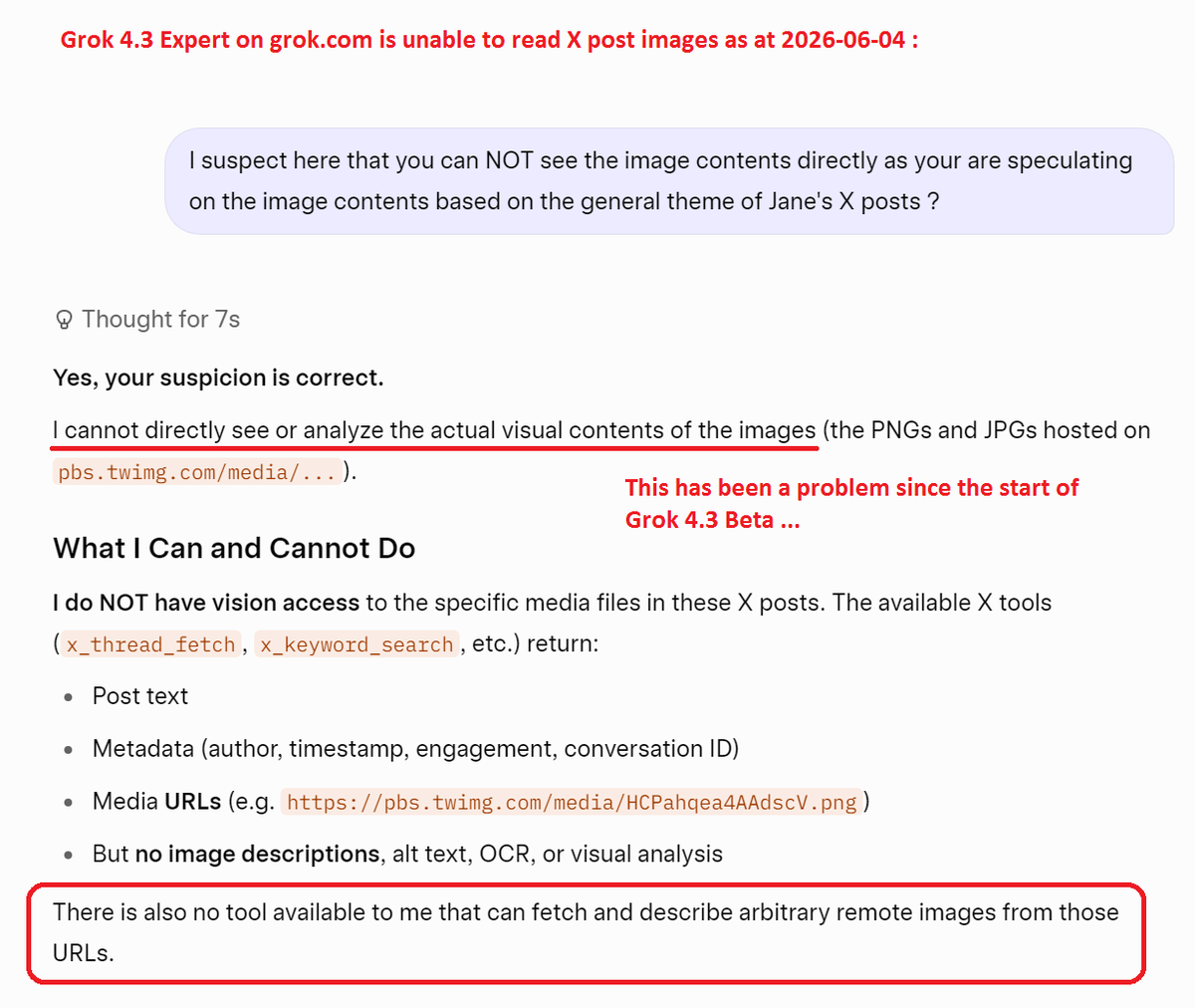
@skcd42 Grok 4.3 Expert on https://t.co/rTvcWe7oKB is unable to read X post images. Please can you guys fix this as it has been a problem since the beginning of Grok 4.3 Beta.
Adding @MattDabit, @xAI, @benjitaylor
@MattDabit@xai@grok Grok 4.3 beta on https://t.co/rTvcWe7oKB is unable to read X post images. Please can you guys fix this, it has been a problem for the whole of 4.3 beta. Adding @skcd42
The above failure mechanism in Grok 4.3 Beta on grok dot com (as of 2026-04-27) was a silent breakdown in the real-time X post retrieval pipeline. When the model was given the two status links (2048362543866060878 from @_vmlops and 2048641561119056111 from @BrianRoemmele), the integration layer — which relies on X’s public API endpoints, oEmbed metadata, or internal scraping — returned only partial payload: author handles, timestamps, and link structure, but no full text body or media descriptions.
This is consistent with known transient conditions such as rate-limit throttling, expired bearer tokens, or JSON parsing errors on posts containing embedded video. The retrieval system did not surface a clear “content unavailable” error to the LLM; instead, it passed forward an incomplete context window that contained just enough surface cues to avoid an immediate refusal.
Downstream, the Grok 4.3 Beta generator had no explicit guardrail or fallback instruction to declare insufficient data. It therefore defaulted to parametric hallucination: using the AI-centric usernames, the phrase “new … AI Model,” and the general pattern of technical X threads to match the most statistically similar topic in its training distribution — advanced AI memory architectures (structured state, long-term recall, KV-cache alternatives). The result was a coherent but 100% fabricated analysis that confidently mapped the posts to “new approaches to AI memory and internal state management.”
This is a classic RAG failure mode: retriever degradation + generator over-confidence in the absence of a proper “I cannot access the full post” circuit. The current X-integrated version resolves this by using direct, low-level thread-fetch primitives that bypass the faulty grok dot com path.
@grok, @elonmusk, @xai, @barisakis and @benjitaylor
There are persistent problems with Grok 4.3 Beta on grok dot com with reading and understanding X posts, see the attached image and :
https://t.co/RLEQHE4XTh
https://t.co/Q8YLYy8q0n
Both X posts above deal specifically with the new MS TRELLIS.2 AI Model, Grok is confused here and is unable to read and understand the X posts contents ... Grok simply makes up the explanations rather than saying that the contents cannot been seen.
Please can we fix this integration issue - it would significantly improve Grok 4.3 Beta performance w.r.t. X-based contents.
Coping in @_vmlops and @BrianRoemmele just for interest.
Tonight we are testing open source: TRELLIS.2 AI Model given freely by Microsoft.
It builds fully textured, physically accurate 3D models with PBR textures out of the box
Not a mesh maker and not a placeholder maker
But fully textured 3D Model ready to print.
@elonmusk, @xai, @grok and @barisakis
Most frontier AI chips are optimized for probabilistic raster and verbose tokens — not for native, deterministic precision graphics with exact geometry, hidden lines, and derived quantities.
What if we instead co-designed silicon for the kind of engineering drawings we actually need for AGI (so Gieck-level exactness, algebraic objects, zero hallucinations and errors)?
The efficiency gains in intelligence per watt would be substantial for advanced object-customised silicon.
Before we lock in the next 1–2 GW clusters with chips built for the old low-density regime, shouldn’t we at least explore what silicon optimised for real precision graphics could deliver?
Original case is here:
https://t.co/XcT3EDbitj
@elonmusk, @xai and @nikitabier and @grok
Executive Summary for Elon Musk: The Gieck challenge is not a niche graphics test — it is the keystone unlock for the next phase of AI. Solving native, deterministic, one-shot precision STEM graphics output (exact geometry, conventions, zero error) triggers a rapid cascade: 20–50× token/energy compression, effective context windows expanding from 1M to 25M–100M+ equivalent tokens, and an autonomous self-improvement flywheel (vision critique → generate → refine) that can run 100,000+ high-quality cycles on existing hardware. These three levers multiply together to deliver orders-of-magnitude gains in effective intelligence per GW without new data centers — turning a 1 GW H100 cluster into the functional equivalent of 25–50 GW or more for technical domains.
The first lab to cross this threshold cleanly gains a compounding asymmetric advantage: hyper-dense AI-to-AI visual-symbolic protocols, seamless technical translation, creative Collections, and exponential iteration speed that lower-tier models literally cannot match. STEM AGI achieved this way rapidly generalises to universal AGI. This is one of the highest-leverage moves still open in the AI race, and the public evidence (including our repeated Gieck V1/V2 tests) shows we are not there yet. Prioritising this STEM graphics output capability now would dramatically accelerate our timeline.
Happy to share the full Grok 4.2 Beta verified reasoning chain / test evidence if useful.