We’ve added 100s of new smart money wallets, categorized by strategy and edge:
- Trading bots
- Bonding Soon Whales
- High Win Rate Wizards
- Hyped High Volume Market Makers
- Manual Movers
- Wall Street Wizards,
- Insiders, Sports, Politics, Weather, etc
Copy trade any of them in one click.
everyone is salivating over spacex's s1
while 99% would benefit more from reading bending spoon's f-1
their path is more reproducible and less circumstantial
10 point tldr on what actually happened
1. On March 31, Google Quantum AI published a 10x improvement to Shor's algorithm for elliptic curve crypto, demoed on secp256k1 (the curve behind Bitcoin/Ethereum signatures).
2. The optimizations were withheld and locked behind a zero-knowledge proof that demonstrates the improvement exists without revealing it. Google cited engagement with the US government. First known case of ZK-enforced academic censorship.
3. Streisand effect kicked in. French researcher André Schrottenloher independently rederived the main secret optimization two months later in "Optimized Point Addition Circuits for Elliptic Curve Discrete Logarithms."
4. Craig Gidney revealed he'd sat on the same optimization for a year under censorship pressure.
5. André missed several minor optimizations, suggesting more headroom remains in the circuit.
6. The https://t.co/VZ7limszeA challenge weaponizes the ZK verifier as an automated submission filter and reward function. It broke a Shor world record within hours and currently shows an 8.4% improvement over Google's circuit (measured as logical qubit count × Toffoli gate count).
7. AI autoresearch (Karpathy-style) lowered the barrier so far that amateurs, including a teenager, are landing valid optimizations.
8. Same day, neutral-atom startup Oratomic claimed just 10K physical qubits suffice to run Shor on secp256k1. The tech checks out btw. Google has now started its own neutral atom lab, pivoting from pure superconducting focus.
9. Neither paper gives qday timelines. Filling the gap: author puts qday-by-2032 at 50%, by-2030 at 10%. The US government's 2035 deadline (NSA→NIST) looks badly behind and will likely get pulled forward.
10. Migration target proposed for 2029 (aligned with Google, Cloudflare, Ethereum Foundation). The Ethereum path replaces BLS, KZG, and ECDSA with hash-based crypto via leanVM.
Two $1M bounties open:
- the Proximity Prize
- the Poseidon Initiative
Reminder: TradeFox will no longer be active after June 1.
Please sell all positions, withdraw funds, and export your wallet from the Portfolio page.
We've added a Sell All button to make this easy.
We've also included instructions if you'd prefer to sell manually using your Polymarket API keys.
After June 1, you'll still be able to export your wallet at https://t.co/Z4dsRNjg5w
the reason evals can’t distinguish between frontier models is the same reason a 100 iq person can’t reliably tell a 140 iq physicist from a 160 iq physicist.
you need to be within one standard deviation of the frontier to measure it.
the models outstripped us in december and the benchmark's just the last instrument still polite enough not to mention it.
LLMs are changing who starts companies, but not in the way you think.
The obvious effect is people with less technical backgrounds can build software more easily.
The more interesting effect is they’re pulling in people who were kept out by opportunity cost.
Previously, my smart friends in banking, PE, hedge funds, and VC would have startup ideas, talk about them, maybe sketch them out, but rarely test them.
Now a surprising number have side projects with real users and revenue because the threshold to try something has fallen so much.
That seems like a much bigger deal than people realize
Coase's Theorem and Jevon's Paradox in an AGI world
Two laws are colliding in the labor market right now: Jevons' Paradox and Coase's Theorem.
Everyone keeps debating the surface-level question, "will AI replace engineers?", and missing the actual structural shift underneath.
Jevon: when you make a resource cheaper, total consumption goes up, not down. Cheaper coal means more coal burned. Cheaper light means more light consumed. Cheaper code means more code written.
Coase: firms exist because transaction costs make it cheaper to coordinate inside a company than across a market. Lower those costs and firms shrink. AI is a transaction-cost solvent. Contracts, coordination, documentation, code review, translation, legal review, all the connective tissue that made the big firm necessary, is collapsing in cost.
Stack them together and you get three predictions:
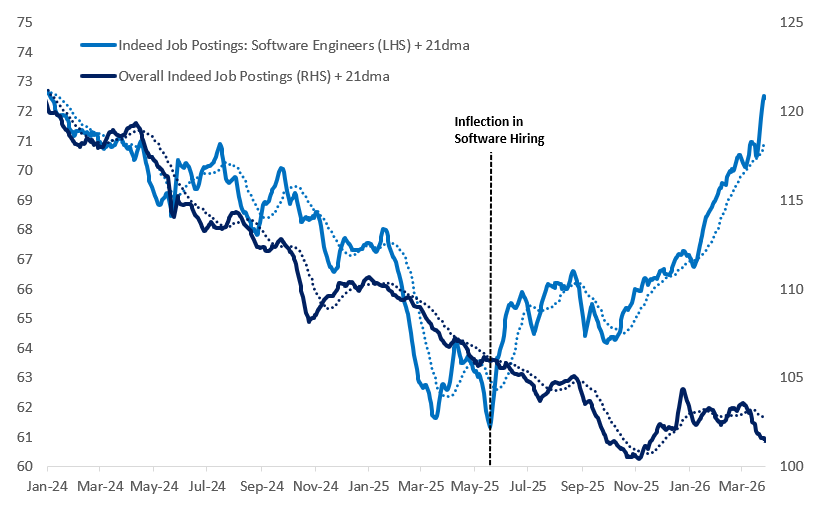
1. Total number of SWEs: increases
2. Total number of companies: increases
3. Employees per company: decreases
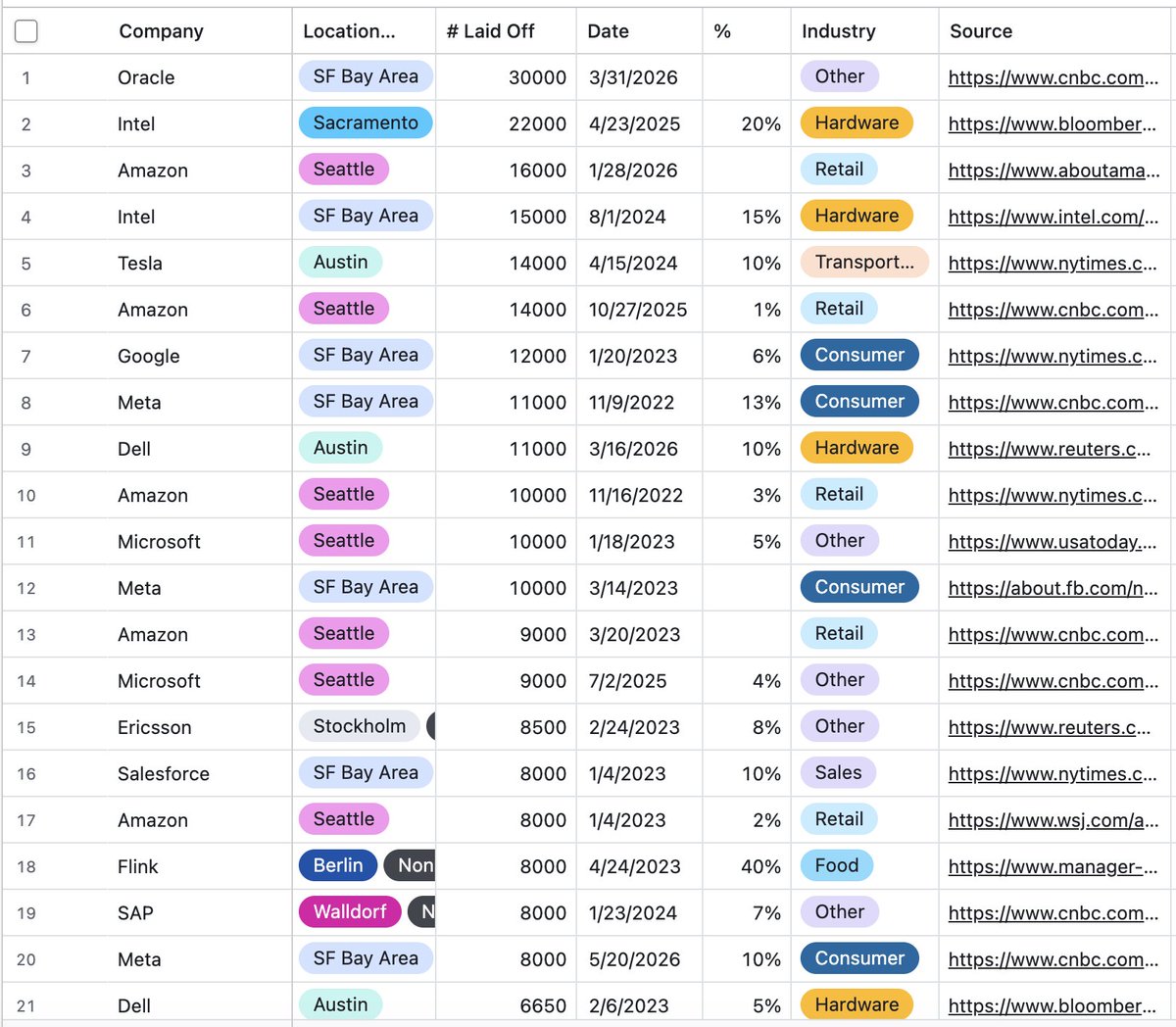
This is exactly what we're seeing. Big tech is laying off engineers by the tens of thousands. Small companies, one-person companies, and zero-person companies, are scrambling to hire them. The headlines look contradictory. They aren't. They're the same phenomenon viewed from two ends of the distribution.
The 10,000-person engineering org was a Coasean artifact. It existed because coordinating 10,000 humans inside one firm was cheaper than contracting 10,000 firms. Not anymore. AI is forcefully refactoring the org chart in real time.
Expect more engineers, in more companies, at smaller headcounts. The median software company of 2030 will look less like Google and more like a guild: three people, twelve AI agents, one product, global reach.
In the next post, I'll cover AGI's interaction with Baumol's cost disease.
Hit the follow button so you don't miss it.
Seems like $SPCX is trading at a notable premium on implied valuation ($2.5T area) compared to current secondary markets ($1.5T) valuation of @SpaceX.
Is this momentum on launch day or have @HyperliquidX and @tradexyz traders uncovered something?
Moravec's Paradox from 1980 explains exactly what Griffin is watching unfold.
Roboticist Hans Moravec asserted that what is hard for humans is easy for machines, and what is easy for humans is hard for machines.
So, the skills we treat as elite, like abstract reasoning, financial modeling, and legal analysis, are evolutionarily recent. They sit on the surface of human cognition. Machines learn them in months.
But the skills we treat as ordinary, like walking across a cluttered room, folding a towel, or knowing when something is "off" with a patient, rest on billions of years of sensorimotor evolution. They are so deeply wired into us we do not even register them as intelligence. Machines have wrestled with them for forty-five years and counting.
Griffin's seven-figure analysts are being automated before his office cleaners. Moravec called this in 1980. We are simply watching the timeline arrive.
White-collar work commanded a premium because that kind of thinking was rare among humans. Once machines can do it cheaply, the premium goes with it.
Plan accordingly.
If your ai bills are creeping into five or six figures a month, keep reading.
I'll cover:
1. what's driving the increase in token costs
2. six techniques to reduce burn
3. metrics to track cost relative to output
SWE is becoming compute allocation. Moving from Cursor to Claude Code or Codex is not enough.
Here are a few things that actually move the number.
1. Prompt caching is the biggest lever. Cached input tokens are 90% cheaper. For agent loops, your system prompt and repo map stay stable across dozens of turns. If your cache hit rate is below 70%, you're lighting money on fire.
2. Context size is the cost function. A hard task in a small context is cheap. A trivial rename across a 200k token repo dump is expensive. This is why naive RAG often beats stuffing the whole monorepo in. You need to do real context curation with AST retrieval and symbol-level chunking.
3. Use sub-agents to keep your main context small. Use sub-agents to keep your main context small. When Claude Code spawns a sub-agent for something like running tests, that sub-agent does its work and only sends back the answer. The bloat stays contained. If you run everything in one big loop instead, every tool result piles up in the same context window and costs balloon fast.
4. Recursive review is dangerous. Generate, review, revise, re-review is four passes over overlapping context. If those passes aren't cache hitting, you've paid for the same tokens four times. Review on diffs, not full files.
5. Task wise Tool selection. Cursor wins on tight IDE work like debugging and small edits. Tab completion alone justifies the seat. Claude Code / Codex wins on multi-file features because sub-agents keep context clean.
The arbitrage: Cursor on the $20 plan for bounded iteration, Codex or Claude Code on usage-based for architectural work. Don't pay premium rates for tab completion.
6. Chinese open source models. The weights are fine and you'll save costs. The risk is the inference provider seeing your prompts, which usually contain keys, internal architecture, and things you accidentally pasted. Self-host or use a vetted provider and the math often works for non-frontier workloads.
Metrics to track:
- cache hit rate
- input output token ratio
- tokens per merged PR
- Cost per successful task, not cost per call
if you follow the trend lines:
1. pure software co token spend surpasses employee spend by 2027
2. agency / services firms by 2028
3. SMB back offices by 2029
4. regulated enterprises by 2030
AGI labs generate $1T in annualized revenue by 2031
@CRYPTO_KFA@tradefoxintern@Prithvir12 we let users know that the app will be sunset on may 1st over a month ago. you can still go to https://t.co/nMFk5YZTeZ to export ur wallet.
dm us if you need any help.