This smart Polymarket trader has a PnL of $330k with $225m in volume!
1) Here's his strategy:
- Buy moonshot bets like 'Will Kanye win the elections'. Essentially buying lottery tickets and hoping one hits
- You may be asking, but isnt this just gambling? Well yes, on an individual position basis its a coin toss. But in aggregate, he manages his position sizes very efficiently and is able to ensure diversification of bets
- This leads to almost VC-esque returns where most bets are expected to go to 0 but the few that hit do a 100x
- Very risky strategy IMO but has worked for this trader
2) Here's how you can copy trade him in 20 seconds using @tradefoxai:
- Paste his wallet address in the search bar
- Follow him and then click copy all trades
- Input variables based on your risk tolerance and click 'Copy'
TradeFox will now automatically copy every single trade made by Agriculture Secretary within 3 seconds (Link in comments)
10 point tldr on what actually happened
1. On March 31, Google Quantum AI published a 10x improvement to Shor's algorithm for elliptic curve crypto, demoed on secp256k1 (the curve behind Bitcoin/Ethereum signatures).
2. The optimizations were withheld and locked behind a zero-knowledge proof that demonstrates the improvement exists without revealing it. Google cited engagement with the US government. First known case of ZK-enforced academic censorship.
3. Streisand effect kicked in. French researcher André Schrottenloher independently rederived the main secret optimization two months later in "Optimized Point Addition Circuits for Elliptic Curve Discrete Logarithms."
4. Craig Gidney revealed he'd sat on the same optimization for a year under censorship pressure.
5. André missed several minor optimizations, suggesting more headroom remains in the circuit.
6. The https://t.co/VZ7limszeA challenge weaponizes the ZK verifier as an automated submission filter and reward function. It broke a Shor world record within hours and currently shows an 8.4% improvement over Google's circuit (measured as logical qubit count × Toffoli gate count).
7. AI autoresearch (Karpathy-style) lowered the barrier so far that amateurs, including a teenager, are landing valid optimizations.
8. Same day, neutral-atom startup Oratomic claimed just 10K physical qubits suffice to run Shor on secp256k1. The tech checks out btw. Google has now started its own neutral atom lab, pivoting from pure superconducting focus.
9. Neither paper gives qday timelines. Filling the gap: author puts qday-by-2032 at 50%, by-2030 at 10%. The US government's 2035 deadline (NSA→NIST) looks badly behind and will likely get pulled forward.
10. Migration target proposed for 2029 (aligned with Google, Cloudflare, Ethereum Foundation). The Ethereum path replaces BLS, KZG, and ECDSA with hash-based crypto via leanVM.
Two $1M bounties open:
- the Proximity Prize
- the Poseidon Initiative
the reason evals can’t distinguish between frontier models is the same reason a 100 iq person can’t reliably tell a 140 iq physicist from a 160 iq physicist.
you need to be within one standard deviation of the frontier to measure it.
the models outstripped us in december and the benchmark's just the last instrument still polite enough not to mention it.
LLMs are changing who starts companies, but not in the way you think.
The obvious effect is people with less technical backgrounds can build software more easily.
The more interesting effect is they’re pulling in people who were kept out by opportunity cost.
Previously, my smart friends in banking, PE, hedge funds, and VC would have startup ideas, talk about them, maybe sketch them out, but rarely test them.
Now a surprising number have side projects with real users and revenue because the threshold to try something has fallen so much.
That seems like a much bigger deal than people realize
I spent I spent the last 3 years trying to instill the lessons from this book into every designer and engineer I’ve been fortunate enough to work with.
Now it's been rendered into a single claude markdown file.
Incredible.
The global semiconductor supply chain is far more interconnected than you realize
Comment 'me' to get access to this entire research dashboard on the global semiconductor industry
The global semiconductor supply chain is far more interconnected than you realize
Comment 'me' to get access to this entire research dashboard on the global semiconductor industry
Seems like $SPCX is trading at a notable premium on implied valuation ($2.5T area) compared to current secondary markets ($1.5T) valuation of @SpaceX.
Is this momentum on launch day or have @HyperliquidX and @tradexyz traders uncovered something?
Moravec's Paradox from 1980 explains exactly what Griffin is watching unfold.
Roboticist Hans Moravec asserted that what is hard for humans is easy for machines, and what is easy for humans is hard for machines.
So, the skills we treat as elite, like abstract reasoning, financial modeling, and legal analysis, are evolutionarily recent. They sit on the surface of human cognition. Machines learn them in months.
But the skills we treat as ordinary, like walking across a cluttered room, folding a towel, or knowing when something is "off" with a patient, rest on billions of years of sensorimotor evolution. They are so deeply wired into us we do not even register them as intelligence. Machines have wrestled with them for forty-five years and counting.
Griffin's seven-figure analysts are being automated before his office cleaners. Moravec called this in 1980. We are simply watching the timeline arrive.
White-collar work commanded a premium because that kind of thinking was rare among humans. Once machines can do it cheaply, the premium goes with it.
Plan accordingly.
Rome looked hopeless against Carthage in 260BC.
Carthage had the wealth, fleet, trade networks, and technology.
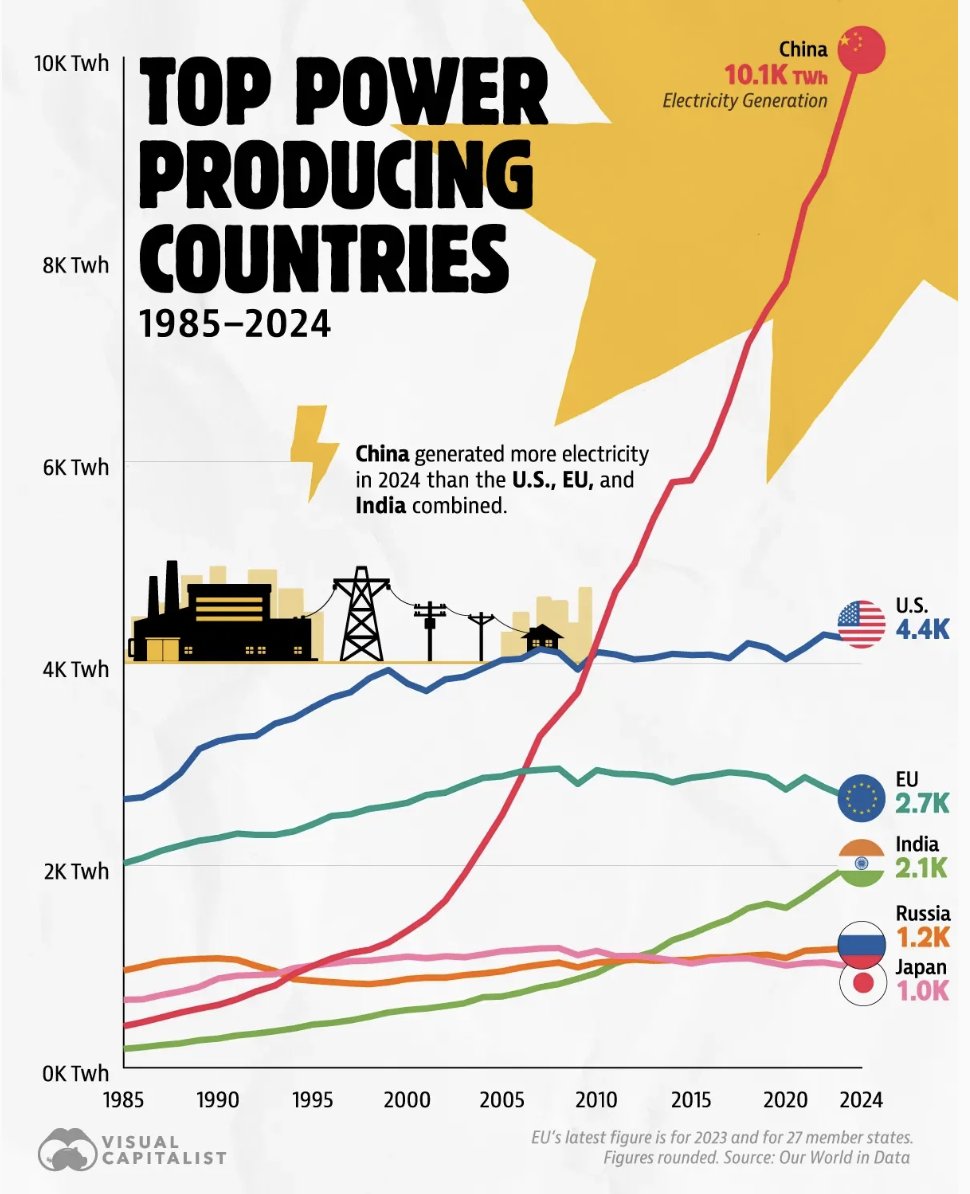
Today, China is leading on electricity generation, trade networks, and purchasing power parity.
Sicily was the flashpoint then.
Taiwan is today.
How do we avoid the Thucydides trap?
if you follow the trend lines:
1. pure software co token spend surpasses employee spend by 2027
2. agency / services firms by 2028
3. SMB back offices by 2029
4. regulated enterprises by 2030
AGI labs generate $1T in annualized revenue by 2031
mallaby delivers again
the infinity machine is hard to put down
sounds banal but the single most important factor in any moonshot is talent density of the founding team
and building it is entropic, non-linear, artistic, scientific, and fortuitous