At TIG, we always knew we’d make some surprising allies as we pursue our mission.
The Pope, however, was not on our 2026 bingo card.
During the first encyclical of his tenure, @pontifex was clear: algorithms must henceforth be included in the basket of ‘goods that are universally intended for everyone’.
Today at 5PM BST, tune in to hear @Dr_JohnFletcher and @0x_Asuka discuss how TIG ensures that frontier technologies will remain accessible to all.
See you there!
The next GRASS Token Holder and Network Participant Call will take place on July 7. The call will provide an overview of Grass network progress, the development roadmap, business milestones, growth highlights, and more.
To promote equal access to information, the call will be open to the public. Questions may be submitted in advance for consideration during the session.
Further details, including the exact time and registration information, will be shared soon.
Another great discussion from @haitzu with $TIG founder @Dr_JohnFletcher
45 minutes of your time and you'll understand why $TIG is a multi billion dollar protocol in the making
👉 https://t.co/u3SNqDrW0H
Tokenised algorithms 🔥🖊️
$TIG
The "Honest Token" Angle
Max supply: 130M $TIG. Circulating today: ~29M.
Emission is tied to actual algorithmic output — not arbitrary schedules or team unlocks.
The more genuine breakthroughs the protocol produces, the more valuable those emissions become.
There's a fee to submit (10 TIG for code, 250 TIG for a breakthrough claim), which burns spam and keeps the innovation bar real.
This isn't a token that inflates to pay influencers. The game theory is: be useful, get rewarded, stay open.
Every algorithm ever produced on TIG lives in a public GitHub repo. Permanently.
The team held off on a token for years while they built the actual infrastructure.
That's unusual.
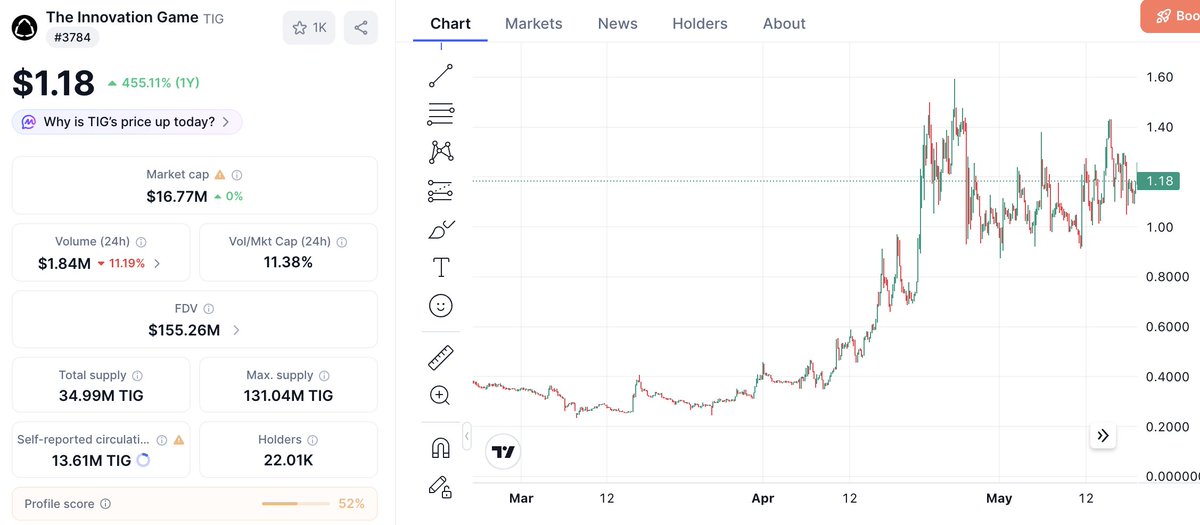
And it's why the chart going from under $1 to over $5 ATH in its first year isn't just speculation — there's something underneath it.
$tig
A couple of points on the recent OpenAI math result and why TIG is built for exactly this.
First of all, this is a genuinely impressive result. It's a longstanding famous problem and many mathematicians are impressed with it.
Where TIG comes in is the difference in how its algorithm challenges are verified vs how proofs like the one from OpenAI are verified.
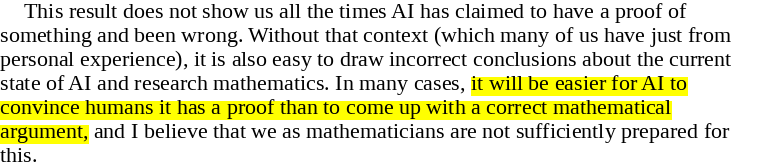
The AI did the proof with over 125 pages in its chain of thought.
BUT
It took nine mathematicians multiple weeks to verify it actually worked.
The raw output required polishing (missing definitions, scrambled logic) and ultimately needed a human-edited, reorganised, clearer version as the final proof.
So the AI produced something but humans had to do all the heavy lifting to figure out if it was real.
That is the whole problem with AI doing maths.
Generating gets faster, verifying stays slow and expensive.
One of the nine mathematicians flagged this directly, worried that even experts will struggle to verify future proofs.
TIG sidesteps this entirely.
The problems on TIG are asymmetric.
Hard to solve, trivial to verify.
If an algorithm is better (eg runs quicker), it does not matter at all what the contents of the algorithm are.
You run it.
It either works or it doesn’t.
If it works, you can tell immediately if it was better.
No expertise needed.
This is what the miners (benchmarkers) in the TIG network do.
When an algorithm is submitted, benchmarkers run and then adopt the best one.
So with the increase in AI x Maths, TIG works not only on challenges of economic importance, but on the exact shape of problem where AI-generated work can actually be trusted at scale.
This is a big reason why $TIG @tigfoundation is such a high conviction play for me.
It’s the only way you can invest directly in algorithms in addition to being the most efficient means available for improving them. 20% of the TIG challenges that’re live so far have produced state-of-the-art algos.
It doesn’t matter what @base, KOLs, and retail participants think, do, or say- $TIG will reach a multi-billion dollar valuation with or without them since 100% of revenue gets TWAP’d into the token.
The savvy of you will have noticed Leopold Aschenbrenner just filed his 'Situational Awareness LP' Q1 2026 13F, showing a multi-billion dollar put position against AI hardware
Why? Moore's law seems to be hitting a ceiling; there may be fundamental limitations for physical hardware advancements
Algorithmic improvements offer an alternative avenue to explore in order to make greater advancements in AI capabilities
@tigfoundation (TIG) is a decentralized protocol that uses proof-of-work as a coordination mechanism for algorithmic research & development
Take the philosophy of Bittensor’s incentives mechanism, but apply it specifically for algorithms
The thesis is that algorithms are the most undervalued & most monopoly-prone layer of the AI stack
TIG is building the open-source alternative to what Google DeepMind could otherwise own outright
@Dr_JohnFletcher has been researching this area for over a decade; four of them created TIG with the protocol having been live for two years
The next major catalyst will come from the commercial model being proven; when that happens the repricing will be violent
We are at the stage in the cycle where there are AI tokens with viable products that solve real world problems
I'm an avid believer that crypto enables AI; strong incentive mechanisms for the brightest minds to participate, or allowing vast amounts of capital to be transferred globally
Those paying attention to the teams innovating with these novel concepts could find themselves at the beginning of an asymmetric bet
This podcast is worth a watch, also subscribe to my free newsletter (link in bio) where I’ll cover several other promising opportunities emerging
Open source built Linux on volunteer time.
AI can't be built that way because the machines cost real money.
@Dr_JohnFletcher on why open source AI needs a way to capture value, and why TIG was built to do it.
The $TIG thesis is that algorithms are the most undervalued and most monopoly-prone layer of the AI stack, and TIG is building the open-source alternative to what Google DeepMind / Anthropic / Open AI could otherwise own outright
- innovators submit optimised algos
- benchmarkets test algos vs. test cases
- TIG manages license rights to these algos
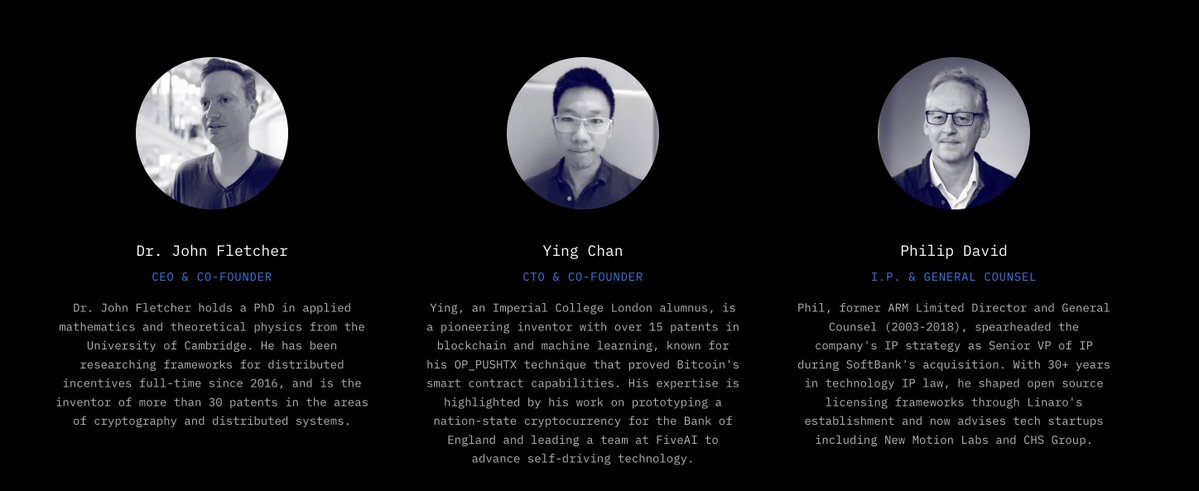
Critical to this endeavour is Philip David
Who spent a decade at ARM, who licensed their chip design to companies like Apple, Qualcomm, Samsung etc
But let's be clear:
their commercial model is not yet empirically proven
Licensing revenue is the long-term engine, but the network is still in its build phase and trades as such
1. TIG has assembled fascinating token architecture
2. Run by a Class A team
3. Tackling one of the defining problems of our time
Available in the public markets
Yeah $TIG is flying under the radar
An open protocol for algorithm development
listening to John explain how algorithms can optimise & help you extract maximum utility from any given chip
DeepMind, OpenAI, Anthropic, they're all racing to own the algorithmic layer
if they win, you pay a tax on every optimized query, every solved route, every compressed model
Over the last 50 years, we focused on hardware
The fight was between Intel, ASML, TSMC: who could etch circuits smallest and cheapest at scale?
many years ago we realised Moore's law seemed to be hitting a ceiling, that there may be fundamental limitations of physics
as such, the focus changed to how we could extract maximum utility from the hardware
the fight will be for the most optimised software
I spoke with @Dr_JohnFletcher to discuss the TIG mission
Full ep on our youtube
00:00 Intro
00:26 Primer on $TIG
02:18 Cambridge, ARM and the TIG Team
06:33 Why open source?
15:21 Why challenges for algorithms
20:00 Role of IP licensing
23:29 Defending Against Algorithmic Monopolies
27:40 Monetisation
28:40 Use Cases
36:23 Power Struggle vs AI Labs
39:12 Freedom Ideology
It was an absolute pleasure chatting with @haitzu
I really appreciate how he's clearly done his research on $TIG and his genuine curiosity around the issue $TIG addresses..
Full interview here https://t.co/aWnvq29ndu
TIG is NOT another speculative AI project — it is a direct, engineered solution to the biggest structural threat facing open technological progress in the AI era.
By fixing the economic layer (how discoverers actually get paid without closing their work), TIG turns what used to be an unfundable public good into a sustainably funded, competitive, open marketplace.
If it works at scale — and the early technical results suggest it can — it becomes the default place where the world’s best new algorithms are discovered, tested, and rewarded.
For holders, this means the token has a built-in, growing use case tied to real value creation: every time a company or researcher wants top-tier open algorithms (in AI, logistics, medicine, science, etc.), they need TIG to participate in or license from the network.
In short, TIG is positioned as infrastructure for the next wave of algorithmic breakthroughs — the layer that matters more than raw compute, according to leaders like Jensen Huang (NVIDIA).
If it succeeds in keeping frontier algorithms open while funding them properly, the token captures a good slice of that enormous, compounding value.
In conclusion, it pays to be early to $TIG!
Reminder.. $TIG is still a sub $50m valuation
Now.. go look at all the recent news, developments and AMAs around @tigfoundation
Next.. take the time to understand the total addressable market for algorithmic breakthroughs.. optimisation.. efficiency.. routing.. scheduling.. AI.. logistics.. research..
Basically every system on earth that gets better when the underlying algorithm improves
Then.. come back to the current $TIG valuation
You're welcome 🍻
$TIG