@danicamckellar 12:30, Fred Savage: "May your wishes all come true. May you build a ladder to the stars. And climb on every rung. May you stay forever young." 🎙️📺📸🎶🎼🎵
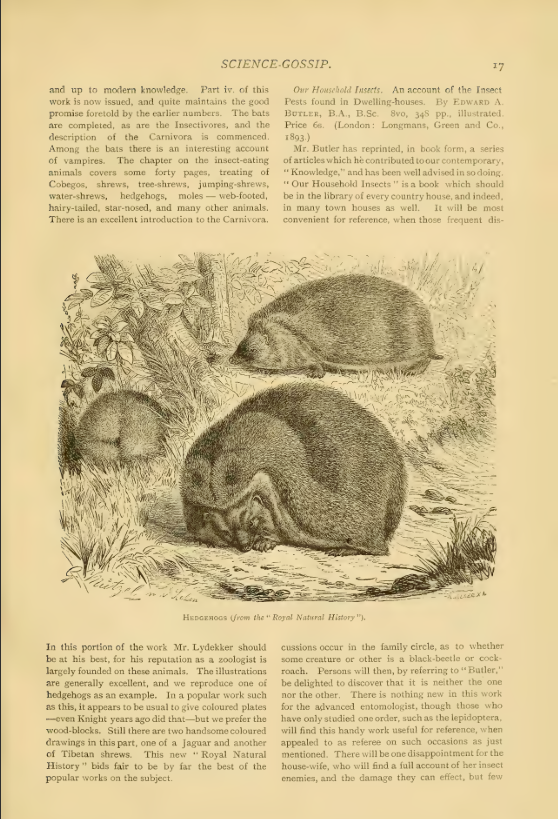
In the meantime, I will be away, for those with a love for discolored pages and "wildlife at our doorsteps": here is an archive of a science magazine from the 1890s, now held by the American Museum of Natural History.
https://t.co/qmGJ2mcoAi
The coast redwoods of California live in a narrow band of Pacific coast fog. The fog is not incidental to their biology. It is their water supply.
During the dry California summer, when months pass without rain, the coastal fog rolls in from the Pacific each morning. The redwoods' needles condense the fog droplets, which run down the needles and drip to the ground. Research in coast redwood forests has measured fog drip contributions of 250 centimeters per year at some sites, on top of about 140 centimeters of winter rainfall. In the driest months, fog drip is the only water input.
But the relationship runs in the other direction too. Redwoods transpire enormous quantities of water vapor. A large redwood can transpire 500 liters of water per day through its leaves. In a dense stand, this collective transpiration adds moisture to the coastal air, increasing fog formation. The trees do not simply receive the fog. They help create it.
What this means: in a redwood forest, the forest makes some of its own weather. Remove the trees, and the fog dynamics change. Degraded redwood forests are drier not just because there is less canopy to intercept fog, but because there are fewer trees transpiring the moisture that becomes the fog in the first place. The cause and the effect are the same system.
This is a pattern that appears across several forest types: the Amazon's "flying rivers," the cloud forests of Central America, the eucalyptus forests of Ethiopia. Dense native forests modify the climate at the local scale. That modification is part of what makes them resilient. It is also part of what makes replacement difficult: a young replanted forest doesn't yet have enough mass to run these feedbacks.
#forestfacts #nature #science
Glimpse of River Usk's ecology at the Riverfront Theatre & Arts Centre in Newport, Wales. What a day, with a myriad of estuarine issues, passionately playing out
A "brownfield rainforest" and wild habitat for endangered species, in a formerly industrial site along the Thames estuary — an accident? Or forces of Lovelock's Gaia?
https://t.co/wIMOvcdP78
@danicamckellar@GAfamilyTV@PureFlix@billabbottHC@Gleb_Savchenko Ok, I'll explain what I meant🙂First, Russell participates in gardening despite the suit. Then, helps out in the competition despite being an amateur. In the end, tells Christine to team up with Ivanov because of the sprained foot 🍁
South San Fransisco Bay marsh hundreds of years ago, with flocks of greater white-fronted elk, tule elk, various sandpipers and a coyote. Oil on primed illustrationboard, 2006. #historicalecology
The mesmerising beauty of a "holloway". Holloways are ancient sunken lanes formed over centuries by erosion from traffic and weather, often developing into lush, enclosed natural corridors lined with hedges, trees and undergrowth.
If you're worried about potential food shortages, or about the rising cost of fresh produce, now might be a good time to start growing some of your own vegetables. We suggest 4 easy crops to grow at home (including veg that can be grown in small spaces): https://t.co/11nDxkhlfm