Credibility in L&D comes from consistent delivery, accurate data, proactive updates, and real solutions.
Influence grows when your work is trusted — every cycle, every report, every room.
If you want leaders to support training, speak their language:
• impact
• risk
• metrics
• solutions
Executive communication is clarity + brevity + confidence.
The best Training Supervisors bridge strategy and execution.
They turn vision into systems, KPIs, coaching, and daily discipline.
Great teams succeed because great supervisors align the work.
Strong L&D leaders don’t just run training.
They manage stakeholders, align expectations, and translate learning into business results.
Influence is a core competency — not an optional skill.
Every learner moves through:
1. Unconscious incompetence
2. Conscious incompetence
3. Conscious competence
4.Unconscious competence
When trainers teach to the stage, skill development accelerates and mastery becomes predictable.
The Learning Pyramid is useful as a concept, but the famous retention percentages aren’t research-based.
Its real value: a reminder that active learning always outperforms passive learning.
Design for interaction, not information dumping.
Brinkerhoff’s SCM goes beyond averages by studying two groups: top performers after training and those who gained little.
It reveals what truly drives success, what blocks transfer, and where to invest for maximum impact.
Most training fails not in the classroom but in real-world application.
LTSI identifies the forces that help or block transfer — motivation, supervision, relevance, environment.
If you want real impact, measure the system, not just the learner.
The 70-20-10 Model isn’t about strict percentages — it’s about designing learning ecosystems.
70: experience
20: coaching
10: training
When L&D teams align all three, learning stops being an event and becomes part of daily performance.
Still Available!
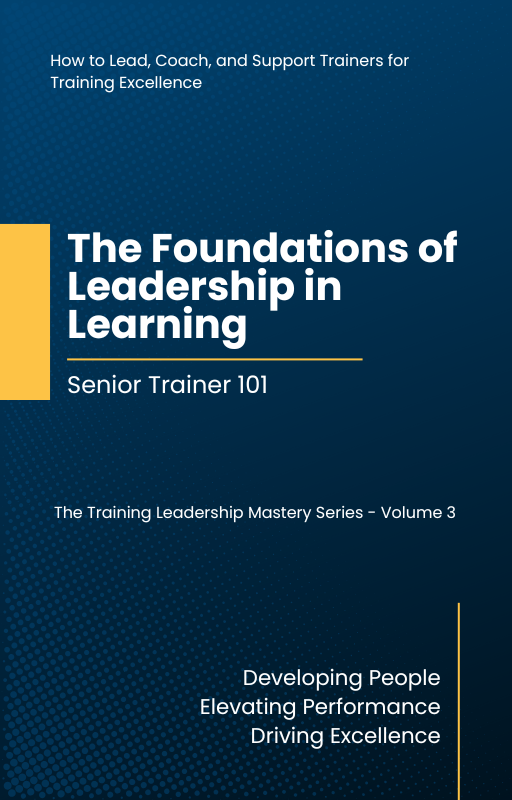
Senior Trainer 101: The Foundations of Leadership in Learning is now available!
For trainers stepping into coaching, mentoring, & standardization roles.
Link: https://t.co/Wo5kUPCEje
#L&D #TrainingLeadership#SeniorTrainer#CorporateTraining
Observation + feedback is where real skill change happens.
Great trainers don’t criticize—they coach with clarity, standards, and action steps.
Training ends.
Development continues.
#Coaching#LearningCulture
Behind every “smooth” training session is a trainer who planned everything: flow, timing, materials, activities, contingencies.
Great training is never accidental—it’s organized.
#CorporateTraining#LDSkills
Communication is a trainer’s most underrated superpower.
It’s more than speaking clearly—it’s simplifying complex ideas, listening actively, and reading the room.
Great communication = great learning outcomes.
#LND#TrainerTips
Great trainers aren’t just good speakers—they’re experts in what they teach.
Technical & SME expertise builds credibility, improves accuracy, and enables real-world examples.
If trainers don’t understand the work deeply, learners won’t either.
#LearningAndDevelopment#Training
The 101 Series: Building the Foundations of Learning Leadership (Part of the Training Leadership Mastery Series)
Every great trainer, leader, and learning professional starts with one thing — a strong foundation.
#TrainingLeadershipMasterySeries
The Training Cycle should be a closed loop. Evaluation data informs new needs, content updates, and delivery improvements. Continuous improvement is what separates mature L&D functions from basic training teams.
Most teams stop after training delivery, but the Training Cycle includes reinforcement. Coaching, microlearning, refreshers, and nesting support are what turn learning into on-the-job performance.
Great trainers don’t just facilitate. They support the entire Training Cycle: needs assessment, design, development, delivery, and evaluation. This is what turns training into business impact.