Christian children praying at their church in Iraq.
In the last 25 years, Iraq’s Assyrian Christian population has fallen from over 2 million to only 100,000. A real genocide.
Even after the horrors of the Islamic State, their faith remains unshaken.
The amazing @lalshareef explains how Israel removed Jews from Gaza in 2005 to get peace, leaving behind greenhouses worth millions of dollars.
The Palestinians looted the greenhouses, and Gaza was turned into a terror fortress.
This must go viral.
During the collapse of the Ottoman Empire, The Young Turks committed genocide and killed:
🪦 1.5 million Armenians
🪦 1.2 million Greeks
🪦 275,000 Assyrians
🪦 200,000 Maronites
Hasan Piker’s uncle Cenk Uygur proudly named his show after their genocide-perpetrating ancestors.
Now they both believe they have the moral authority to accuse others of ‘genocide’ and lecture about ‘human rights.’
Their hypocrisy knows no bounds.
Dialogue you've seen a hundred times, compressed:
"I'm anti-war." — Then you support Ukraine's defense? "No, I mean I'm against fueling the conflict." — So the invaded should stop shooting? "I just think diplomacy—" — With the party that broke every agreement it signed? "Well, both sides—" — Name Ukraine's crime. "…It's complicated."
It's not complicated. It's a home invasion with a UN seat. "Anti-war" that only ever disarms the victim has a proper name: pro-victory — for the invader.
In 2009, Russian opposition leader Boris Nemtsov told Obama: Don’t try to help us. Help Ukraine.
A thriving democracy in Ukraine, he believed, could help bring change to Russia in the long run.
Nemtsov was assassinated in 2015.
From my interview with @KyivIndependent
I was the last person to interview Fedorov & could tell he was holding back. His video the next day backfired because the majority of Ukrainians don’t want elections during the war. People are worried that he’s now flying to America to meet Musk - who also demanded elections.
But the bigger picture isn’t here in Kyiv.
Ukraine’s entire existence is still at risk. Russia is not going to stop unless it’s forced.
Long range strikes are having a crippling effect on its economy. And it’s why the most important person I interviewed this year is actually Robert Brovdi who is spearheading that campaign. He represents the big picture above all of this - a focus on the strategy for Ukraine to defeat Russia and win.
Socialism destroys wealth before it even builds it, because it severs the link between effort and reward at the root.
Consider the Soviet collective farms. When the Bolsheviks forced peasants onto kolkhozy after 1929, grain output collapsed almost immediately. Why would a farmer work sixteen-hour days when the state claims the harvest? He wouldn't. He didn't. Soviet agricultural output remained so depressed that the USSR imported American grain through the 1970s and 1980s, paying in hard currency its own system couldn't generate. The incentive to produce disappears the moment production stops belonging to the producer.
You see this everywhere socialism touches. Venezuela's Chávez nationalized over 1,200 private companies between 1999 and 2012. Output in those sectors didn't rise; it cratered. PDVSA, the state oil company, produced 3.2 million barrels per day in 1998. By 2020 it produced under 400,000. Managers stopped caring because the profit signal, the one mechanism that communicates what people actually want, got switched off.
The incentive problem is only half the indictment. The other half is the destruction of choice.
When the British National Health Service controls your healthcare, you don't negotiate price, quality, or timing. You wait. In August 2026, NHS England carries a waiting list of roughly 7.5 million people. You get what the committee decided you deserve, when they get around to it. A market lets you trade your own resources for the care you value most. A bureaucrat's judgment replaces yours, permanently.
Central planners cannot possess the dispersed, local, constantly changing knowledge that prices carry automatically. Destroying price signals evaporates wealth.
Liev Schreiber: "Lot of people think that I'm involved in Ukraine because I have Ukrainian grandparents, but I'm involved in Ukraine because I'm American, and I think that the cause of democracy is probably clearer here than anywhere else in the world right now, at least to me."
Milton Friedman casually dismantles the “capitalism = greed & exploitation” narrative on national television:
“Tell me, is there some society you know that doesn’t run on greed? You think Russia doesn’t run on greed? You think China doesn’t run on greed?
The world runs on individuals pursuing their separate interests. The great achievements of civilization have not come from government bureaus. Einstein didn’t construct his theory under order from a bureaucrat. Henry Ford didn’t revolutionize the automobile industry that way.
The only cases in which the masses have escaped from the kind of grinding poverty you’re talking about are where they have had capitalism and largely free trade. If you want to know where the masses are worst off, it’s exactly in the kinds of societies that depart from that.
The record of history is absolutely crystal clear that there is no alternative way, so far discovered, of improving the lot of the ordinary people that can hold a candle to the productive activities that are unleashed by free enterprise.”
How Russian propaganda works abroad, in one sentence per layer:
For the right: "Russia defends tradition." For the left: "NATO caused this." For the pacifist: "Weapons prolong war." For the cynic: "Everyone lies equally." For the tired: "It's complicated."
Five contradictory messages, one output: do nothing.
Russian propaganda doesn't need you to love Moscow. It needs you paralyzed — and it has a script for whichever ideology you brought to the table.
Whenever a take ends in "therefore, inaction," check the return address.
‼️MEAGHAN MOBBS: I find myself mourning not only those Ukraine loses, but the West’s capacity to be shocked by their loss. We have grown blind and accustomed to what should remain unbearable.
The West sleeps. Ukraine stays awake - and continues to pay for our long refusal to see the world as it is.
Morning, friends.
I’m alive.
But this night broke something in me.
Kyiv was bombarded from midnight
Until morning - ballistics, Kalibrs, cruise missiles, drones.
Homes, shelters, a children’s clinic, food warehouses were hit.
Many people died.
And even now, at noon, jet shaheds keep coming.
I’m so tired of surviving.
So tired of being a target.
I just want this hell to end.
🇷🇺🇷🇺💩💩Officer Uldarov said that he" cleared " the basement of 300-400 civilians, including 40 of them children. According to him, it was a 9-storey building. The occupier adds that "he had no choice" and that he had orders to clean up everyone.
Uldarov's direct speech: "I carried out the order with this hand, killed the children. You know, on orders. The thing is, we are... we were given the command to erase and destroy everyone. We went to kill everyone – women, men, pensioners and children, including small five – year-olds." According to the Russians, a command came from Prigozhin to clean up Bakhmut. Do not spare anyone – the elderly, children. "Clean them all up." In Soledar, Savichev's direct speech was even worse: "civilians were coming out. And there was an order: everyone who was 15 (years old) and older - to shoot them all at once without words. 20-24 people were shot, including 10 15-year-olds and 17-year-olds."
I will do everything possible to ensure that my grandchildren, great-grandchildren and great-great-grandchildren will always remember who Russians are.
Howard Zinn built his career on a single premise: that American capitalism is a machine designed to crush the poor, and that the state is the only force capable of stopping it.
That premise is backwards.
Zinn's 1980 book "A People's History of the United States" sold over two million copies and became standard reading in universities across the country. It frames every strike, every labor dispute, every economic conflict as a story of workers crushed by capitalist greed. What it never does is trace the actual source of that power back to the state itself.
The railroad barons Zinn despises? They extracted their wealth through federal land grants and government-backed monopoly charters, not through free exchange. The company towns he condemns? They existed because state licensing and zoning locked workers out of alternatives. Every villain in Zinn's story wielded political privilege, not market competition.
Concentrated corporate power requires state protection to survive. Remove the protection, and competitors flood in. Zinn never engaged with that argument, because engaging with it destroys his entire thesis.
You are left with a historian who correctly identifies that ordinary people suffered, then blames the wrong institution. He hands you the problem and then hands you more government as the solution, which is exactly like handing an arsonist the fire hose.
Generations of students absorbed Zinn's framework and walked away believing capitalism causes poverty rather than understanding that political privilege does. That confusion has real costs. It produces voters who demand expansions of the very state apparatus that generated the exploitation Zinn claimed to oppose.
Ukraine. A little boy prays to God. He thanks Him that a Russian Shahed did not fall on him, asks for forgiveness, and asks that Russian Shaheds stop falling on people and that Ukrainians defeat the Russians. He also expresses his sorrow over the war.
Note that even under threat of death, he does not hate those who came to kill him, but simply wants victory to end the war.
The real GOAT.
Ludwig von Mises rebuilt economics from the foundation up, and a comparison to Einstein is not flattery: it is a structural observation about what each man did to his field.
Einstein rewrote physics by showing that measurements of space and time depended on the observer's frame of reference. Mises did something comparably radical in 1912 with The Theory of Money and Credit, then again in 1920 with the socialist calculation paper, and definitively in 1949 with Human Action: he showed that economic calculation is impossible without private property in capital goods, because prices emerge only from voluntary exchange. The Soviet planners in Moscow were not making policy errors you could fix with better data. They were attempting something logically incoherent, the way you cannot find a square root of a color. Stalin murdered millions chasing a mathematical phantom that Mises proved impossible before the Soviet state was even ten years old.
What separates Mises from most geniuses is the range. Einstein worked physics. Mises worked epistemology, monetary theory, capital theory, business cycle theory, and political philosophy simultaneously, weaving them into a single coherent system. His 1922 book Socialism predicted the collapse of every centrally planned economy with the precision of a structural engineer predicting which wall bears load. The Berlin Wall fell in 1989. The Soviet Union dissolved in 1991. The math was settled in 1922.
The state, being an institution that lives by compulsion rather than consent, cannot tolerate this kind of clarity. Governments fund universities. Universities employ economists. Those economists publish papers justifying central banking, redistribution, and regulation, because tenure flows toward conclusions that flatter power. Mises spent years teaching in Vienna without a paid university position, funding himself through the Chamber of Commerce. He was excluded not because he was wrong, but because clarity about power's limits threatens the institutions that distribute tenure.
You want to rank intellectual giants; let's rank them by what they overturned and what they built in its place. Mises overturned classical economics, demolished the theoretical case for socialism, and constructed a complete science of human choice on aprioristic foundations. Einstein, asked about Mises by journalist Henry Hazlitt in the 1940s, expressed genuine admiration. The greatest physicist of the 20th century respected the greatest economist. The tenured mediocrities who ignored Mises respected neither.
A New York Times investigation has exposed the extraordinary scale of Russia’s operations to destabilize Moldova.
GRU-linked operatives allegedly trained pro-Russian Moldovans in Serbia, Bosnia and Moscow, teaching them how to break police lines, provoke unrest and set buildings on fire.
Moscow’s operation went far beyond street violence. Hundreds of Orthodox priests were reportedly paid and recruited to influence voters and spread Kremlin narratives, while vast sums were poured into an industrial-scale vote-buying operation.
Another coordinated Russian operation to subvert a neighboring democracy from within.
Hayek and Keynes met in person, debated in print, and disagreed on nearly everything that matters in economics, and the consequences of that disagreement are still bleeding out of your tax bill today.
The clash crystallized in 1931. Hayek arrived at the London School of Economics from Vienna, the University of London had just given him a visiting position, and his four-part review of Keynes's Treatise on Money appeared in Economica. Keynes fired back. Both men were brilliant, both were prolific, and both understood that they were fighting over something fundamental: whether market prices carry real information, or whether a wise technocrat with a budget deficit can simply override them. Hayek said prices are signals produced by millions of individual decisions that no single mind can replicate. Keynes said the economy is a machine and the state can tune the throttle. One of these positions respects human knowledge. The other assumes the government knows your business better than you do.
The irony Keynes fans never want to confront: Keynes himself, by 1946, was alarmed at where Keynesian policy was heading. He told Henry Clay at the Bank of England that he hoped markets would reassert themselves before his own ideas "did too much damage." He died that April. His followers immediately ignored the warning and spent the next three decades engineering the stagflation of the 1970s, the Nixon wage-price controls of 1971, and the general wreckage that Hayek had predicted with embarrassing precision in 1931.
Hayek won the Nobel in 1974. The prize committee gave it to him alongside Gunnar Myrdal, a committed social democrat, because they lacked the nerve to award a free market thinker alone. Even in Stockholm, the state needs a security blanket.
The deeper issue is moral, not just technical. Every time a government "stimulates" the economy, it does so by extracting resources from producers through taxation or debasing the currency through credit expansion. The state is not a benevolent engineer: it is an institution that compels compliance at gunpoint, then calls the wealth they exctacted "revenue." The pretense of knowledge is not merely an intellectual error, but the philosophical license for coercion. Every stimulus package passed since 2008 proves the lesson is still being refused.
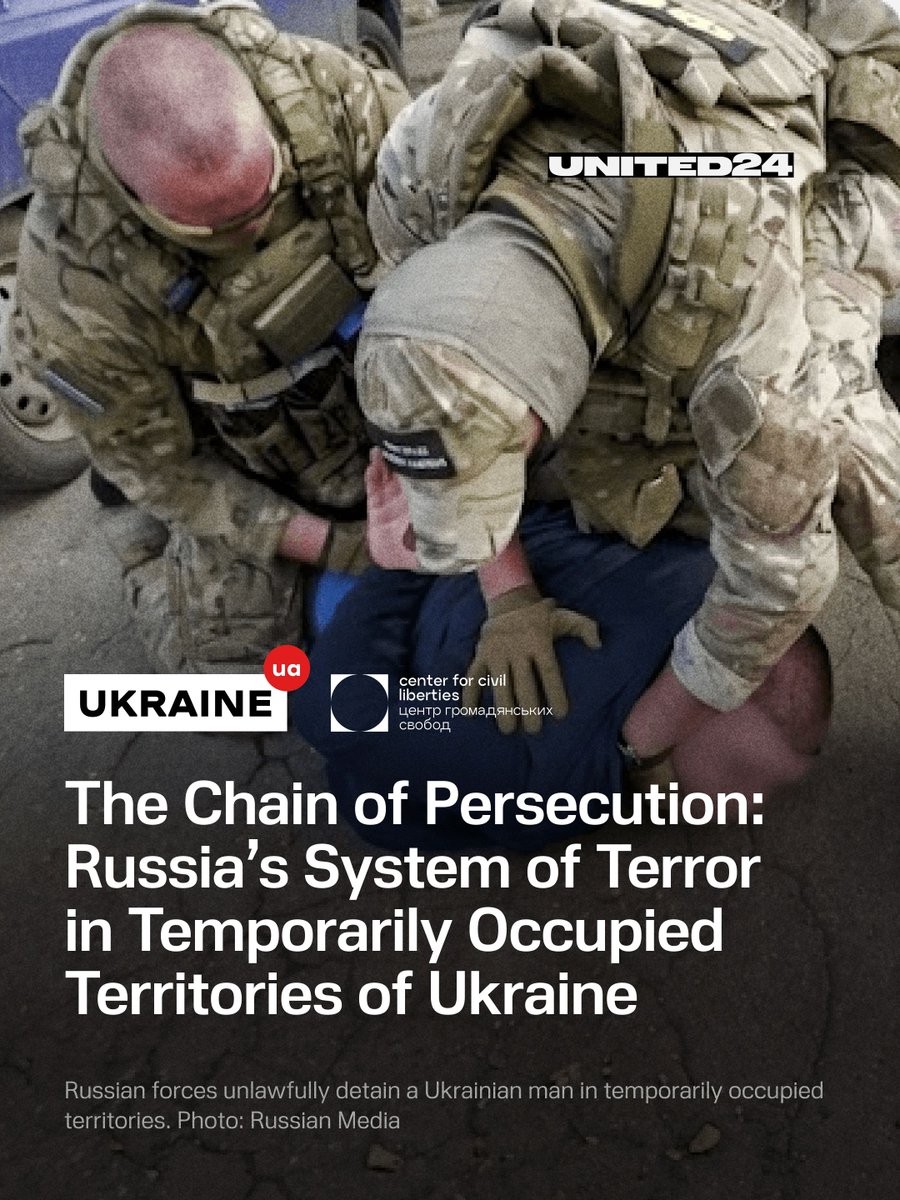
OCCUPATION IS NOT PEACE.
Over 114,000 Ukrainians remain missing as a direct result of a decade-long, systematic campaign of enforced disappearances, torture, and sham trials carried out by Russia. @ccl_ua, @ukraine_ua
🧵 1/9 ⬇️