My submission for the @binance 2026 Builder Contest.
➖ Openclaw portfolio coach "Alpha Hunter"
An autonomous AI agent living in Telegram that actually manages your Binance portfolio, no more staring at charts or missing out on yield.
✅ Risk Audits: Scans your spot wallet and flags high-beta exposure.
✅Alpha Scout: Monitors live Binance Launchpools and runs instant project "vibe checks."
✅ 1-Tap Execution: Stakes your idle BNB directly from the chat using natural language.
🔥 Overall
The real utility? It replaces the clunky exchange GUI with natural language. Just text "Buy $50 of SOL" or "Sweep dust to BNB" and the agent executes it. A universal remote for your crypto.
Built entirely via vibe coding using OpenClaw, Hermes-4-70B, and official Binance AI Skills.
➖ Bot: https://t.co/Or2CmlgEqG
➖GitHub repo: https://t.co/xH5Y2MLdl9
@BinanceLabs@Binance_intern #Binance #BinanceBuild
Just Created a video meme on how Nullshot saved the day for a website due tomorrow
It's not so good because of time management,but I hope I was able to make you laugh and educate you on the importance of nullshot.
Deploying the website soon...get ready to crack ur ribs.
@Nullshot_ai
#NullshotJams
My third art on @DroseraNetwork
Just like the carnivorous drosera plant that catches its prey with precision, drosera Traps act as smart security measures for the blockchain.
The traps are custom-built smart contracts that automatically detect threats and respond instantly, protecting protocols in real time without human intervention.
Drosera provides a decentralized security layer that helps keep your Web3 projects safe from vulnerabilities.
grand rising 🧡
GM and happy new week CT .
Lets dive in to more details about Zama
Fully Homomorphic Encryption is computationally heavier than plaintext execution, and Zama doesn’t hide that reality. Instead, its design focuses on making encrypted computation economically predictable. FHE costs come from ciphertext size, circuit depth, and bootstrapping operations, all of which directly impact gas and latency on-chain.
@zama addresses this by optimizing FHE parameters and encouraging selective encryption. Developers don’t encrypt everything ,only sensitive values like balances, bids, or votes. Public logic remains plaintext, reducing unnecessary cost. Operations such as comparisons, additions, and threshold checks are optimized to run efficiently within FHE constraints.
This hybrid execution model allows protocols to budget privacy. A DeFi app may keep pricing logic public while encrypting user positions, or a DAO may encrypt votes but leave governance rules visible. By treating privacy as a configurable resource rather than a default overhead, Zama turns FHE from an academic ideal into a deployable economic primitive for Web3.
Zama is privacy.
GN CT.
Lets explore Zama’s Key Management & Decryption Model
@zama separates computation from decryption at the protocol level. Smart contracts operate entirely on FHE-encrypted data, meaning validators and execution nodes never access plaintext or private keys. Computation is trustless, but decryption is tightly controlled.
Instead of a single decryption authority, Zama uses distributed key ownership. Decryption rights are enforced through threshold mechanisms, ensuring no single party can reconstruct secrets alone. This removes the classic privacy failure point seen in enclave based or MPC heavy designs.
In practice, this enables secure use cases like private balances, confidential voting, or encrypted AI inference. Contracts compute freely, but only authorized outcomes are revealed , privacy preserved by cryptography, not assumptions.
Believe in Zama .
Happy Sunday CT.
Zama’s security model starts by assuming minimal trust. Validators, sequencers, developers, and even @zama itself are treated as potential adversaries. Instead of relying on honest execution or trusted hardware, Zama’s design enforces confidentiality through cryptography. Fully Homomorphic Encryption ensures that transaction inputs, contract state, and intermediate computations remain encrypted at all times , so even malicious operators cannot access sensitive data.
Key material is protected through decentralized MPC-based key management, where secrets are split across independent operators. No single party can decrypt user data, and collusion requires breaching multiple, isolated actors. Correctness is preserved using cryptographic verification layers, ensuring encrypted execution still produces valid outcomes.
This explicit threat model eliminates entire classes of attacks: data exfiltration, insider misuse, and MEV-driven exploitation. By designing for adversarial conditions rather than trusted assumptions, Zama delivers privacy guarantees that scale across public blockchains where trust is weakest and cryptographic enforcement matters most.
Zama = Privacy.
GN CT
Lets talk about Zama before signing out for the day
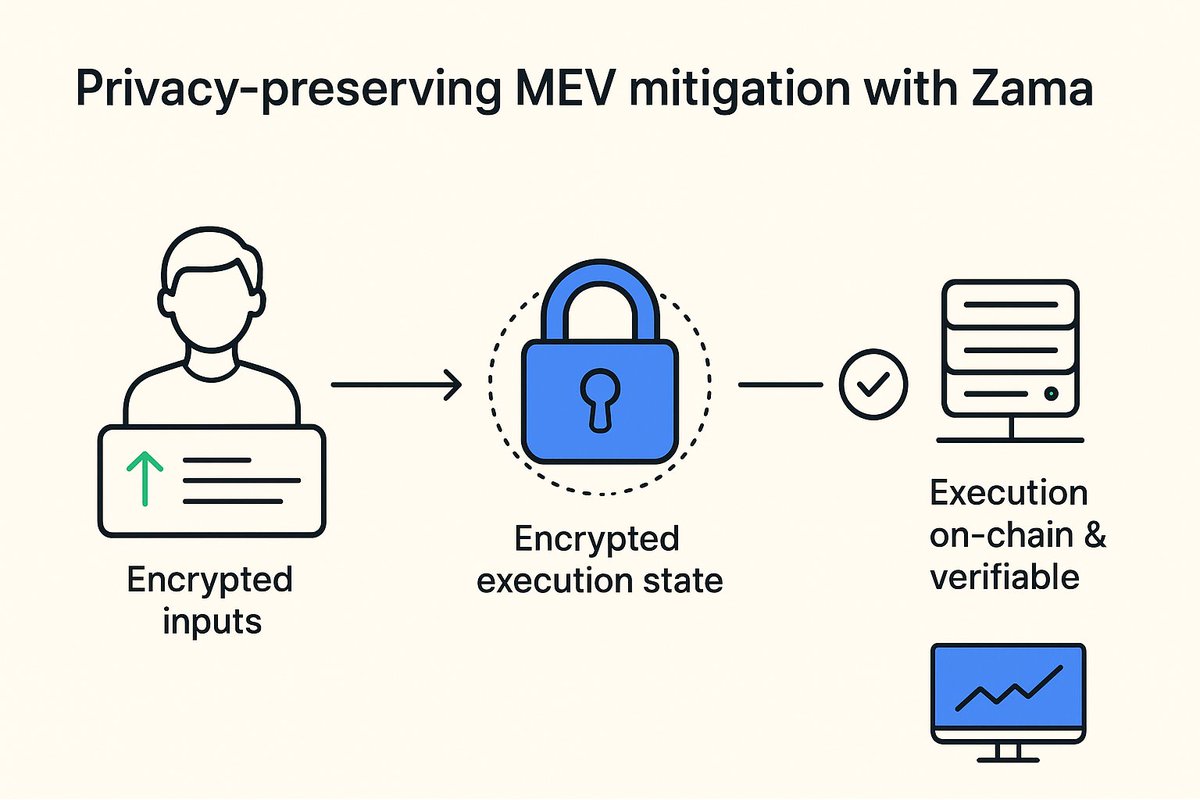
MEV exists because blockchains expose transaction intent before execution. Order size, swap paths, bids, and liquidations are visible in the mempool, allowing searchers to front run, back run, or censor transactions. @zama changes this dynamic by making transaction inputs and execution state encrypted by default using Fully Homomorphic Encryption.
With Zama, validators and sequencers can execute swaps, auctions, and liquidations without seeing amounts, prices, or strategy. AMMs can compute pricing curves on encrypted balances, and lending protocols can evaluate liquidation thresholds without revealing positions. This removes the informational asymmetry that MEV relies on, not by enforcing rules, but by eliminating visibility.
Unlike off chain commit-reveal schemes or trusted relayers, Zama’s approach keeps execution fully onchain and verifiable. Validators prove correctness using cryptographic guarantees rather than transparency. The result is a system where MEV extraction becomes structurally unprofitable, not socially regulated , ushering in fairer markets without sacrificing decentralization or composability.
Believe in Zama .
GM and happy weekend CT.
Most privacy projects in Web3 require developers to abandon the EVM ,either by moving to custom VMs, specialized ZK circuits, or app specific rollups. While these approaches provide privacy, they fragment liquidity, break composability, and dramatically increase development complexity. @zama takes a fundamentally different path with fhEVM, an EVM compatible execution environment where smart contracts operate on encrypted data without changing the underlying programming model.
With fhEVM, developers continue using Solidity and standard tooling while variables become encrypted types handled natively at runtime. This allows private logic such as encrypted balances, hidden bids, or confidential identity checks to coexist with existing DeFi protocols and infrastructure. No separate privacy chain, no trusted hardware, and no custom language.
By preserving full EVM compatibility while embedding Fully Homomorphic Encryption at the execution layer, Zama delivers privacy without ecosystem fragmentation. This makes fhEVM uniquely positioned to bring confidential computation to existing L1s and L2s where users, liquidity, and developers already live.
Believe in Zama.
GN CT
Zama is turning encrypted AI from a theoretical concept into something you can actually run in production. The breakthrough comes from end to end Fully Homomorphic Encryption (FHE) inference, where models operate directly on ciphertexts with no decryption at any stage. Zama’s TFHE stack accelerates programmable gates, supports multi-bit packing, and delivers sub second bootstrapping , the core barrier that made FHE too slow for real AI workloads.
With optimizations like programmable Boolean circuits, efficient key switching, and ciphertext batching, @zama enables neural networks, scoring models, and decision trees to execute while staying fully encrypted. The system supports operations such as comparisons, activations, and conditional logic , tasks that ZK and MPC struggle with for real time inference. This makes private recommendation engines, credit scoring, medical analytics, and onchain AI agents practically deployable.
By combining FHE-native smart contracts with fast encrypted inference, Zama makes private AI not just possible, but scalable across consumer apps, enterprises, and blockchain ecosystems.
gZama
GN CT
Zama is turning encrypted AI from a theoretical concept into something you can actually run in production. The breakthrough comes from end to end Fully Homomorphic Encryption (FHE) inference, where models operate directly on ciphertexts with no decryption at any stage. Zama’s TFHE stack accelerates programmable gates, supports multi-bit packing, and delivers sub second bootstrapping , the core barrier that made FHE too slow for real AI workloads.
With optimizations like programmable Boolean circuits, efficient key switching, and ciphertext batching, @zama enables neural networks, scoring models, and decision trees to execute while staying fully encrypted. The system supports operations such as comparisons, activations, and conditional logic , tasks that ZK and MPC struggle with for real time inference. This makes private recommendation engines, credit scoring, medical analytics, and onchain AI agents practically deployable.
By combining FHE-native smart contracts with fast encrypted inference, Zama makes private AI not just possible, but scalable across consumer apps, enterprises, and blockchain ecosystems.
gZama
GM CT
The emerging FHE dev stack is forming fast , and @zama is shaping the baseline.
Fully Homomorphic Encryption is moving from theory to usable infrastructure, and the emerging FHE developer stack now looks similar to early smart contract or ZK stacks , opinionated, modular, and optimized for specific workloads.
At the center is Zama’s Concrete framework, which provides programmable FHE primitives, TFHE-rs kernels, automatic parameter selection, and a compiler layer that converts higlevel logic into FHE-safe operations. Developers don’t need to hand tune noise budgets or ciphertext parameters,
the stack abstracts these details.
For example, a developer building privacy preserving AI inference can run an encrypted logistic regression model end to end without ever exposing raw data. Similarly, fintech teams can deploy encrypted credit scoring circuits where both the model and user data remain private.
This is how FHE becomes developer friendly and mathematically elegant.
GM CT.
Lets talk about Zama as always .
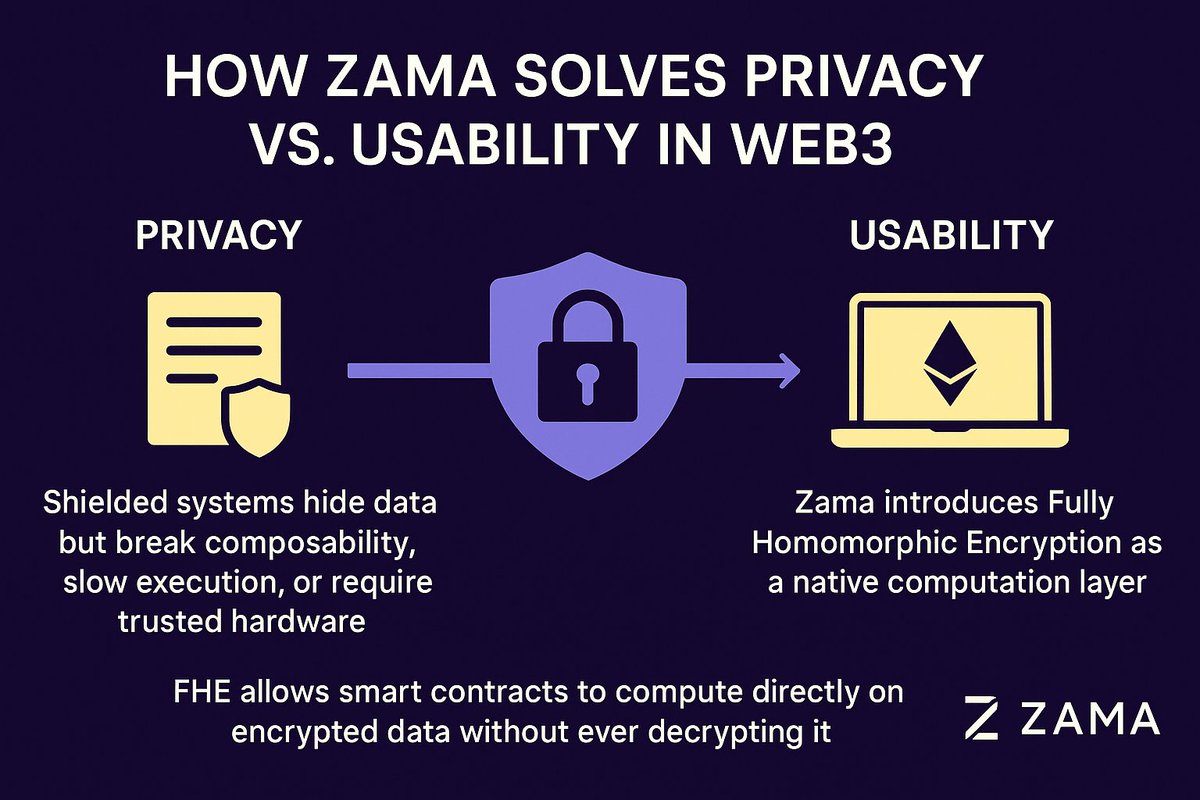
Privacy has always weakened usability in Web3. Shielded systems hide data but break composability, slow execution, or require trusted hardware. @zama solves this by introducing Fully Homomorphic Encryption (FHE) as a native computation layer, allowing smart contracts to compute directly on encrypted data without ever decrypting it.
This removes the usual trade off , it enables users to keep full confidentiality while developers keep the standard EVM workflow. No new languages, no closed circuits, no off chain trust dependencies.
For example, a lending protocol can evaluate collateral ratios on encrypted balances, or an onchain game can process encrypted player actions without revealing strategies. Everything remains private, verifiable, and fully composable with existing DeFi and infrastructure.
By integrating FHE into toolchains like fhEVM, Zama preserves the openness of Web3 while adding the privacy layer it has always lacked ,making encrypted smart contracts just as easy to build and deploy as public ones.
gZama
GN CT
AI on chain has always hit a wall: sensitive data can’t be processed without exposing it. @zama breaks that barrier with fully homomorphic encryption, allowing AI agents to run computations directly on encrypted inputs while keeping every value hidden end to end.
This unlocks privacy preserving inference, confidential model evaluation, and encrypted agent decision making without relying on trusted hardware or offchain black boxes. Models can operate on user data they never see, and chains can verify results without learning the underlying information.
With Zama’s FHE stack, onchain AI becomes trustless, verifiable, and fully confidential , opening the door to private agents, secure predictions, and encrypted autonomous workflows.
Believe in Zama
GM CT
Zama is redefining onchain privacy by bringing fully homomorphic encryption (FHE) directly into smart contract execution. Instead of hiding data through off chain workarounds, Zama enables computations to happen while data stays encrypted end to end.
This flips the traditional model because now developers can build private DeFi logic, encrypted identity systems, and secure data sharing protocols without exposing user inputs, state, or outputs at any point.
By pairing FHE with scalable cryptographic tooling and EVM-compatible frameworks, @zama is building a privacy layer that finally lets Web3 operate with confidentiality, auditability, and trustless security at the same time.
gZama.