Ships wait for calm. Surfboards chase the wave.
In perps, you choose direction, you choose leverage. You don't endure volatility — you ride it. Like a surfer rides the wave to turn, fly, and accelerate.
Today's chip stock rally tells you one thing: it's the heartbeat of the AI cycle.
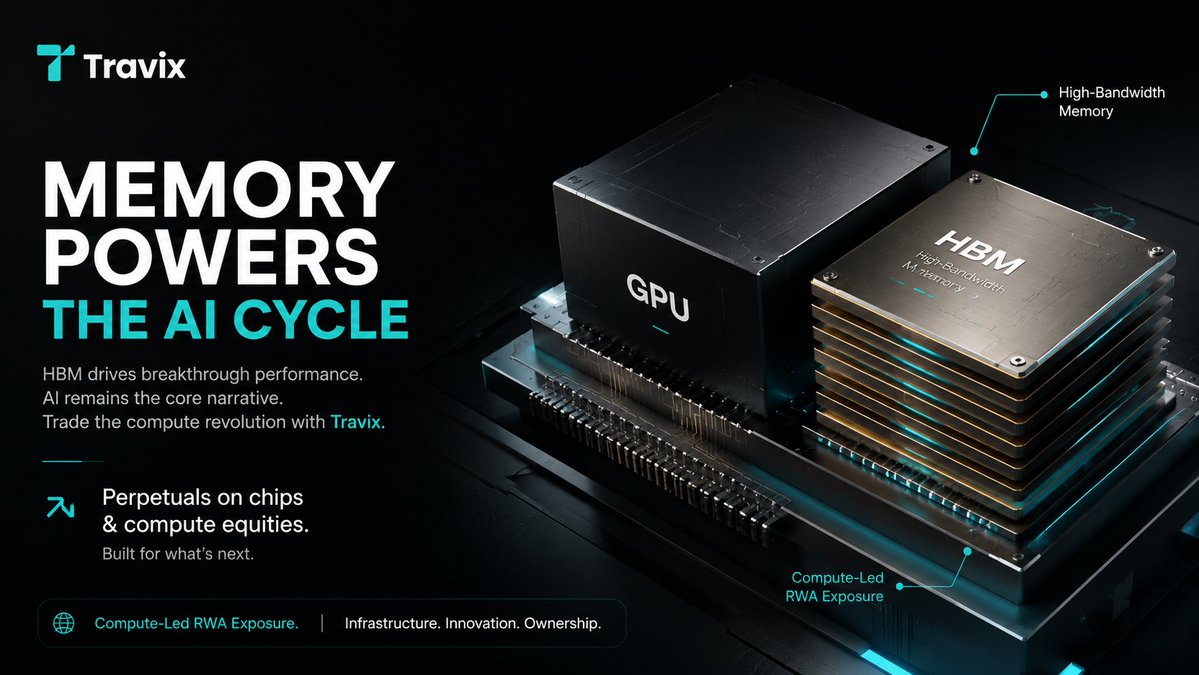
Every AI training run, every inference query, every second of model improvement — it all burns HBM. No HBM, and the best compute is just an engine with nowhere to go.
The chip rebound isn't a bubble signal. It's a paradigm signal. Compute isn't a commodity — it's infrastructure.
Travix gets that.
We offer perps on chip stocks — and beyond that, hardware, compute infra, and the RWA built around computation. But we're not stopping there.
This is "Compute-Led RWA Exposure" — turning compute into something you can actually own.
On Travix, you get exposure to the compute economy through perps. No hardware to custody. But you still capture every upside of the compute boom.
In spot markets, you can only buy, only wait, only let time wear you down.
In Perps, you can go either way. Leverage is your call. Direction is your call. One click, and everything is on the line. It's not gambling — it's price discovery stripped bare.
When the wave hits, you either drown — or you ride it.
Travix chose to ride.
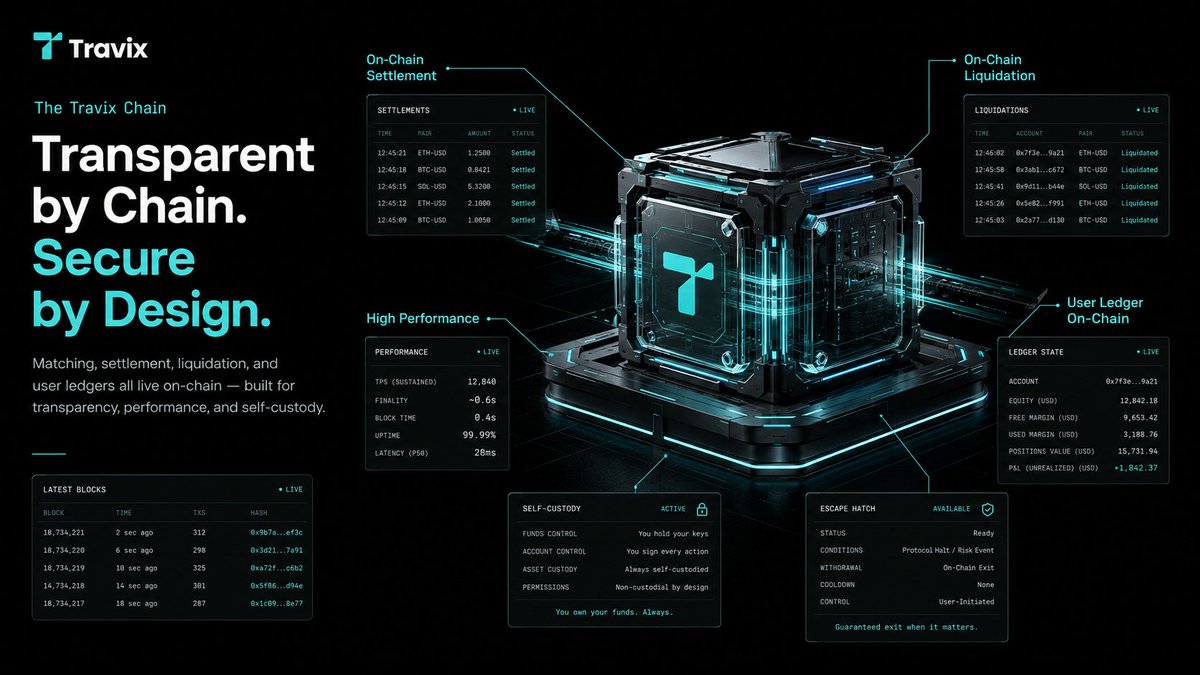
Our matching engine, liquidation logic, user ledger — none of it is built just to be "faster." It's built so you stay transparent and in control, right at the peak.
Trading was never about conquering the market.
It's about deciding, clearly and soberly, who you want to be when the liquidity rushes in.
Transparency isn't a marketing tagline — it's built into Travix CORE.
Security isn't a promise — it's what cryptography guarantees.
Travix is almost here.
Not to help you dodge risk —
but to let you own every decision, fully informed and fully aware.
You're not trading contracts.
You're trading your belief in what's true.
Trading is a spiritual practice, and your portfolio is the glass that reflects it.
Gains are light; losses are shadow. And only in the dance between the two does a full trader emerge.
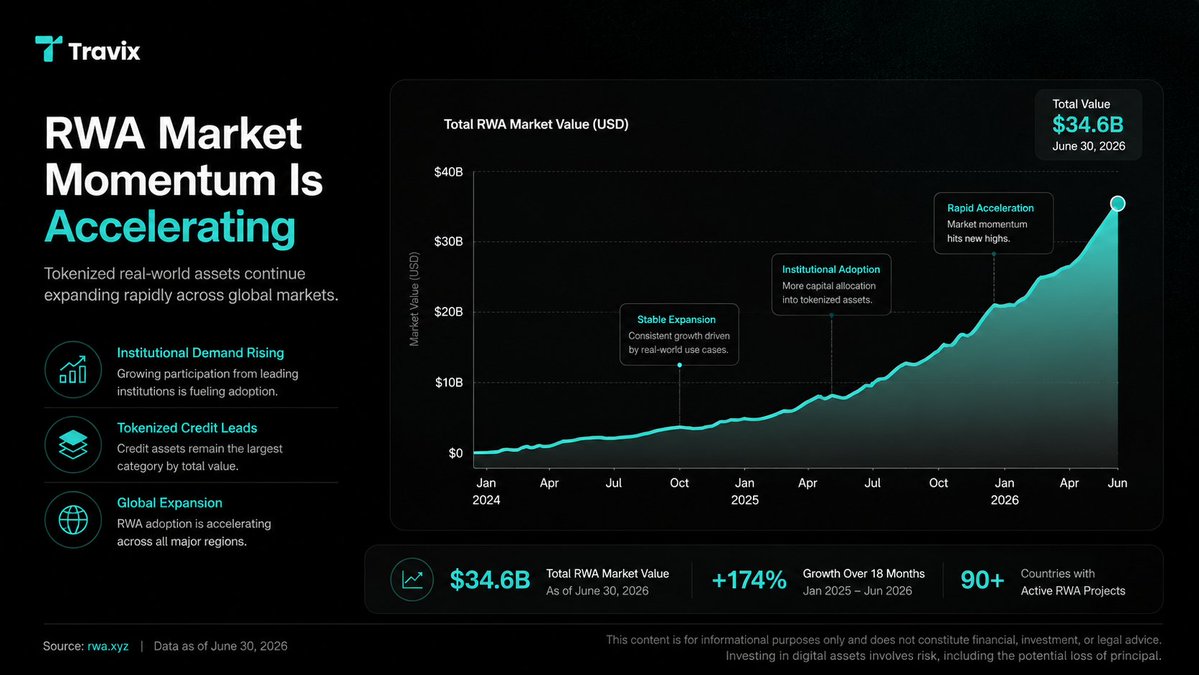
The total value of the RWA market has surged to $34.6 billion (as of June 30, 2026), soaring 174% in just 18 months, with active projects spanning over 90 countries.
Three distinct phases are now clearly visible: steady expansion, institutional adoption, and accelerating growth.
On a deeper level, RWA is the enduring bridge between the physical world and digital civilization. As traditional assets gradually settle into inertia, exotic RWAs — like compute — are rising as the lifeblood of AI, the oil of the future, the fuel for civilizational leaps.
Every watt of electricity, every chip, is redefining what wealth truly means. Travix, as a PerpDEX dedicated to exotic RWA, channels this unstoppable momentum straight onto the perpetuals battlefield.
No room for lukewarm waiting — only the fierce collision of leverage and conviction. No empty promises — only the raw dance of volatility and opportunity, where life and death trade places with every tick.
One Margin. Asia FX, Unified.
There is a line on the map that money has never been allowed to cross freely.
1997 taught this region what happens when your currency risk lives on someone else's balance sheet.
Travix opens it.
East and Southeast Asian FX, on-chain, in one unified cross-margin account. One collateral pool behind every pair. No capital stranded in six silos. No waiting for a desk to quote you back. Up to 100x. Self-custodied. Always open — because the won doesn't stop moving when New York does.
We didn't build this because FX was missing from a list of markets.
The rails were the constraint. Never the conviction.
One margin. Every Asian market. Unified.
Trade what this region actually is.
🇰🇷 🇸🇬 🇮🇩 🇭🇰 🇹🇼 🇲🇾 — live on Travix.
The horizontal bar is stability.
The vertical post is foundation. The 45° bevel is momentum. Three shapes make a T — and make our exchange: steady, grounded, swift.
Details aren't just decoration. They're how dense our promise is.
Most retail losses during earnings season aren't about being wrong — they're about being late.
And time zones make it worse. Seoul and Shanghai traders? That's a 4 AM alarm for US after���hours. Hong Kong's day, London's morning — US markets are asleep. Real assets, still locked to New York's clock.
That's why perpetuals exist.
No closing bell on‑chain. The moment earnings drop, the market moves — and you can be in it. TSLA, GOOGL, MSFT, META, AAPL, AMZN — one margin account, long or short, 24/7.
Bet on AI spend. Bet against consumer weakness. One portfolio, one view.
Earnings tell you what's happening. Perpetuals let you answer — instantly.
Key week. Major impact. Trade earnings on Travix.
SK Hynix perpetuals — now live in your pocket.
The hardest name in HBM. Every NVIDIA AI chip runs on its memory. Every move of the memory supercycle shows up on this chart.
But until now, trading it meant a Korean broker, time‑zone hell, and a 9‑to‑3:30 cage. AI never sleeps — but you had to wait for Seoul.
Not anymore. Travix brings it on‑chain: 24/7, global, from your phone. Subway, midnight, US session — SK Hynix trades when you trade.
Real assets. On‑chain perps. One tap.
Let's start with a brutal fact: on the battlefield of certainty, retail traders are already out of the game.
The millisecond CPI is released, institutional algorithms have already parsed it, executed, and filled. The instant earnings drop, billions in quant capital converge on the same spread. The nature of these trades is a race of speed and infrastructure — co‑located racks, microwave transmission lines, hundreds of data engineers. Where events are certain and information is public, alpha gets eaten within milliseconds. By the time you see the news, the price is already old news.
In certainty, retail traders aren't participants — they are liquidity.
But the world of probability follows a different logic. "Will the Fed cut rates in March?" "Will this bill pass?" "Will that company's product slip?" — these questions have no definitive answer, only a distribution of opinions. And distributions of opinion are precisely what institutional machines are worst at pricing. Models need historical data; unique events have no history. Algorithms need structured inputs, yet the critical clue might be buried in a forum post or a slip of the tongue at a hearing.
That's the habitat of mispricing. While everyone crams into the speed race on certainty, the open plains of probability still hold large, unclaimed pricing errors. An engineer who truly understands the industry may have a better read on "will this chip yield hit target" than all of Wall Street. A policy watcher with a decade of experience reads hearings the way others read co‑location.
Retail's only structural edge has never been speed — it's knowing, in one narrow domain, just a little more than the consensus. Probabilistic markets are the only place where that edge can be monetized.
Keynes said the market isn't about what you think is right — it's about your judgment of where the crowd is wrong. In certain events, the crowd is rarely wrong — because machines don't make mistakes. In probabilistic events, the crowd is often wrong — because the future isn't written yet.
Is event trading dead? The certainty half is indeed dead — buried by machines.
The half that lives is called probability — and it's open to only one kind of person: someone who dares to bet against the consensus, and has been right before.
On CME's precious metals desk, gold has never stood alone.
Palladium futures serve the global automotive industry — every combustion engine's catalytic converter contains it, and automakers need to hedge.
Platinum connects jewelry, chemicals, and hydrogen energy — refiners need to hedge.
Nickel on the LME prices both stainless steel and EV batteries — steel mills and battery manufacturers both need to hedge. Behind copper, lithium, and rare earths lie the real exposures of power grids, automakers, and defense contractors.
These markets have existed for decades for one simple reason: industrial enterprises have real, material risks that need to be transferred.
Hedging is not a speculator's game — it's an industrial necessity. The notional size of the global commodity derivatives market is far larger than most people imagine, and behind every single product stands a procurement director or CFO who can't sleep at night.
What enterprises and traders face is not a single market — it's a collection of disconnected markets.
Travix brings the entire metals complex onto a single margin table: gold, silver, platinum, palladium, nickel, copper, lithium, rare earths — each one an independent perpetual market, all sharing the same cross‑margin account. 7×24. Globally accessible.
Traders can express any cross‑commodity view. Enterprises can hedge an entire supply chain in one account.
Gold is the entry point — not the destination.
At the end of the market lies every risk that needs to be priced.
In prediction markets, thousands of people quote the probability of an event — with real money. That is the most honest causal gauge humanity has ever invented.
The catch is the time lag between this gauge and asset prices: Polymarket's probabilities have already shifted, but the news hasn't been written yet, and the K‑line hasn't reacted.
Whoever can read this time lag stands upstream of price.
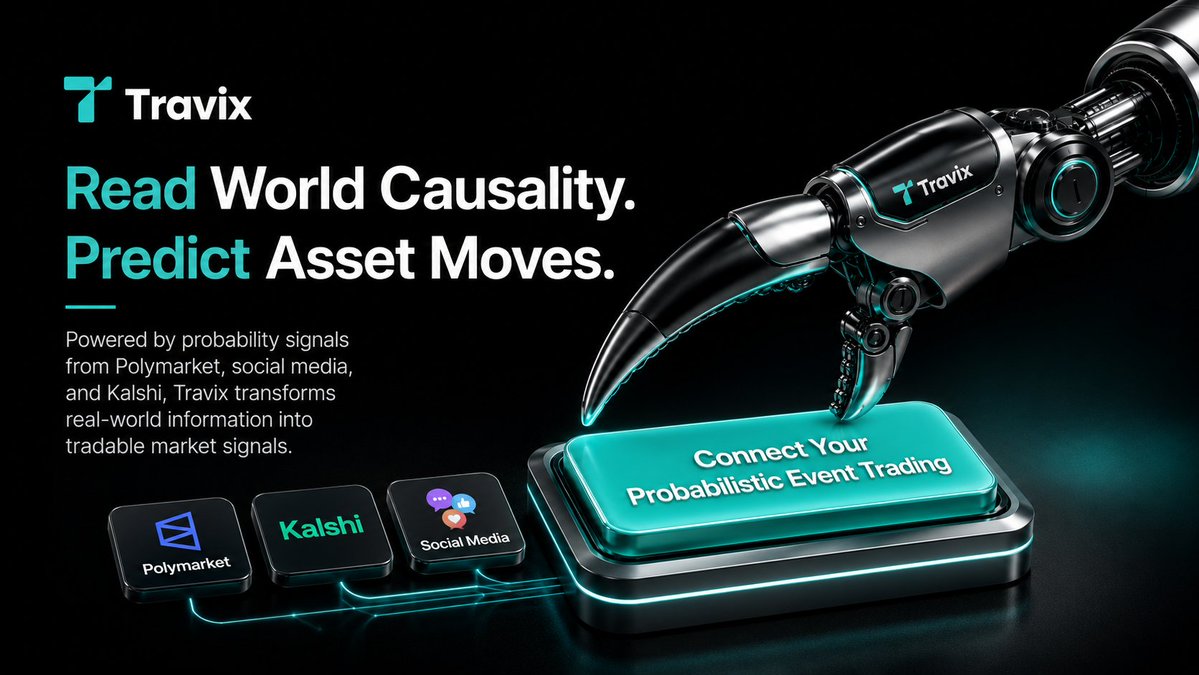
That's exactly what Travix's Financial World Model does: it pulls probability signals from Polymarket, Kalshi, and social media, translates "what the world is beginning to believe" into "where assets are likely to move" in real time, and hands it off to verifiable agents for execution.
From probability to position — no human hesitation in between.
The biggest lie of the AI era is packaging the unverifiable as "mysterious intelligence."
Crypto gave us a maxim: Don't trust, verify. Strangely, this principle seems to go out the window when it comes to AI trading — people will use zero‑knowledge proofs to verify a single transfer, yet hand over six‑figure sums to an agent that won't even publish its backtest data.
Travix gives verification back to you. Strategies are on‑chain — logic is auditable. Backtests are public — parameters are reproducible. Execution leaves a trail — every trade is an on‑chain fact. That +24.73% isn't a number on a marketing graphic; it's a record anyone can audit. A Sharpe of 2.13 isn't a talking point — it's on the ledger.
Whether an agent dares to be verified is, in itself, the best filter. Sunlight is the best disinfectant. The chain is the best auditor.
Transparent. Backtestable. Executable.
Trust deserves to be given — but only to things that can withstand doubt.
Hyperliquid listing CXMT (Changxin Memory Technologies) Pre-IPO perpetuals is worth a closer look.
Because it marks a turning point: the frontier of on-chain price discovery is pushing into the heart of East Asian assets.
For too long, on-chain finance has been overwhelmingly U.S.-centric — the Magnificent Seven, Treasury yields, dollar stablecoins. A U.S. trader who wanted to express a bullish view on China's memory capacity had almost no tools to do so.
Some might ask whether East Asian assets are a niche category. Look at the data: over 60% of global semiconductor capacity is in East Asia. Nearly half of global manufacturing value‑added comes from East Asia. What has never been niche is the assets themselves — only the channels to access them.
Once the channel opens, the water will flow on its own. We've been tracking this category for a long time. Now, our peers have also cast their votes with action.
The Pre-IPO Perpetual (IPOP) Market for CXMT is now live.
CXMT is a pre-IPO market reflecting the market-implied value of 1 ordinary share (A-share) of ChangXin Technology Group Co., Ltd. (SHE: 688825) in USD terms. CXMT manufactures semiconductor DRAM memory chips. After the IPO, the oracle will convert the underlying stock’s Renminbi price to USD at the prevailing FX rate.
Einstein’s theory tells us that mass curves spacetime. The same principle applies to trading positions—the larger the position, the more it distorts one’s perception of time and risk.
With each passing day, doubt accumulates: is this conviction, or is it simply stubbornness?
It is only after selling prematurely that the true depth of the well becomes visible—the gravitational pull of a missed opportunity far outweighs that of a temporary drawdown.
Behavioral finance has already quantified this asymmetry: the pain of loss is roughly twice the intensity of gain, and the regret of an early exit defies even that metric.
The real question, therefore, is not about holding duration. It is whether your decisions are anchored in price noise or grounded in the underlying structure of causality.
Price can mislead. Causality does not.
Trading isn't about penthouse or yacht moments — it's about stacking thousands of small wins.
Taleb put it well: systems that last have limited downside and high repetition.
$11 won't change your life. But $11 × discipline × time? That's a whole different game.
Rockets don't go to the moon in a single burn. They stage, separate, and push — again and again — until they escape orbit.
Drop your position today — big or small. We want to see it.
History shows one thing: whoever holds the scarcest resource prints the money.
Gold in the 19th century. Oil in the 20th. Memory in the AI era.
HBM? Sold out through next year. DRAM? Prices are exploding. Compute you can scale. Power you can build. But memory? Everyone's fighting over the same fabs.
Scarcity is real — but the price signal is still hidden in industry spreadsheets, invisible to most.
Travix brings DRAM to the order book. The first memory perpetual markets, live 24/7. Anyone can go long or short.
The new currency era doesn't wait for a central bank.
Enter a new era of global memory trading.
Every trader has that one K‑line burned into their memory.
2013 — "Bitcoin is a scam."
2021 — "SOL at $3? No ecosystem."
Last month — "I called it perfectly… but my margin was stuck in another wallet."
Kierkegaard said life is understood backwards but lived forwards. Trades are the same — the ones you missed only look obvious in hindsight.
There are two kinds of regret:
• Wrong call — you pay tuition.
• Right call — but no way to act — you pay with frustration.
Travix can only help with the second one.
What's the biggest trade you let slip? Drop it below 👇
Everyone knows the brutal truth: edges decay. The strategy you find, someone else will find it too. Your informational advantage becomes public before you know it. So the real question isn't "do you have an edge?" — it's "where does your edge come from?"
Travix's answer: build it into the system, not into luck.
Layer 1 – Market breadth. Crypto, stock indices, FX, gold — and exotic RWAs like DRAM and compute. One account, one margin, all of it. While everyone else is fighting over the same BTC trades, you can be early in markets that haven't even been priced yet. The fattest edge lives where nobody's watching.
Layer 2 – Capital efficiency. Unified cross‑margin means your positions hedge each other, freeing up margin across the board. Same capital, more firepower — that's structural leverage, not risky leverage.
Layer 3 – Downside protection. Position insurance transforms liquidation from "game over" into "covered event." Staying in the game is the prerequisite for compounding — and one of the most overlooked edges there is.
Layer 4 – Tooling asymmetry. Verifiable AI agents execute your strategy 24/7 — transparent, on‑chain, and auditable. No black boxes, no hype.
The Greeks called it aretē: the excellence of fulfilling a thing's true purpose.
Trading, at its best, should be exactly that — full market access, capital efficiency, risk protection, and the right tools.