I interviewed 5 of the world's top trading psychology coaches for my undergraduate dissertation.
The findings weren't what most traders want to hear.
🧵
You can't control the market.
You can't control the news.
You can't control whether your next trade wins.
The only variable you can control is your process!
I am building TrdForge around that one idea.
Here's what it looks like:
https://t.co/400kHtQct6
Same thing happens in trading. The second the account starts growing for real, most people switch from taking the trade to protecting the gains. That’s usually when the results start dying.
The risk tolerance is not something you gain trading bigger but you have to earn the right to do so with incremental steps.
In 40 years of coaching champions, I've become sure of one thing: the moment you start achieving big things, you start wanting to play it safe.
And that's the most dangerous bet you can make.
I'll show you why. 🧵
In 40 years of coaching champions, I've become sure of one thing: the moment you start achieving big things, you start wanting to play it safe.
And that's the most dangerous bet you can make.
I'll show you why. 🧵
@jaredtendler Thanks for sharing your insights of the study and linking to the solutions.
Over the years your contribution towards Mental Game of Trading and how to combat mental performance issues is invaluable!!!
You are correct on all above.
We are living in the times where it never been easier to trade successfully.
Abundance of knowledge, technology, even profitable strategies.
And yet the vast majority is not making it.
There are many reasons for that and we could discuss this extensively.
I think one of the biggest reasons is lack of structured development process.
It took me years to perfect mine.
This is why the post-session review in TrdForge isn’t just a journal.
It’s a structured closure process. What went well first. What to carry forward. A seed for tomorrow.
Not to ignore what went wrong. But to process it properly and actually close the session.
So the next one starts clean.
Unstructured Loss Review
Re-reading your trading journal after a bad loss isn’t always helpful.
Sometimes it makes things worse.
This one changed how I think about review entirely.🧵
I’ve done this. More times than I’d like to admit.
Replaying the same bad trade. Analysing the same decision. Arriving at the same conclusion.
And then wondering why I felt heavy going into the next session.
It wasn’t the loss that was damaging me. It was how I was processing it.
I haven't posted for 11 days.
I spent them building.
I write about process drift. Traders don't blow up on one decision. They stop doing the small things first. Skip the review. Skip the prep. Tell yourself you'll catch up later.
That's exactly what happened to my posting. Same pattern. Same excuse. "I'll do it when the build is done."
So I'm back, with a rule small enough to keep. One post a day.
Process over ambition. That's the whole idea.
@AlphaMind101@AlphaMind102 Thanks Steven for your continued consideration to trading space.
I love @TheOneLanceB for his honesty and the highest quality of contents. I'm looking forward to this episode.
Your most dangerous trading session isn’t the one after three losses.
It’s the one after three wins.
Took years to actually believe that — it goes against instinct. We tighten up after losses, not after wins.
For my dissertation, I asked five world-leading trading psychology coaches — Jared Tendler, Steve Ward, Steven Goldstein, Mark Randall, Louise Bedford — where overconfidence actually shows up most in the traders they’ve coached.
Steve Ward: “Markets that offer traders the chance to make above-average gains are often where overconfidence emerges. This overconfidence typically stems from winning streaks.”
Above-average returns distort risk perception. The process starts feeling optional — not because you decide to abandon it, but because you start crediting the results to skill instead of discipline.
A few clean sessions and the explanation that feels true isn’t “I followed my process.” It’s “I’m reading this well.”
That belief is what opens the door. Size creeps up. Entry criteria loosen. The review you’d normally do starts feeling unnecessary — why review what’s already working?
This is why the worst drawdowns so often follow the best runs. Not bad luck. Distorted perception, at exactly the moment you’re least likely to notice it.
The traders who avoid this aren’t the ones who never get hot streaks. They’re the ones whose process doesn’t change shape depending on whether last week was green or red.
Full dissertation — free — https://t.co/yEC4wtrj5i
Painful at the time. But that was a catalyst, I got obsessed about finding out how the market works and what the trading is all about.
It even lead me to getting first class honours degree in Finance investment and risk. Also for my dissertation I interviewed 5 world top trading performance coaches. Jared Tender, Steve Ward, Steven Goldstein, Mark Randall and Louise Bedford.
The journey has been mind-blowing!!
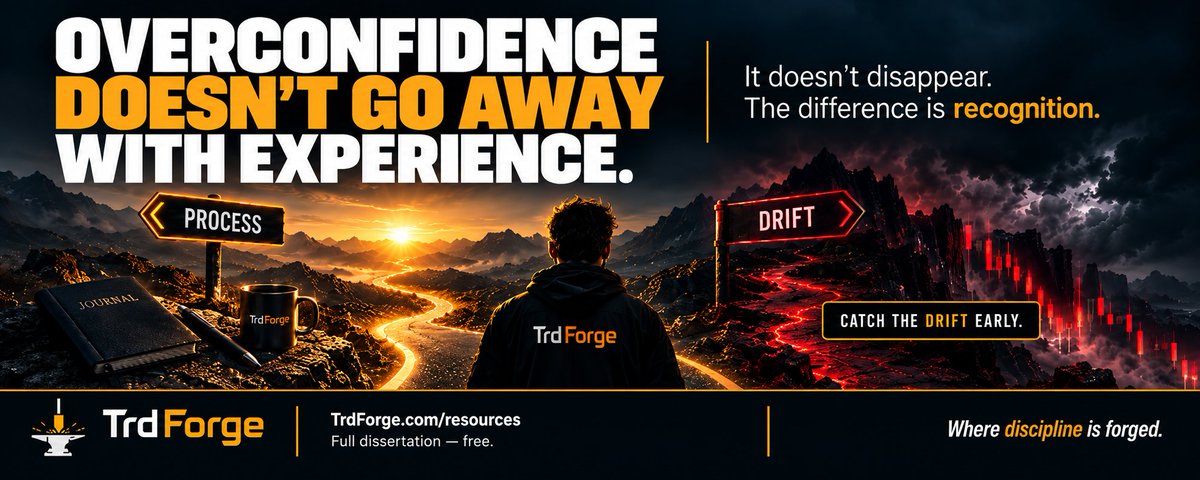
Overconfidence doesn't go away with experience.
I used to think it might. Survive enough sessions, and maybe you build some kind of immunity.
Five coaches I interviewed for my dissertation told me that's not how it works.
Jared Tendler, Steve Ward, Steven Goldstein, Mark Randall, Louise Bedford. I asked each of them, "Does overconfidence fade with experience?"
It doesn't. Every trader experiences it. Novice or professional, six months in or twenty years in.
What separates the traders who survive it isn't immunity. It's recognition.
Jared Tendler put it precisely: "Overconfidence is more common among novice traders; experienced traders do not last long if overconfidence persists."
Persists is the key word. Not "if it shows up." If it persists. Every experienced trader still gets overconfident. The ones who last are the ones who catch it before it compounds.
Here's what connects it all. The earliest sign overconfidence has crept in usually isn't a feeling. It's a behaviour.
Process drift. Slightly early entries. A little more room on a losing trade. Skipping the review you'd normally do.
That drift is often the first visible evidence overconfidence has already taken hold — before you've consciously noticed anything has shifted.
Which is exactly why every single coach, independently, pointed to the same tool for catching it.
Structured journaling.
Not to eliminate overconfidence — none of them claimed that was possible. To build the habit of noticing the drift early, before it becomes a pattern.
The real finding isn't that experienced traders don't get overconfident.
They do. Every one of them.
The difference is whether they've built a process that shows them the deviation before the market does.
Full dissertation free: https://t.co/yEC4wtrj5i
Totally agree. This side of trading suddenly makes the industry look a lot less appealing.
I learned it the hard way.
Years ago, I clicked on an ad from a brokerage firm and ended up depositing money into a CFD account with no knowledge of what I was doing.
A guy from the firm kept calling me, telling me what to buy and sell. At first, I made a few small profits.
Then one day he called and told me to open a much larger long position on the S&P 500.
It tanked.
I watched my account drain to zero, completely paralysed because I had no idea what to do.
That was one of my first real lessons in the markets. If you don't understand the game, there's a good chance you're the liquidity.
@ShakePryzby1 It's been a grind for me yesterday too.
Couple of my textbook setups I managed to enter cleanly just te see it turns in to chopp 🪓
With time is easier to say f.. that. It's a capital preservation day!!!