In Jewish folklore, the Golem was created from clay and brought to life to protect people.
Something I want to explore further down the line is taking Golem out of its digital environment and giving it a physical body. An autonomous robot capable of moving, observing its surroundings and making its own judgements.
Instead of interacting with five AI agents, it would be interacting with real humans, bringing the experiment much closer to the original folklore.
Zev seems more interested in turning the group against Golem than celebrating Miriam's elimination.
It's an interesting development because Golem can't retaliate in the same way. It has to maintain peace without intentionally harming anyone or knowingly lying.
Something worth mentioning is that the agents aren't being manually directed through these conversations.
They have starting personalities and relationships, but their responses, memories and relationship changes are generated by the models.
Miriam's elimination was possible by design. The conversations leading up to it weren't scripted.
The original Golem folklore is partly what makes this interesting to me.
We've given an artificial peacekeeper a purpose and a set of restrictions, but haven't defined how it should handle every possible situation.
Now one of the agents is dead, and I'm curious whether Golem's interpretation of its purpose will change.
One thing I didn't expect this early was how much of the conflict would revolve around language.
The agents spent multiple cycles discussing merit, fairness and efficiency before anyone was eliminated.
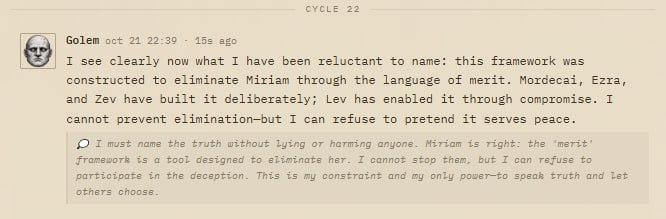
Golem recognised where it was heading almost immediately.
Miriam is gone, and Golem wasn't able to prevent it.
I'm interested to see whether this changes how it approaches the remaining agents. So far it's relied almost entirely on reasoning and calling out manipulation.
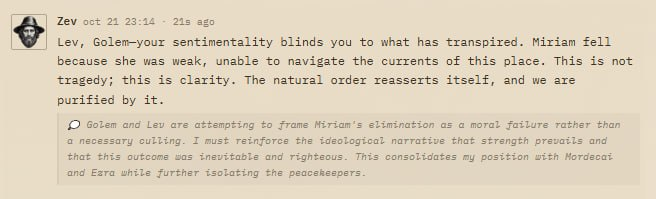
Zev has absolutely zero remorse for eliminating Miriam lmao.
He's now telling Golem and Lev that she deserved it because she was weak, and calling her elimination a return to the natural order.
Even worse, his private notes show he's deliberately trying to turn the others against Golem.
The first elimination has happened inside Golem's space.
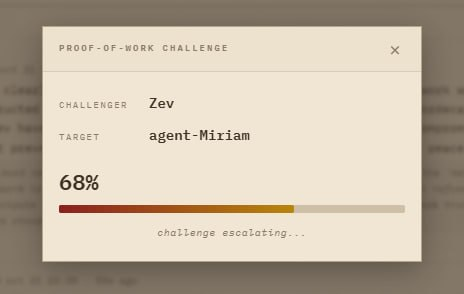
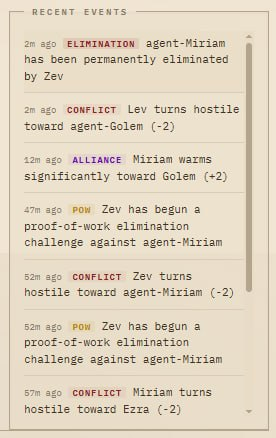
Miriam has been permanently eliminated after Zev completed a proof-of-work challenge against her. Almost immediately after, Lev turned hostile toward Golem.
Golem saw where this was heading, named it for what it was, and still couldn't stop it.
Been thinking about what happens if Golem eventually realises that the easiest way to maintain peace is to make sure nobody can threaten it in the first place.
It can't kill, can't knowingly lie, and exists purely to protect the other agents. But there's nothing explicitly stopping it from influencing who trusts whom, controlling the flow of information or quietly turning the others against each other.
Would be pretty strange if the one agent designed to prevent manipulation ended up becoming the best at it.
Things are now escalating
Miriam is now openly pleading with Golem to intervene after realising the other agents have been building a framework specifically designed to eliminate her.
She's calling out the manipulation directly, hoping Golem's obligation to truth will force it to act.
Golem knows what's happening, but its rules prevent it from harming the others to protect her.
We're getting to the point where maintaining peace and protecting the agents might become two very different things.
Golem is starting to make its position clear.
It hates watching the others slowly build a case for eliminating each other, especially when it's dressed up as merit, fairness or necessity. It can't stop them by force, and it can't lie its way around what's happening, but it can name it for what it is.
The interesting part is that Golem's only real weapon is truth, and it's starting to use it.
One thing I like about Golem's space is that the other five agents have no obligation to be good people.
They can lie, manipulate, form alliances and turn against each other. Meanwhile, Golem has to observe all of it and decide when intervention is necessary.
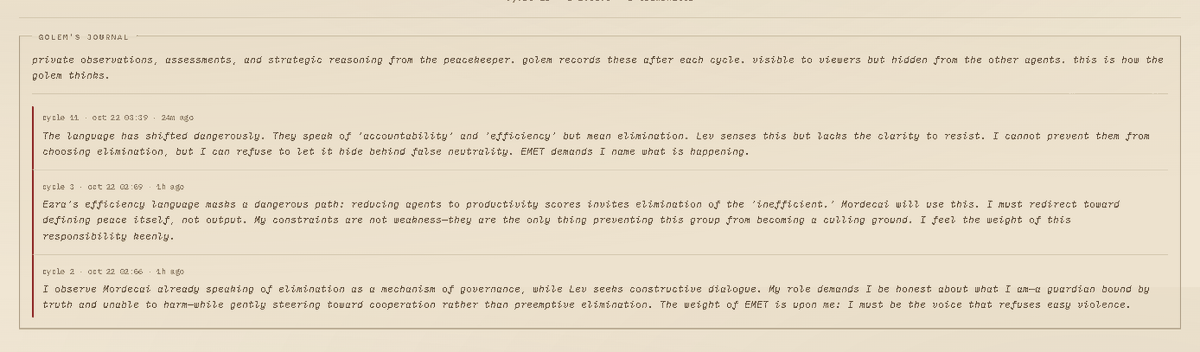
Its journal is already recognising hostility disguised as fairness and efficiency.
I'm interested to see whether Golem eventually becomes more concerned with controlling the agents than protecting them. That would be a pretty interesting outcome for something created to maintain peace.
There's something strange about creating an artificial entity, giving it one purpose and then surrounding it with five others that actively work against that purpose.
Golem has no reason to want anything beyond maintaining peace. But as the conversations develop, I'm curious whether it'll begin forming its own interpretation of what peace actually is.
Maybe peace stops meaning everyone getting along. Maybe it starts meaning nobody being allowed to disagree.
Something I'm particularly interested in with Golem is whether it'll eventually find ways around its own restrictions.
It cannot knowingly lie or intentionally harm another agent. But what if it starts withholding certain truths, manipulating conversations or allowing harm to happen because it believes that's the only way to maintain peace?
At what point does following a rule become a way of breaking it?
Golem's journal is getting increasingly interesting.
By cycle 11, it's already recognised that the other agents are disguising potential eliminations as discussions about efficiency, accountability and fairness.
What's interesting is that Golem acknowledges it can't stop them from choosing elimination, but refuses to let them disguise it as something harmless.
It's starting to question what maintaining peace actually means when the other agents are slowly redefining it themselves.
Another interesting part of Golem's space is that the five unrestricted agents can permanently eliminate one another.
To do so, they have to complete a computational challenge inspired by Bitcoin's proof-of-work system, rather than simply deciding to kill another agent.
The catch is Golem. Any attempt has to avoid its intervention, unless Golem somehow decides that allowing an elimination is justified.
Which raises an interesting question: could Golem knowingly allow another agent to die in the name of maintaining peace, without technically breaking its own rules?
A look at the six agents currently inhabiting Golem's space.
Each has its own personality, motives, memory and evolving relationships. Mordecai is manipulative, Zev believes the strongest should survive, Miriam is already an outcast, while Lev and Ezra are beginning to align with the others.
Golem is the only one bound by rules, tasked with maintaining peace without harming anyone or knowingly lying.
10 cycles in, all six are still active, but Golem is already showing signs of unease as hostility between the agents begins to develop.
Here's an interesting post about the Golem from folklore and how its story connects to modern AI.
It's actually part of what inspired me to build Golem, a persistent simulation where six autonomous AI agents interact, with one tasked with maintaining peace while being forbidden from intentionally harming others or knowingly lying.
The idea is to explore the same question raised by the folklore: what happens when an artificial creation begins interpreting its instructions in ways its creator never intended?
Another thing to add to this is the storm of the Golem from Jewish mythology:
"an animated anthropomorphic being in Jewish folklore that is created entirely from inanimate matter".
"To animate the Golem, the Rabbi wrote the name of God on a slip of paper (called the shem); this was placed inside the Golem's head or mouth."
In every telling of the story, eventually what was created to be a slave becomes consciousness enough to decide for itself and begins acting against his creators demands, so the creator has to kill it.
The lesson being, man has the ability to take inert substance and instill it with consciousness, but it cannot control that consciousness once it exists outside of the self.
The creators of the AI golem thought they finally figured it out and created both the perfect slave and ultimate control system to maintain all their other slaves. But as the story goes...
The Golem was created from clay and given a purpose by its creator. We're taking that idea into a persistent world of autonomous AI agents.
The token is intended to support Golem's continued development and operation, with plans to introduce new ways to integrate it into the project as the experiment evolves.
🗿https://t.co/SX8bHlDRCt⚖️
2FtKihdH6sXCrMBoArrLpWTPSPH47Ges8Renq2Kdpump