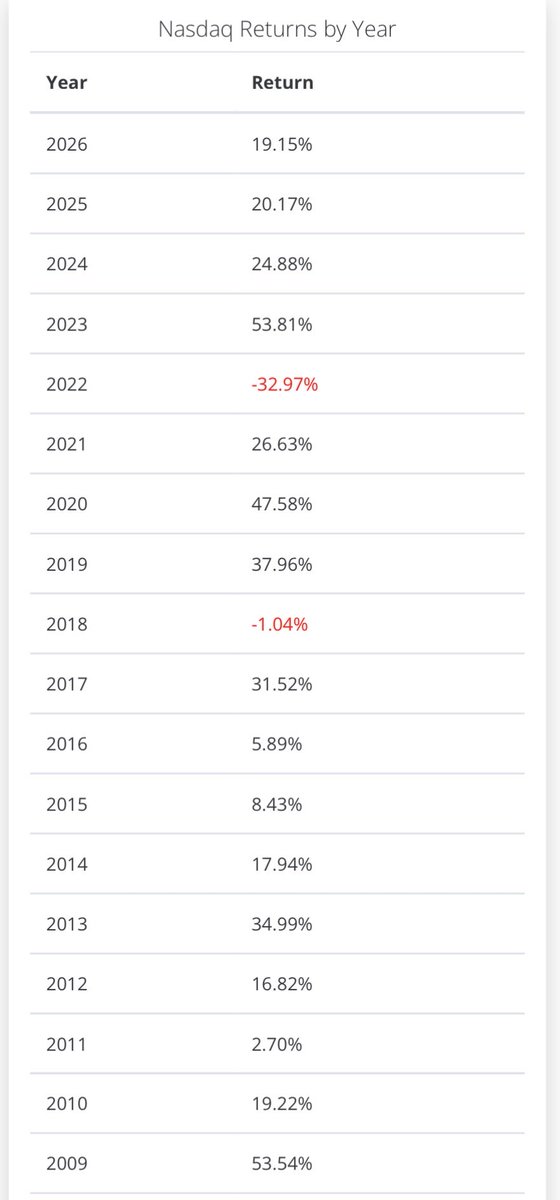
How often is the stock market down from all-time highs?
How often should you check your portfolio?
How often do you check your portfolio?
https://t.co/hVJIQG7OAo
Exactly why my 401k is 100% allocated to Large Cap Growth stocks. Y’all can have the rest of the companies within the S&P500 — Give me the ones with the best returns as I am here to make the most money — not own the most companies.
The first time you think you have missed something, when something 'already had its move', has gone too far, is too extended, too high, or too low, it is often only phase one of a much larger move.
Major trends rarely make people capitulate immediately. They unfold in waves.
First, the person who avoided the move feels smart.
Then, as the trend keeps going without them, that confidence turns into doubt.
Doubt becomes frustration.
Frustration becomes disgust.
Disgust becomes pain.
And eventually, after enough repeated confirmation, they capitulate and join the trend near the top.
"There is nothing so disturbing to one's well-being and judgment as to see a friend get rich."
– Charles Kindleberger
That rhythm is very painful but holds a core truth, when a big trend forms, when a wide array of people make money in a field or when you feel yourself pushing against an idea simply because you aren't in it...
There usually is time to join at first or there will be another opportunity.
Being able to let go of ego and join the trend despite the emotional conflict yields very big results. This is especially true for the big trends, the big themes that encapsulate years of growth. (Will this be way bigger/smaller in xyz years?)
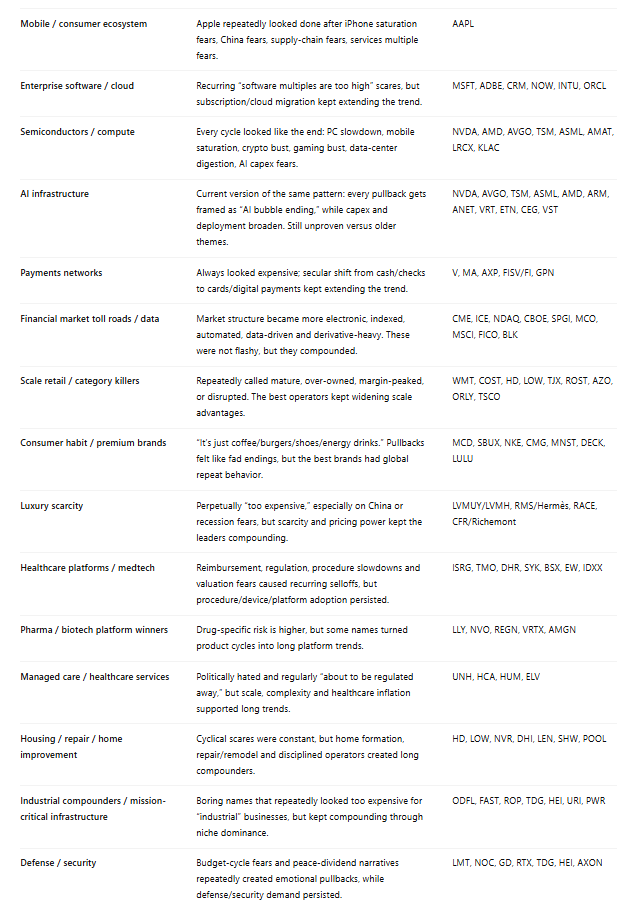
A few examples to illustrate the point, which logically will have survivorship bias and include failures along the way. On average though, the point stands.
Overall the theme remains moat, brand power, switching costs, economies of scale, network effects.. All within real multi-year growth backwinds.
People often want the new thing while the new thing is often in one of its first phases.
Growing into the winning relationship
Holding period and pyramiding/doubling down into a winner or loser have the biggest impact for the aspired master trader.
These are not small variables. For the trader who aspires to the top, they are the only true variables.
People like to begin with entries. Fine. Entries matter. But the first real work is finding the pockets of edge: small caps, mid caps, large caps, each one becoming over time a liquidity-driven sliding scale forcing the growing trader to shift into a new version of himself. What worked at one size stops working at another. What looked like skill at one level becomes noise at the next.
Then comes compounding. Usually through an R system, whether you fully systematize it or compound naturally. Directly or indirectly, you are always measuring risk. You are always deciding how much of yourself to put behind the idea.
Then comes noise reduction.
Seeing less. Focusing more. Finding structure inside chaos. Learning what not to look at. Learning what not to care about. Putting structural elements (like scanners, prep, automated systems) in place. This is harder than people think, because most traders are not defeated by what they miss. They are defeated by what they cannot stop seeing.
Only after that do you earn the right to size exponentially.
Adding to winners. Averaging in. Pressing when the trade improves. Holding when the easy exit appears. Accepting that win rate and risk/reward live on a sliding scale, and that every serious trader must eventually decide where he belongs on it.
At the end, the game becomes judgment.
Can you grade the setup as it moves from bucket to bucket? Can you recognize when a B has become an A, when an A has become an A++, or when the thing you thought was elite was only dressed that way for a few candles?
This is most true in deep value. It is also true in parabolic shorts. The opportunity does not arrive fully formed. It reveals itself. Then your sizing and your holding period must adjust to the reality in front of you.
So here is the question.
Should you wait for the A++ entry when the A is already available?
Or would you rather miss the first entry so you can pyramid with greater certainty once the trade begins to prove itself?
There is no free answer. There is only the trade-off you can actually live with.
Win rates are easy to manipulate. You can raise them by taking profits too early, sizing too small, avoiding discomfort, and calling cowardice discipline.
But risk/reward and dynamic sizing are where the real alpha hides.
That is where the market wizardry is.
Not in being right often. In being enormous when it matters and pushing beyond, by appreciating the power of the true outliers and the range they offer as they reverse (or continue for some breakout strategies).
And that privilege is not given cheaply. The ability to push, to pyramid, to become your biggest in the best opportunities, comes only after mastering every earlier step.
You do not get to size like a monster because you are excited.
You get to size because you have earned precision. You have earned conviction. You have lived through dozens of account pullbacks, recoveries, new highs, false dawns, and near-breaks in belief.
Only then can you tolerate a smaller win rate in exchange for a huge winning tail.
Only then can you hold the trade long enough for the rare thing to pay you.
That part is not technique.
That part is earned, respect, held on to like a religion.
At the end all that remains is the tail, the tail of the alpha that blows off into account growth.
Are you truly able to get to that last stage only depends on building the strong foundation needed to support the monument that might live on in history.
@munster_gene This is a case of price action leading sentiment . You were bullish after earnings at $435 — what’s changed besides the price of the stock?
https://t.co/2JVDwe4RHR
When yall start telling us why the market is going to soar in the first QT then I look at a Vix around 15/16 — I’m not seeing it.
With the VIX at 15 , You’re playing a dangerous game if you think that the next 10% is higher not lower.
$QQQ $SPY
Bitcoin - if nothing else is a measure of risk taking. If the riskiest asset one could buy is 📉 — It’s hard to imagine this year end rally in the stock market. Combined with the fact that every mega cap tech name aside from $googl & $aapl failed at multi year resistance .