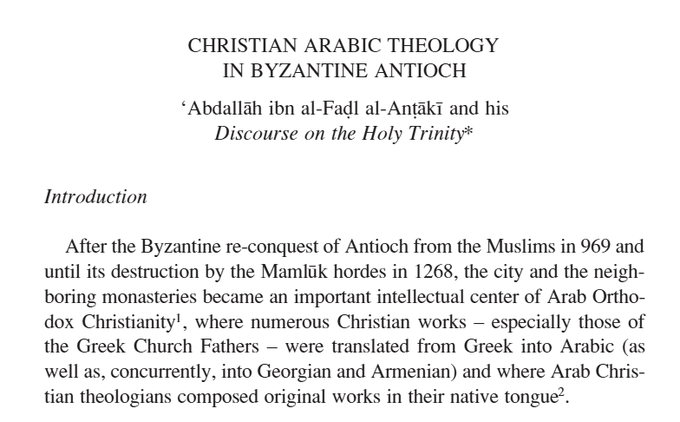
@Scholarius1@AngloVarangian Yeah, there's been a lot of very good stuff done on Arabic translations in Antioch in recent years by Alexandre Roberts, Joe Glynias and Sasha Treiger, but a lot more can be done by way of comparisons to what was going on in Slavonic and Georgian, as it was all losely connected.
@nishanciefendi He had the advantage of being able to work from the Greek edition printed in Paris in the 1630's, but in general he was amazingly prolific, with probably the largest Arabic homiletic corpus of anyone from that time. There's a good new book in open access about the...
"Some who are mature in age, although they seem to participate with perception, end up being less initiated than the infants, and participate in these things unto judgment."
Read the letter of John III of Antioch (998/999) on the Communion of Infants:
https://t.co/Rp1JOpmOzy
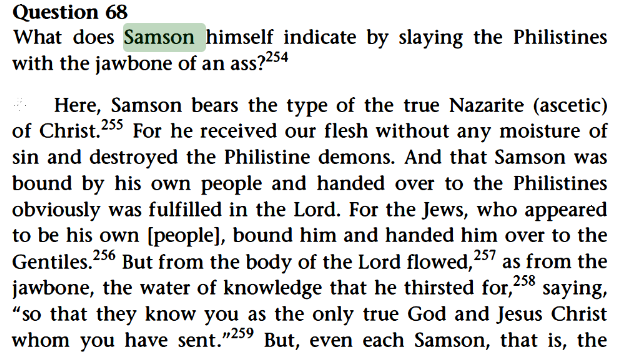
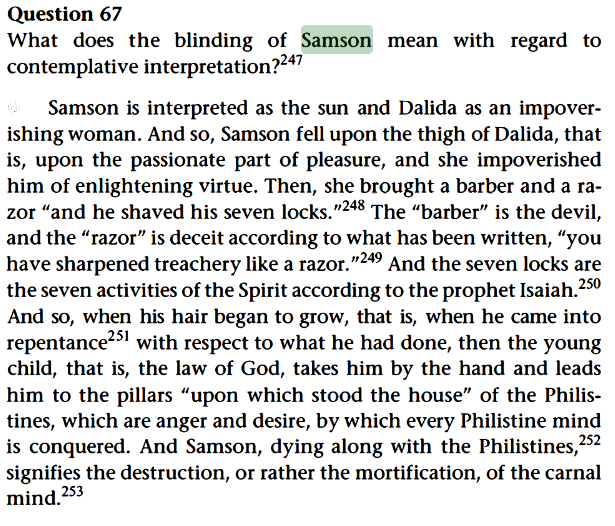
@orthobrohammer Though, what Prassas translates here as "of the true Nazarite (ascetic) of Christ" is more accurately translated by Larchet as "du vrai nazaréen, le Christ" (of the true Nazarite, Christ), so it's again Samson as a type of Christ.
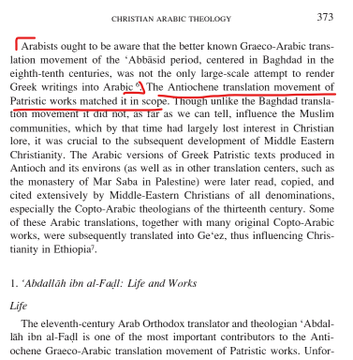
Brilliant study by S Noble & A Treiger of the 2nd great Greco-Arabic translation movement. In the late 10th cen the Byzantines reconquered Antioch. Over the next 3 cens (incl under Crusader rule) a thriving intellectual culture translated hundreds of works from Greek into Arabic there. So you've heard of 9-10th cen Baghdad, & now you've heard of 10-13th cen Antioch.
Ten years on from what had been called “The Great and Holy Council,” held in 2016 on the island of Crete, the significance of the council is still being examined and debated.
➡️ Register to attend OTSA's 2026 Florovsky Lecture: https://t.co/FZKjU8PBHZ
@stvlads Where can we find recent examination or debate? The whole thing seems to have been memory-holed the moment it ended and I can't think of a decision it made that has had any impact anywhere.
A very nice discussion of my work on Iraq for Sharq al-awsat by Luay Muhammad. I am honoured! https://t.co/1UAmTQyQLiثقافة-وفنون/كتب/5277852-فيليب-وود-يسبر-تاريخ-الأقليات-الدينية-في-العصور-القديمة
@antiallebuarian ... prooftexting arms race. The missionaries' successes, though, were more due to other activities. The only local actors who seem (from reading them) convinced by their discourse were the ones who were educated in it from an early age.
Linked below is a quick translation I made of the response of the 16th century Antiochian Orthodox bishop Anastasius ibn Mujalla to Latin missionaries. It's more interesting as a statement of identity than as polemic, where he sees his church as uniting...
@antiallebuarian ... a poor fit for their audience, because they couldn't conceive of people who didn't take the papacy as axiomatic and the Council of Florence as holy writ. But within a few decades, with the increased circulation of printed Greek books, everything turned into a...
“Rum, Russians, Georgians, Wallachians, Serbs, Moldavians, Turks [i.e., the Turkish-speaking Orthodox of Anatolia], Arabs and others in various places,” who are united “despite the remoteness of their countries from each other and the differences in their language”...