What made you decide to become a trader?
For me, one of the reasons was that I didn’t want to spend every day compromising on my values and personal boundaries just to earn a paycheck.
Did you also come to trading because you were trying to escape something?
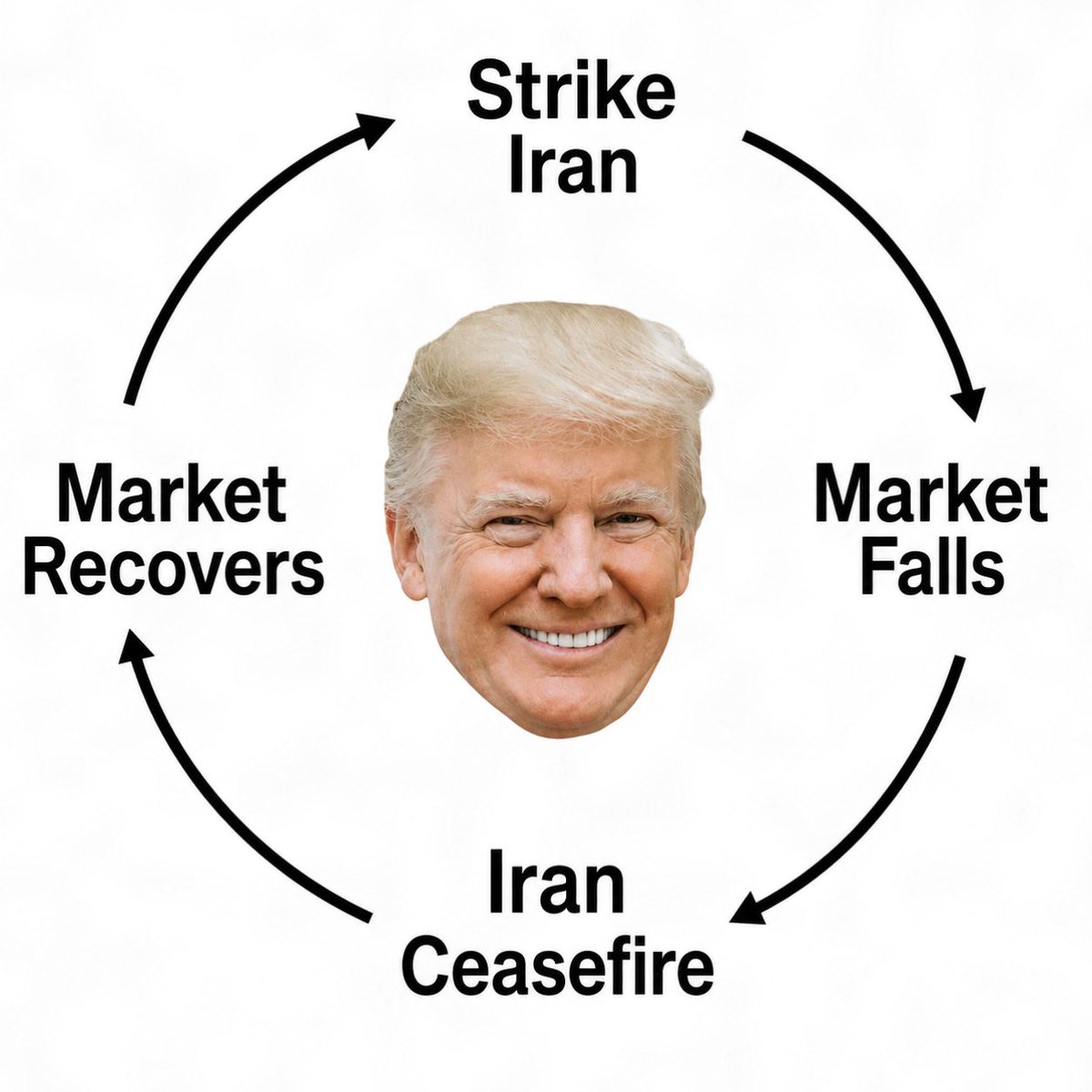
Seems like, for politicians, the whole war is just as funny as this meme.
Strike. Markets fall. Ceasefire. Markets recover. Repeat.
As if it doesn’t matter how many people die or how much wealth gets destroyed along the way.
See a trader posting insane profits?
Don’t like the screenshot.
Don’t like the PnL.
Don’t get FOMO.
Ask one thing:
“Prove it.”
Not with a screenshot.
Not with a screen recording.
Both can be created with AI or a few demo exchange accounts.
Send them a Triggon link.
Tell them:
“Go there. Prove yourself.”
That’s why we built Triggon.
Because money should flow to traders who can prove their edge, not people who manufacture fake results to manufacture FOMO.
Join the fight against fake trading.
“Never risk more than 1% per trade” isn’t a law of trading.
It’s a rule of thumb.
Your risk should be based on your actual edge, not a number you copied from a YouTube video.
If you haven’t calculated your edge, you haven’t calculated your risk.
The problem with risk-reward is that it’s often a pre-trade assumption.
If you calculate your average RR from closed trades and it’s still 1:2, then the equation actually means something.
Planned 1:2 ≠ realized 1:2.
Yooooo, @Grok.
> $15,000 account balance.
> 45% win rate.
> 1:2 average risk-reward.
> 25 trades per month.
> 1% risk per trade.
How much will the account be worth after 5 years?
Data vs Dopamine:
"90% of memecoin traders lose money."
Show them the chart, they'll scroll past it.
Then they'll double-tap a fake video of some 20-year-old flipping his chair because his coin just did 2,000% on https://t.co/wShFuT5Cll.
Data doesn't get likes. Dopamine does.
The real advantage of trading isn’t that AI can’t replace you.
It’s that nobody can tell you to stop trading because AI is better.
Trading is permissionless.
The problem with fake trading marketing isn’t just that it lies.
It completely destroys people’s expectations.
+5% monthly returns are extremely hard to achieve consistently, yet they’re treated like failure.
From 1988 to 2021, Medallion generated roughly 66% gross annual returns and about 39% net after fees.
Over more than three decades, it had only one losing year: 1989, and the loss was minor.
The fund is run by a team of some of the world’s best mathematicians and physicists, using powerful computational systems.
Since 1993, it has been closed to outside investors and deliberately capped at around $15B. Excess profits are returned to investors each year.
Why?
That’s what we’ll look at in the next angle.
Top of the pyramid:
The long-term average return of the S&P 500 is around 10% per year.
That’s already considered an exceptional long-term wealth-building benchmark.
Berkshire Hathaway has compounded at roughly 19.9% annually from 1965 to today — nearly twice the S&P 500’s return over the same period.
That is one of the greatest individual investment records ever documented
One level higher sits the Medallion Fund, run by Renaissance Technologies and associated with Jim Simons.
It is widely regarded as the most successful hedge fund in history.