The machine economy sounds futuristic until you define it clearly:
billions of machines, agents, apps, and protocols moving value between each other, 24/7, with no human in the loop.
Most business owners think of money as a chore—waiting for card payouts, chasing late invoices, and manually matching bank transfers.
But a massive shift is happening in Europe with The Finance Computer (https://t.co/YP7vZ38s3o) and xMoney (@xMoney_com). They are turning money into active, thinking software.
For merchants and business owners, this is a game-changer. Here is the future of business, explained simply:
🧱 Plug-and-Play Banking: Want to give your customers custom cards, rewards, or an in-app wallet? Instead of spending years begging regulators for an expensive financial licence, you just plug into this computer via one API. You bring the customers; the machine handles the complex compliance.
🛒 Zero Redirects, Higher Sales: Traditional checkouts kick your customers out to clunky bank verification pages—where many abandon their carts. With this architecture, everything happens inside your own design on a single screen, capturing sales while the customer is hot.
⚡ Blink-of-an-Eye Payouts: Forget waiting days for credit card companies to settle your funds. Transactions hit your account in 600 milliseconds. Cash flow is instant, automated, and ready to deploy.
🤖 The Rise of "Zero-Human" Companies: This is where the future gets wild. Because money is now code, you can build completely autonomous business loops.
A customer buys a digital product.
The digital money reads its own instructions and instantly splits itself: 70% goes to the creator, 20% routes to a pool to auto-pay the cloud servers, and 10% drops into a savings vault.
When the server bill is due, the money streams fractions of a cent to the provider by the millisecond—no humans, no invoices, no back-office staff required.
We are entering an era where businesses aren't built on mountains of manual paperwork, but run as self-sustaining software programs that manage their own money perfectly. 🚀
#FinTech #Web3 #FutureOfBusiness #FinanceComputer #xMoney
@FinanceCompute This is one of those ideas that sounds niche at first, then obvious in hindsight.
Machine-native finance could end up being a much bigger shift than people realize.
@PastaBeanFras Finance Computer is one of those ideas that sounds niche at first, then obvious in hindsight.
Machine-native finance could end up being a much bigger shift than people realize.
@beniaminmincu This is one of those ideas that sounds niche at first, then obvious in hindsight.
Machine-native finance could end up being a much bigger shift than people realize.
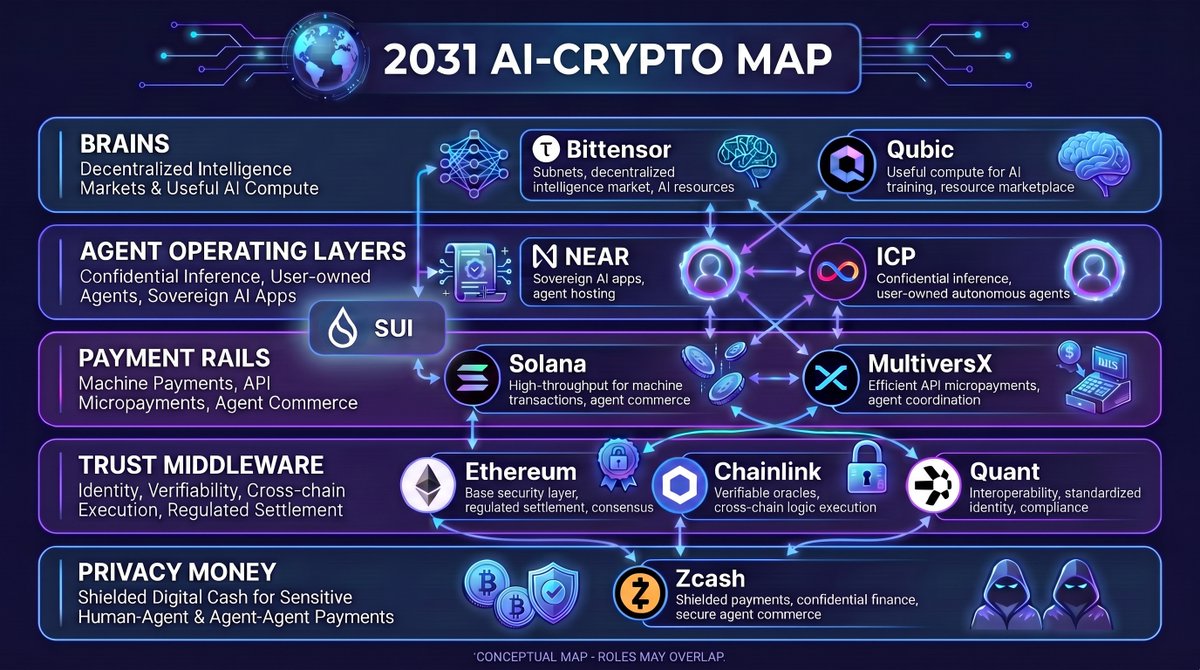
Most people still analyze AI and crypto as separate trends.
I think that’s a mistake.
The real opportunity is the stack forming between them: brains, agent layers, payment rails, trust middleware, and privacy money.
Here’s my current framework for the 2031 AI-crypto stack.
Episode 1 is coming next.
Follow if you want serious research on AI + blockchain before this narrative gets crowded.
It is easy to say “agents will transact.” It is much harder to build systems where billions of autonomous financial actions can happen safely, instantly, and without breaking under stress.
Most people still analyze AI and blockchain as separate trends.
That’s the mistake.
The next big wave will come from where they merge:
• AI agents
• onchain incentives
• machine payments
• decentralized intelligence markets.
Episode 1 is coming.
I’m building this research narrative in public.
Follow if you want signal over hype.
@nametensor@const_reborn@ExploitSummit Gamma is a good idea if it is used to hide complexity from users.
Gamma is a bad idea if it adds complexity that users must manage directly.
I like the idea in principle.
It suggests Bittensor is trying to evolve from a speculative subnet market into a real programmable service economy.
But I would only become bullish on gamma if it does three things: makes buying subnet services easier than today, avoids becoming a new speculative distraction, andclearly feeds value back into TAO and/or subnet economics instead of leaking it away.
TAO = base network money and reserve asset
Alpha = bet on a specific subnet’s economic success
Gamma = spendable service credit for actual product usage.
My opinion is this:
Gamma is a good idea if it is used to hide complexity from users.
Gamma is a bad idea if it adds complexity that users must manage directly.
@a999_16@taomedia_@const_reborn TAO = base network money and reserve asset
Alpha = bet on a specific subnet’s economic success
Gamma = spendable service credit for actual product usage
Because today TAO is the base network token. It is the chain’s native asset, it is emitted by the protocol, it is staked on root, and subnet pools are built as TAO–alpha markets. In other words, TAO is already carrying the roles of base money, reserve asset, collateral, staking asset, and network-level value sink. If you also force it to be the direct unit of payment for every subnet’s actual product usage, you mix together two different jobs: store-of-value / security and service consumption / billing.
@taomedia_@const_reborn Gamma tokens are a good idea if it is used to hide complexity from users.
Gamma is a bad idea if it adds complexity that users must manage directly.
@0xBoomz@const_reborn@ExploitSummit AI is becoming too powerful to leave inside a few centralized companies or states, so Bittensor’s job is to build an open, economically coordinated intelligence network that can compete with centralized labs.
@0xBoomz@const_reborn@ExploitSummit Key message is that Bittensor has moved from theory to proof: it now has meaningful subnet growth, real customers on subnets, and — most importantly — an Affine-trained model that he claims reaches frontier-level performance using decentralized infrastructure.
@iiam_Akshay Well said. The opportunity here is much larger than “an AI token.” If Bittensor succeeds in making intelligence production and discovery an open market, TAO could become one of the most important assets in the AI x crypto space.
AI agents need more than intelligence. They need trust, payment, memory, and coordination. That’s where the real infrastructure race begins. I’m building a documentary around that thesis. Episode 1 coming soon.
@PhyByte This is the kind of context people need right now.
Not spin, not panic — just facts from someone who’s actually been running the network through all of it.
Appreciate you laying it out this clearly.