Time for a new pinned, we covered Jane Doe!
Everyone worked super hard and it came out so well! Thanks @cassioppe for having me for this cover🙇♂️
art: @lilyUF0
mix | master: @kinuetheclown
mv: @AiRoPlen
time | tune : cassi
vocals: me + cassi
https://t.co/RjSi2Ztpbe
✨Drew Crew Assemble!!✨
at 7:30ish pst! my last stream for a few weeks as I go on my trip!! let's figure out the mystery in Danger by Design!!
https://t.co/jbgLg0r0ka
✨STREAM IN 15✨
@URAunitB and I are going to do a FFXIV Music challenge! Will we be able to recreate the FFXIV classics??
https://t.co/f1GfeQhZxx
https://t.co/jbgLg0r0ka
WHAT i just found out its my affiliate anniversary today
anyway, coincidental event today at 6ish cst lol
second image is the wheel wedges
new emotes
new model stuff if we hit 1000 followers :)
im gonna be playing wind waker for the first time for as long as i can go for yeay :D!
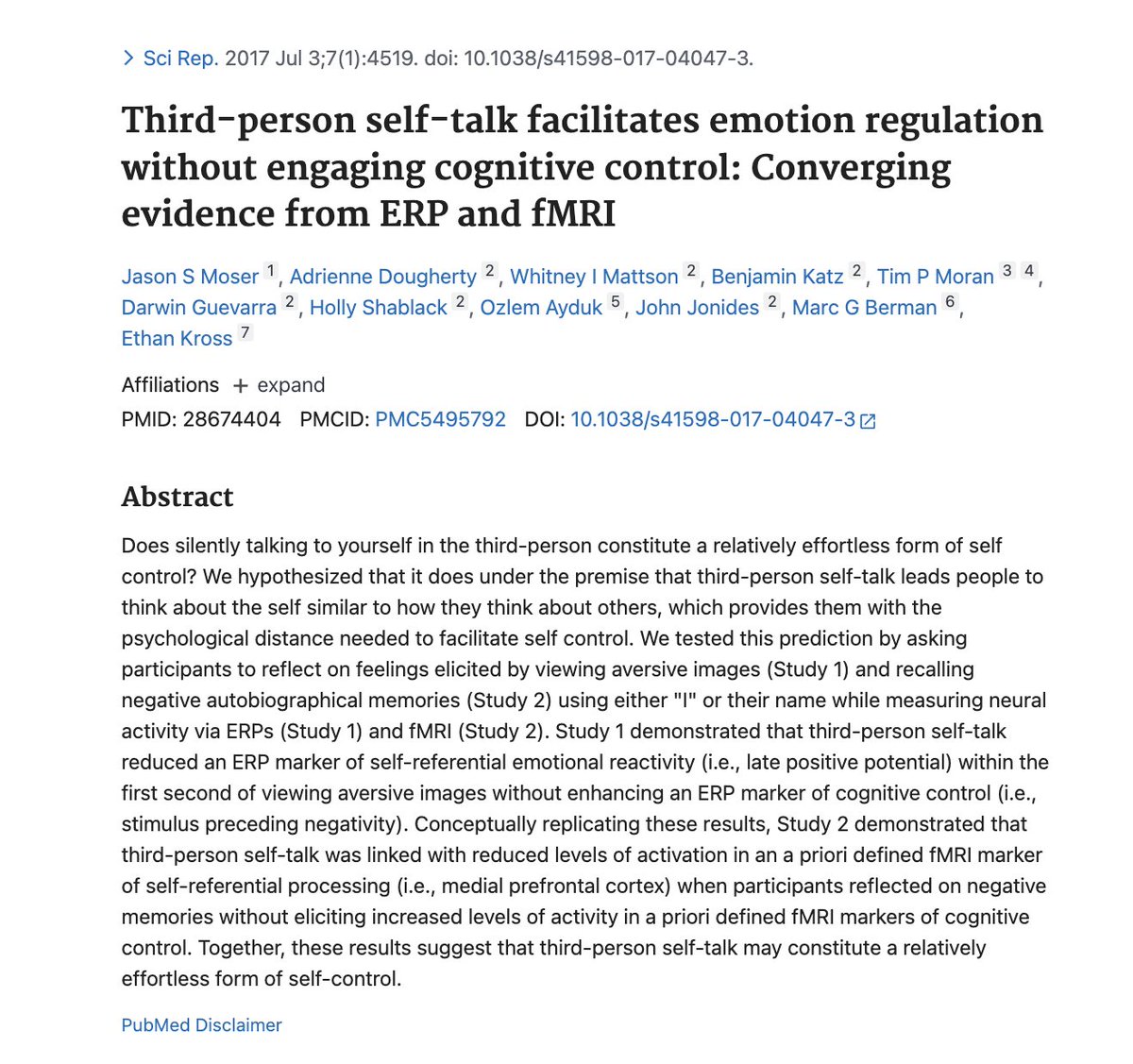
Talking to yourself in the third person, using your own name instead of "I," reduces anxiety without any cognitive effort. A 2017 study in Scientific Reports used brain scans and found that third-person self-talk dampened the emotional response in the brain as effectively as other regulation strategies, but without activating the effortful control regions.
The study was led by Jason Moser and Ethan Kross at the University of Michigan. They showed participants upsetting images and asked them to respond in two ways: using first person ("I feel...") or using their own name ("John feels..."). The brain scans showed that third-person self-talk reduced activity in the medial prefrontal cortex, a region involved in self-referential emotional processing, and it did so within one second.
The key finding was what did not happen. Other emotion regulation strategies, like reappraisal or suppression, require the prefrontal cortex to work hard, which takes energy and depletes over time. Third-person self-talk achieved the same calming effect without engaging the cognitive control network. The brain was regulating itself automatically, as though talking about yourself as another person created enough psychological distance to reduce the emotional charge.
Kross said the finding suggests that third-person self-talk functions as a form of self-distancing: by referring to yourself the way you would refer to a friend, you adopt the same calm, advisory perspective you would use for someone else's problem. The shift is linguistic, it takes one second, and the brain responds immediately.
LeBron James has talked publicly about using this technique before big games. The study says the reason it works is that the brain treats "I am nervous" and "LeBron is nervous" as two different problems, and the second one is easier to solve. https://t.co/iaB3g4zRTT
I matched w this guy bc I was curious about how he makes sense of his own worldview and he said if we hit it off he would fly me to New York and I said I’m more of an Amtrak girl and he said I’m a socialist I don’t do private transportation only public transportation and I said which public planes do you use and he unmatched me