This is my favorite visual artist who is a dude named hiroshi nagai. He went to Guam once and was so overcome by the beauty of the palm trees beach and sunset he dedicated his whole life to painting scenes of what he saw. If that isn’t the realest thing ever I don’t know what is
One of the most breathtaking pieces of Yugoslav brutalism I've ever seen is the Faculty of Philosophy in the University of Novi Sad, Serbia. Insane interior.
P(doom) roundup: what probability do people put on AI killing everyone?
- Vitalik Buterin (Ethereum): 10%
- Zvi Mowshowitz: 60%
- Elon Musk: 20-30%
- Scott Alexander: 20-25%
- Dario Amodei (CEO, Anthropic): 10-25%
- Jan Leike (Head of Alignment, OpenAI): 10-90%
- Geoffrey Hinton (Godfather of AI): 10%
- Paul Christiano (Former Head of Alignment at OpenAI, inventor of RLHF): 50%
- Lina Khan (FTC Chair): 15%
- Average AI engineer (Oct 2023): ~40%
- Average ML researcher (in spring 2022, before things got crazy): 10%
- Dan Hendrycks: recently updated from 20% to 80%
- Average AI alignment researcher: 30%
- Extinction tournament (median for AI experts): 20% chance of catastrophe, 6% chance of extinction
- Extinction tournament (median for non-AI experts): 9% chance of catastrophe, 1% chance of extinction
- BACA Research: 50%
- Scott Aaronson: 2%
- Conjecture AI researchers: 80%
- Eli Lifland: 35%
- Eliezer Yudkowsky: >95%
- Nate Soares: >95% (I think?)
- Holden Karnofsky: 50%
- Average American: 26%
Note: these are just a few I recall from memory and could easily find sources for.
What’s your p(doom)?
My take: I agree with @TheZvi - if your p(doom) is anywhere between 10-90%, it shouldn’t really change what you do, that’s plenty high to justify urgent action.
* Disclaimers: p(doom) usually means as “extinction or similarly bad outcome” but everyone defines it differently, some of these are old and may have changed, many people added various caveats and conditionals, etc.
Just squint and notice the general pattern: a few tech companies are playing Russian Roulette with humanity.
Undersea nations, floating cities, orbital colonies, Mars and Moon bases. Concepts ridiculed as impractical or pointless by people who claim to celebrate all cultures yet fail to understand why man settled remote volcanic islands, frozen tundras, and the wild west.
How far might we be if supposedly learned elites didn't use the power of words to attack the power of technologist-driven technology? It isn't without cause - there is always some ideological pet project they would rather the actually-competent tackle.
The below example is famous, but a moralizing bit from a different NYT editorial board piece demonstrates it more clearly: "We hope that Professor Langley will not put his substantial greatness as a scientist in further peril by continuing to waste his time and money for further airship experiments. Life is short, and he is capable of services to humanity incomparably greater than can expected to result from trying to fly."
History repeats itself. Don't work on AI. Don't work on VR. Don't work on synthetic hydrocarbons. Don't work on defense. And by jove, don't pretend we can go to Mars - to do so would take millions of years, anyone smart and good and of repute must work on wordcel-hyped ESG bullshit instead.
The New York Times, 1903: "Man won't fly for a million years – to build a flying machine would require the combined and continuous efforts of mathematicians and mechanics for 1-10 million years."
One sad thing about the death of physical media is that it is hard to give someone a movie now.
How do you do it? You hope it's on a streaming device that they subscribe to? You put it on a USB?
It's like this weird time where you can't gift someone a DVD and say watch this
From @anduriltech’s @PalmerLuckey:
What is the #1 job most kids want today?
“It’s social media influencer, next is professional gamer, next is YouTuber… the problem is, you can’t tell kids to follow their dreams when their dreams suck.”
What was the #1 dream for kids in 1971?
To be an astronaut 👨🚀 🌕
“We had just gone to the moon… These guys were fighter pilots, PhD mathematician super men, who were also really good looking and well spoken… the ultimate American hero ideal. For a kid to see that and say ‘that’s what I want to be,’ okay tell the kids to follow their dreams.”
Holy. Shit.
I thought this was a typo…
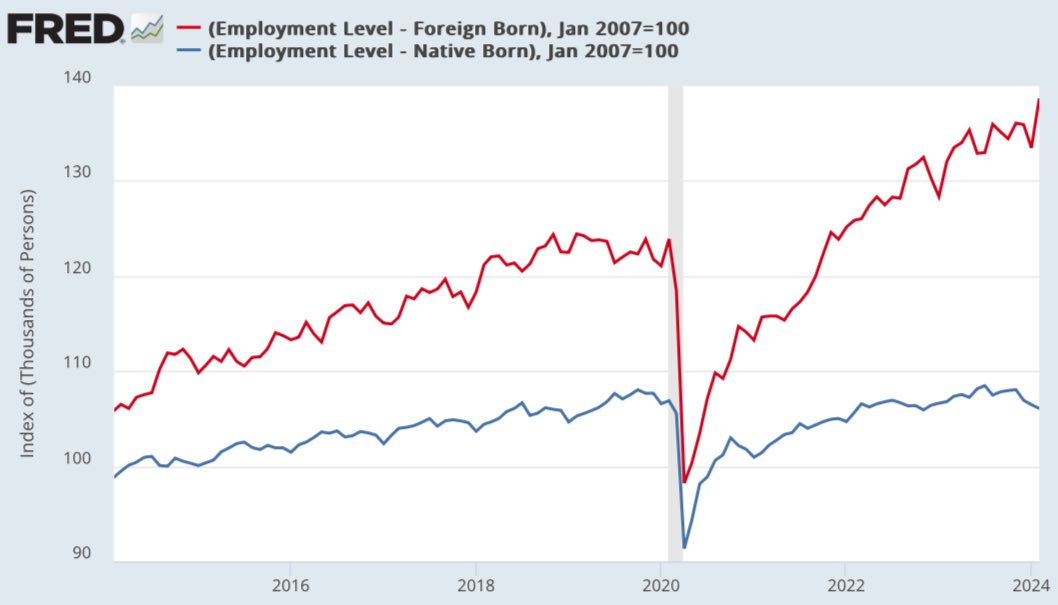
In just February, 1.2 million immigrants (legal and illegal) gained a job. Meanwhile, 500k native-born Americans LOST their job.
Since Covid, native-born workers have actually LOST 2 million jobs. All of the net job gains are immigrants.
TLDR: It's Also Time To Maintain
...though that may mean building new systems set up for software-oriented maintenance by tech execs, as opposed to relying on a failed state to fix things.
See also @pmarca's essay of a few years ago: https://t.co/vOOe154cUu
Google's Culture of Fear
inside the dei hivemind that led to gemini's disaster
New reporting from @micsolana
Last week, following Google’s Gemini disaster, it quickly became clear the $1.7 trillion-dollar giant had bigger problems than its hotly anticipated generative AI tool erasing white people from human history. Separate from the mortifying clownishness of this specific and egregious breach of public trust, Gemini was obviously — at its absolute best — still grossly inferior to its largest competitors. This failure signaled, for the first time in Google’s life, real vulnerability to its core business, and terrified investors fled, shaving over $70 billion off the kraken’s market cap. Now, the industry is left with a startling question: how is it even possible for an initiative so important, at a company so dominant, to fail so completely?
This is Google, an invincible search monopoly printing $80 billion a year in net income, sitting on something like $120 billion in cash, employing over 150,000 people, with close to 30,000 engineers. Could the story really be so simple as out-of-control DEI-brained management? To a certain extent, and on a few teams far more than most, this does appear to be true. But on closer examination it seems woke lunacy is only a symptom of the company’s far greater problems. First, Google is now facing the classic Innovator’s Dilemma, in which the development of a new and important technology well within its capability undermines its present business model. Second, and probably more importantly, nobody’s in charge.
Over the last week, in communication with a flood of Googlers eager to speak on the issues facing their company — from management on almost every major product, to engineering, sales, trust and safety, publicity, and marketing — employees painted a far bleaker portrait of the company than is often reported: Google is a runaway, cash-printing search monopoly with no vision, no leadership, and, due to its incredibly siloed culture, no real sense of what is going on from team to team. The only thing connecting employees is a powerful, sprawling HR bureaucracy that, yes, is totally obsessed with left-wing political dogma. But the company’s zealots are only capable of thriving because no other fount of power asserts, or even attempts to assert, any kind of meaningful influence. The phrase “culture of fear” was used by almost everyone I spoke with, and not only to explain the dearth of resistance to the company’s craziest DEI excesses, but to explain the dearth of innovation from what might be the highest concentration of talented technologists in the world. Employees, at every level, and for almost every reason, are afraid to challenge the many processes which have crippled the company — and outside of promotion season, most are afraid to be noticed. In the words of one senior engineer, “I think it’s impossible to ship good products at Google.” Now, with the company’s core product threatened by a new technology release they just botched on a global stage, that failure to innovate places the company’s existence at risk.
As we take a closer look at Google’s brokenness, from its anodyne, impotent leadership to the deeply unserious culture that facilitated an encroachment on the company’s core product development from its lunatic DEI architecture, it’s helpful to begin with Gemini’s specific failure, which I can report here in some detail to the public for the first time.
First, according to people close to the project, the team responsible for Gemini was not only warned about its “overdiversification” problem before launch (the technical term for erasing white people from human history), but understood the nebulous DEI architecture — separate from causing offense — dramatically eroded the quality of even its most benign search results.
Roughly, the “safety” architecture designed around image generation (slightly different than text) looks like this:
━━━━━━━━━━
These are the first few paragraphs of Mike Solana's newest piece for Pirate Wires. Read the rest on our site (link threaded), or subscribe to @piratewires on @X to get it in your feed.