The French hate air conditioning.
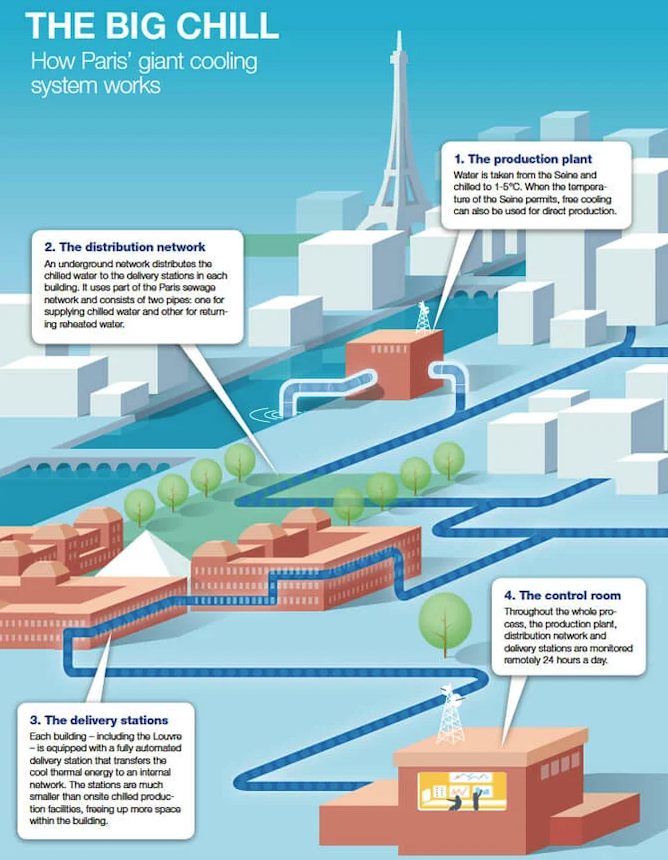
So Paris built a 120-kilometre machine under its streets for producing cold.
It’s called Fraîcheur de Paris, and it does for summer heat what district heating did for winter: centralise the problem.
Instead of every museum, office, hotel, hospital and shop bolting its own cooling plant onto the building, Paris moves cold through pipes.
The network sends water chilled to 2 to 4°C through buried supply lines. The water enters a connected building, absorbs heat through an exchange station, then returns at 12 to 14°C to be cooled again.
It essentially functions with two pipes. One carries the cold out, the other carries heat back.
The production plants cool the circuit from 12°C to 4°C. Some sites use the Seine as a heat sink. In colder periods, the system can use the river’s own temperature for free cooling, which means the machines work less and the electricity demand drops. The Seine water doesn’t become the building water. It stays separate, passing temperature across heat exchangers.
The scale is pretty strange when you see it written down though.
It's got 15 production sites, 4 storage sites, 120 km of underground network with 924 subscribers. This has resulted in 7 million square metres cooled, and 493 GWh of cooling sold.
A cold utility running beneath one of the densest cities in Europe.
The Forum des Halles has been cooled this way since 1979. The Louvre since 1986. Galeries Lafayette, Opéra Garnier, Hôtel de Ville, Station F, La Samaritaine and the National Assembly all sit on the same idea. Tourists stand in the Louvre looking at paintings while a municipal cold loop does part of the dull work below ground.
The boring part is the breakthrough.
Cold can be stored at night in chilled water or ice, then used during daytime peaks. The network is monitored from a control room with more than 125,000 control points. A delivery station inside a building takes 5 to 7 times less space than a standalone cooling installation and avoids the roof and façade clutter that turns cities into compressor farms.
That matters because conventional air conditioning solves heat by moving it somewhere nearby. In a dense city, thousands of private machines mean thousands of outdoor units rejecting heat into streets, courtyards and roofs, plus refrigerants, noise, vibration and maintenance spread across every building.
Paris’s public cooling network has a stated coefficient of performance of 4, against 3 for a wet standalone system and 2 for a dry standalone system. Against an equivalent set of autonomous installations, Fraîcheur de Paris says the network gives 100% higher energy efficiency, 35% less electricity use, 90% fewer refrigerant-fluid emissions and 50% lower CO2 emissions.
The climate backdrop is the real reason this exists.
Paris ran a full crisis exercise called “Paris at 50°C” in 2023. Météo-France’s 2050 reference trajectory for France points to heatwave days becoming five times more frequent, hot nights rising sharply in urban centres, and some local extremes around 48°C becoming possible.
The city signed a 20-year concession in 2022 with Fraîcheur de Paris, owned 85% by ENGIE and 15% by RATP. The contract is worth a projected €2.4 billion. The plan is to extend the network by 158 km by 2042, add 20 production plants and 10 storage sites, and reach more than 3,000 subscribers, including hospitals, nurseries, schools and care homes.
This is basically the infrastructure version of admitting that summer is becoming a public systems problem...
Отказ от АИ гонки это буквально самое умное что сделал Эппл. «Успехи» это когда Микрософт даёт ОпенАИ 13 миллиардов, тот возвращает их Микрософту через AZURE и ОБЕ компании указывают эти бабки как revenue? Эти успехи нас всех скоро убьют, но не так как в фильмах про Терминатора😄🤣🤣🤣
🚨 WARNING: AI BUBBLE IS ABOUT TO BURST
Microsoft gave OpenAI $13 BILLION.
OpenAI sent it back through Azure.
Microsoft booked it as revenue.
Amazon and Google are running similar loops with Anthropic while marking up huge paper gains from AI valuations.
OpenAI is spending over $60 BILLION a year on compute while generating only $25 BILLION in revenue.
Ray Dalio has warned that late stage bubbles are driven by fake flows, not real economics.
That is exactly what this is starting to look like.
@menywddig И самая мякотка писечки; правительство, которое так бесчеловечно поступает с милыми беженцами, сносит целые community бульдозерами и даже лишает гражданства УЖЕ НАТУРАЛИЗОВАННЫХ, это не какие-нибудь крестоносцелюьбивые фашики а САМЫЕ ЛЕВАЦКИЕ ЛЕВАКИ11!!!
a) Британский запрет ножичков - идиотизм, хорошо что хоть для сикхов с шотландцами сделали имключение.
б) картинка на редкость тупая, - может не стоит так носится с крестоносцами, принимая во внимание какими фейлами закончились ВСЕ крестовые походы? Ричард Львиное сердце обосравшийся на поле боя…