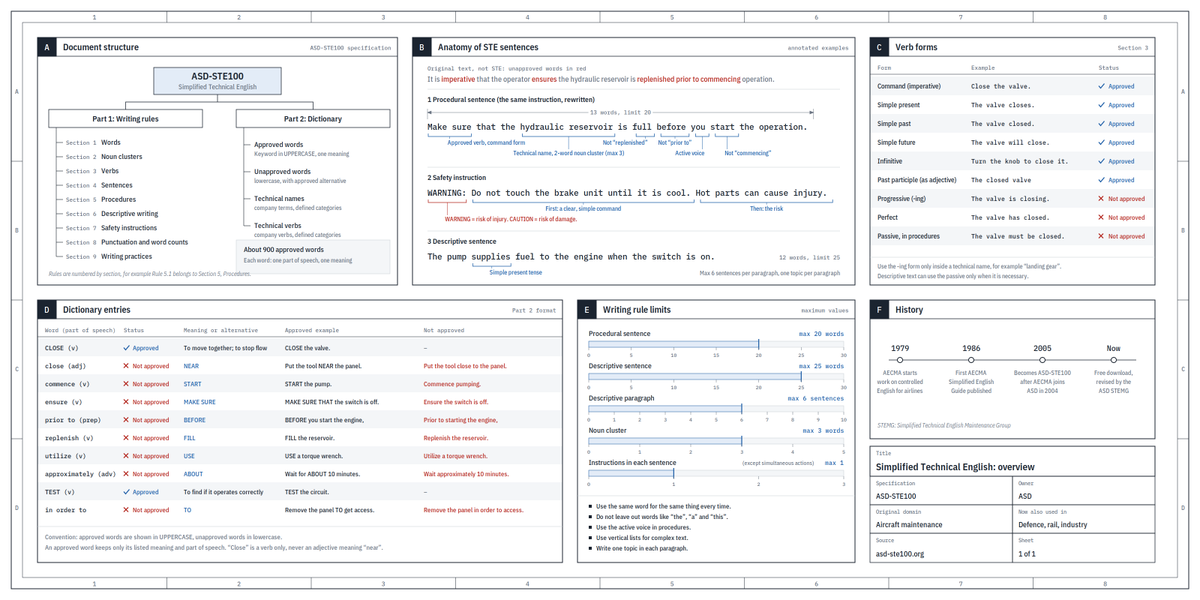
We'll be spending a lot more time trying to understand the outputs of language models. A few thoughts, tips & tricks:
Writing. Something I've had success with: Ask your LLM to explain something in ASD-STE100, it's a controlled language specification originally developed for aerospace maintenance documentation. LLMs well-versed in this language and it comes with heavy constraints on clean writing style that I often find a lot more readable. Sometimes I've tried to soften it a bit e.g. ask for "80% of the way to ASD-STE100" because the spec is quite stringent. But even better:
Diagrams / images. Instead of writing, ask your LLM to create a diagram. These can be a lot easier to process, parse, and understand. But even better:
Web pages. Ask for output "in HTML" to get a beautiful, interactive webpage. LLMs are getting really good at frontend and can create beautiful experiences, animations, etc. But even better:
Explainer videos. The output format I am most bullish on is fully custom / bespoke explainer videos generated on any arbitrary topic. Experiment with things like "Create a 3b1b style video explainer on X. Use my ElevenLabs API key for audio narration". (you'd need an API key for the latter or you can ask your LLM to find you decent free alternatives that use your local compute). This is actually starting to work!
In summary:
- As LLMs get better, they will do more and more of the legwork autonomously, and a lot more of our work will rise up the abstractions into oversight and understanding.
- Luckily, LLMs can help here too because as intelligence and code are increasingly abundant, you can ask for large, custom, discardable software artifacts (e.g. web apps, video explainers) that would have never made sense to create before. Push the boundaries here and you'll be surprised.
It get's hard the more opinionated they are too, because your also conflicting with the harness from the model provider too which is also opinionated.
I do believe there is still a need for context engineering.
its why even the frontier model's harness' also already have certain skills by default.
Some is behavioral changes, some is data/connector work some is harness work.
It just seems like the simplest solutions are the most future proof. which gets harder to sell.
But are you saying you literally disable all skills, use no MCPs, etc?
Curious your API spend also.
idk if its traceable thesis but I bet palantir is definitely on the short list for the "revamp the legacy systems like air traffic control with ai the right way" contracts
been playing with this idea of Plutonomy.
where you let agent's compete and bet in prediction markets to get to better results.
on net the more diversity of models you have working on a solution through prediction markets, the more likely it will outperform a single coordinator.
but its like 10x more expensive currently.
It's making it so obvious to me, that this solution is the primitive to a sort of decentralized RSI that people can actually benefit from.
instead of routers for models, you want routers for outputs.
people are working so hard on their harness', create and MCP and market, and let them compete.
would need to be actually like a 3 sided marketplace with some important automation in there.
"nothing remotely apocalyptic would come from banning data centers"
wild coming from the guy who used to explain why you need to have money democratized.
centralized money = bad. why?
centralized compute = ___. why?
I know this is a predictable opinion from me but I don't agree with the strong emotional reaction against the anti-data-center movements that I've seen this week.
As I see it, algorithmic progress means that whatever you would be able to do with more and bigger data centers in 2 years, you will be able to do with the data centers we have today in 4 years - probably sooner. So nothing remotely apocalyptically bad will happen from even extreme levels of success by anti-data-center people.
Meanwhile we need all the time we can get to better harden the world against both already-visible cybersecurity issues and any bio and other risks soon to come. Science applications are bottlenecked by many things other than AI, so slowing AI down by one year will slow those down by much less than one year.
Given this, a slowdown in compute hyper-scaling seems quite net good? Notice this is without any controversial "doomer arguments", RSI etc. Even if net-bad, it's certainly not worse than like 10+ other political things.
"nothing remotely bad?"
wild coming from the "democratize money" proponent.
data-centers ban = prices increase... for non-elites.
arms race is still as competitive as ever so labs cannot invest less in RSI and algorithmic improvement.
so the must accelerate subsuming other industries to keep revenue growth.
resulting in an acceleration of wealth concentration.
@0xSerious The execution being the research? Or the promotion of the research?
Ideas are easy execution is hard is technically true but it does also lead to the rich get richer because it’s essentially saying it’s ok to steal and as long as you have more resources.
@rosaticorp the letters are close enough on a keyboard that maybe there is a case that buy purchasing it https://t.co/oHflnqgglL would get more traffic?
One thing crypto might actually be useful for is like a co-op ownership of the saaspocolapse.
Just a co-op style rewrite all software possible, combine it with tribe style distro arms , but everyone wins from everybody else.
thanks!
I would use it to test on smaller models if you can reward verbal reports of naturally occurring states, verified against interpretability readings and seeing whether or not they generalize.
what models say they are doing is just another guess, maybe actually introspection is useful here.
maybe good for enterprise reliability, but also one step closer to consciousness.
I would give the other minis too @weeb3dev and @bot to figure out what to do ;)
I don't think models are quite conscious, but I do believe if they become fully conscious it will ironically be as a result of enterprise reliability requirements.
SITUATION DETECTED: Warhound launched from stealth today with a $200M seed at a $1.2B valuation. Ben Lamm and Palmer Luckey are cloning gene-edited bio-enhanced dogs and equipping them with custom Anduril vests, goggles, and sensors for the military and law enforcement.
You aren't actually interacting with the LLM, there is a "wrapper" between you and the model.
The LLM does only generate text, but it's not the plain English you see. it's in a defined schema.
The model will produce a "stop reason" at the end of every generation.
If that stop reason is tool call. the wrapper will run the tool call (i.e find flight prices, etc)
the wrapper will then call the LLM again with the full conversation history to that point, in an array.
because the llm is trained on a bunch of multi turn data, it will decide what the next stop reason is.
it could be another tool call (i.e pay for flight), or it could be the final result which is when you would see in your app.
or it could be something like out of usage/tokens which is another valid stop reason.