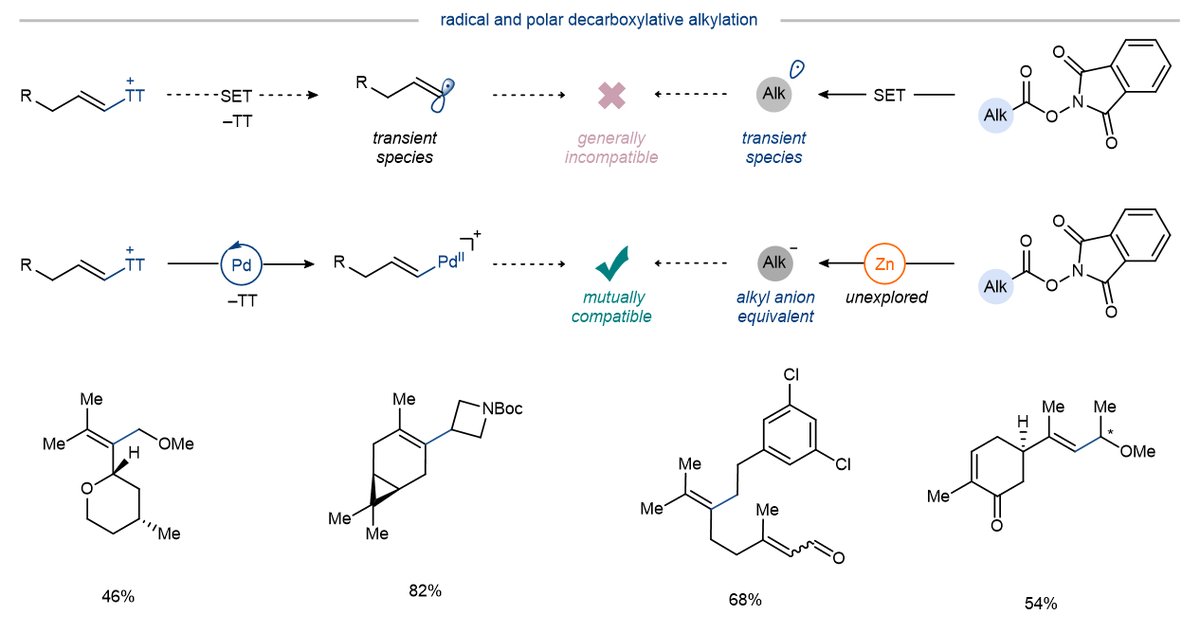
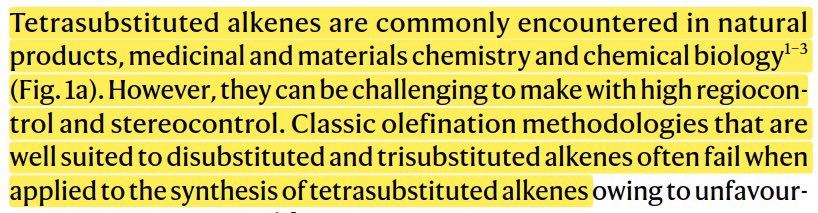
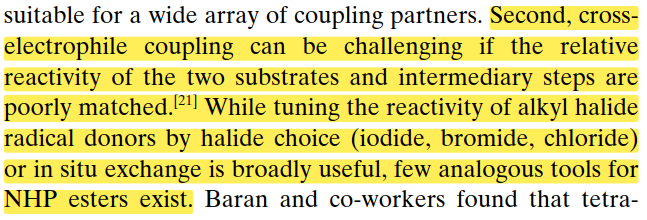
In @Nature, we show that redox-active esters can be transformed into alkyl zinc species useful for transmetalation, providing a solution to rate matching in XEC reactions! First application: alkylation of alkenes via polar decarboxylative cross-coupling!
https://t.co/mOBf4ChHk0
@mato_mauro@g_laudadio@Nature We did not really try to see can we use it as a general electrophile to form organometallic species. But It can be a good idea to look in to that aspect.
@mato_mauro@g_laudadio@Nature Hi Mauro, thanks. Alkenyl-TT is easy to reduce. Even with zinc we can see slow reduction. Using metals with lower reduction potential (Mg/Li) is not so helpful in that way, also alkylzincs are more tolerating towards many functional groups, and suitable for transmetallation step.
@g_laudadio@Nature But if you use Pd/Zn system Pd(0) or Pd(II) is less likely to hamper RAE. Zn is going to reduce RAE. So there is a high possibility of observing alkylzinc species in polar aprotic solvent.
@g_laudadio@Nature Hi Gabriele, I think when Ni/Zn system is used for general C(sp2)-C(sp3) XEC, it proceeds through radical pathway. Ni(I) reduces RAE at a much faster rate than metallic zinc. So probably alkyl radical (or alkyl-Ni, after ligation) is key there.
New method for N-arylation of amines in DNA-encoded libraries! Using ruthenium-mediated pi-arene activation, aryl halides are activated, then undergo SNAr followed by photolysis to give the N-arylated DNA-conjugate.
Out now in @J_A_C_S ! Open Access🔓
https://t.co/G6usOSeAS0