Did you know that NASA's New Horizons spacecraft has been sent to fly by a target nicknamed 'Ultima Thule,' 4 billion miles from the Sun, on New Year's Day 2019. There is no spacecraft has ever explored such a distant world! Wow cool science #2019ES2232
Pluto is a planet again! The IAU definition says that the fundamental object of planetary science, the planet, is supposed to be a defined on the basis of a concept that nobody uses in their research. So experts believe that the distant dwarf has re-earned its title! #2019ES2232
Remember Pluto? The 'once upon a time' planet? Researchers have been contemplating the range and value of a future Pluto orbiter mission. The outcomes found that an orbiter can continue exploration in the Kuiper Belt after surveying Pluto! I wonder what we'll find! #2019ES2232
Further on the hunt for distant worlds, scientists have discovered an exomoon candidate around the transiting exoplanet Kepler-1625b that reveals the presence of a priorly unknown gas-giant moon, wow! #2019ES2232
The search for Earth-like planets, and even extraterrestrial life, just got more precise! This is due to the record-setting starlight measurements made possible by the 'astrocomb'. Who knows what's out there?! #2019ES2232
Carbon monoxide readily accumulates in the atmospheres of living planets. Scientists have produced models show that high amounts of carbon monoxide are compatible with life and might mean there's possibility of life on some planets. #2019ES2232
Usually as stars at the end of their life turn into Red Giants which lose their mass by "stellar wind". But this is not the end for the stars life as scientists have realized they live longer than we expect, in the form of a planetary nebulae fuelled by a white dwarf #2019ES2232
During the formation of black holes massive bursts of light are released in the form of gamma-rays. These bursts are not chaotic nor organized but actually a hybrid of both, interesting stuff #2019ES2232
Kind of scary stuff! A new study finds that some supermassive black holes are 'triggered' to grow, suddenly devouring a large amount of gas in their surroundings, maybe we need a mini-black hole for all these greenhouse gases! #2019ES2232
No human has ever been to Mars yet, that's why NASA is tackling the question everyone is asking - is there life on Mars? It's a dangerous mission for astronauts but it seems that NASA has been able to find all the right solutions to get this meaningful research #2019ES2232
Did you know that the moon has signs of hydration? It also influences the tidal movement on earth through its gravitational pull. I wonder what new research will show about the moon's potential traits #2019ES2232
Shining with the force of 600 trillion suns, this quasar is fuelled by a supermassive black hole at the heart of a young galaxy. The quasar as it looked 12.8 billion years ago - only about 1 billion years after the big bang, one of the oldest known to man, crazy #2019ES2232
It's one thing to have to see your neighbours move in next door, but in this case we now have spotted one of the Milky Way's unknown cosmic neighbours', a dwarf galaxy hidden in a globular cluster just 30 million light years away! #2019ES2232
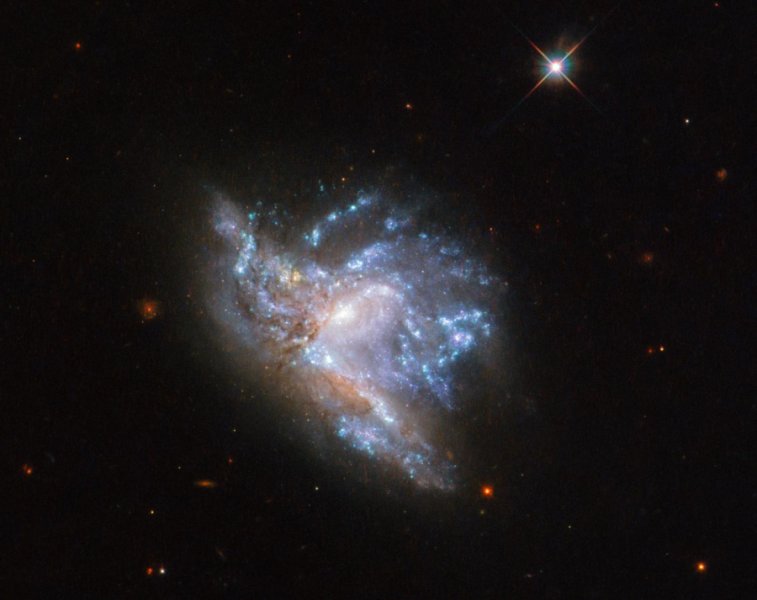
Located about 230 million light-years away, NGC 6052 are two colliding galaxies first discovered in 1784. A long time ago, gravity drew the two galaxies together into the magnificent sight we can now observe! #2019ES2232