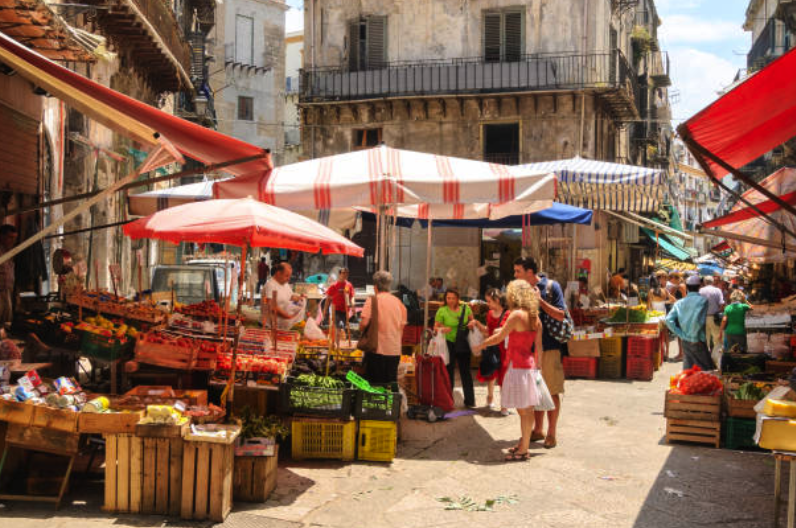
The Ballarò market sits in the Albergheria quarter of Palermo and has been there, in some form, since the tenth century. Its name comes from the Arabic Bahlara, the village near Monreale where the early Arab merchants who set up here are said to have come from. Sicily was under Arab rule from the ninth century to the eleventh, the Normans took it from there, the Aragonese arrived later, and through all of it the market did not really stop trading.
The layout still looks more like a North African souk than an Italian market. The stalls run between buildings that lean toward each other across a street barely wide enough for a moped, and the canopies meet overhead so that the whole quarter is in dappled light even at noon. The vendors do not stand quietly. They shout in a half-improvised, half-rehearsed singsong called the abbanniata, naming the produce, the price, and sometimes the buyer who has been coming for forty years, in a rolling rhythm that has not changed because no one has thought to change it.
Go early. Between seven and ten in the morning the fish has just come off the boats at La Cala, the bread is warm at the corner forno, and the locals are doing their actual shopping; tourists tend to drift in after midday by which time the energy has dropped. You can stand at a stall and have pane e panelle for breakfast — a sesame roll with chickpea fritters, lemon squeezed over it, two euros — then walk fifteen metres for a slice of sfincione, the spongy Palermitan pizza with tomato, onion, anchovy, breadcrumb. Sardines on a charcoal grill smoke up the street. Aubergines split open in oil. Whole swordfish lie on ice with the bills propped up so you can see how big the fish was.
The quarter is also one of the most mixed in Italy. The vendor selling Thai basil at Ballarò grew it himself outside Palermo; the man two stalls down is Bangladeshi, sells string beans and green papaya and squashes that have no Sicilian name, and chats with the Sicilian fishmonger in a Palermitan dialect they have both arrived at separately. The market reflects the city. Palermo has been multicultural for fifteen hundred years and Ballarò is what that actually looks like in practice.
It is also poor. Albergheria is not the Palermo of the postcards. The buildings are crumbling in parts, the lighting is bad after dark, and the police do not interfere with much of what happens in the back streets. The market itself is safe at the hours when it works, which is the morning. Go then. Eat what is in front of you. Pay in cash. The Ballarò has been doing this since the tenth century and it does not really need your advice.
There is a ferry company off the west coast of Scotland called Caledonian MacBrayne, universally CalMac, that operates more than thirty routes to twenty-something islands. Some of the runs are an hour. The longest — Ullapool to Stornoway, across the Minch — takes about two and a half. The fleet is twenty-nine ships. The first ferry of the day, depending on which island you are heading for, sails before seven and the last comes back well after dark.
To most travellers this is transport. To anyone who has spent time on the network, the ferries themselves are the journey. The Loch Seaforth, the company's flagship, leaves Ullapool for Stornoway across open sea, and on a clear day you can see the whole of the Outer Hebrides rising out of the water from the observation lounge. On the Oban-to-Castlebay run you watch the Inner Hebrides fall away behind you for six hours; on the short Mallaig-Armadale hop to Skye you have time for a coffee before they ask you to get back to your car.
The ticket that unlocks the whole thing is called the Hebridean Hopscotch. It bundles a series of crossings into one fare. The classic itinerary is Hopscotch 8: from Oban on the mainland, the ferry takes you to Barra, then up through the Uists by causeway, then by ferry from Berneray to Leverburgh on Harris, by road through Harris into Lewis, and finally Stornoway-Ullapool back to the mainland. You can do it in the other direction. You can do it in a fortnight or take a month. The fare is fixed; the timing is up to you.
What CalMac actually is, beyond the holiday side, is a lifeline. On 1 October 2025 the company entered the CHFS3 contract, a ten-year commitment from the Scottish government to keep these routes running as essential transport for the island communities. The freight crates on the car deck carry the school supplies and the diesel and the shop deliveries that keep the islands inhabited. A ferry cancellation on the Stornoway run, which happens in winter when the weather makes the Minch unworkable, is not an inconvenience to a tourist. It is the bread that does not arrive on Lewis tomorrow.
The schedule is published months ahead, the bookings open in batches, and in summer the foot-passenger fare is buyable on the day but the car deck spaces sell out in February. Plan early. Pack for weather. And give yourself longer than you think — the ferries are slow, the sea is open, and the islands at the other end have not been hurried into anything in a very long time.
Latvia launched its digital nomad visa in early 2022, and its small print is the most particular of any in Europe. Most countries that wrote a remote-worker visa took the position that any third-country national was welcome if they earned enough. Latvia did not. To qualify, you must be a citizen of an OECD country, or your business must be registered in one.
The list is finite. The OECD has thirty-eight members — the United States, the UK, Canada, Australia, New Zealand, Japan, Korea, Israel, Mexico, Chile, Colombia, Costa Rica, plus most of Western Europe. If you hold a passport from outside that list — say, Brazil, South Africa, India, the Philippines — you are not eligible. If you are an OECD national but you freelance through a business registered in a non-OECD country, you are also not eligible. The gate is the OECD membership of the entity that pays you.
The income threshold is 2.5 times the average gross monthly Latvian salary, recalculated each year. In recent applications the figure sits around 4,213 euros a month. The applicant must show six months of prior employment, an employer's statement permitting remote work, and a confirmation of current employment from the foreign tax administration or social insurance authority. The proof of accommodation in Latvia is required at application, not after arrival. Health insurance must cover at least 42,600 euros for the term.
The permit is initially issued for one year, renewable for a second, with a total cap of two years — and unusually for these schemes, the holder can apply for permanent residency in Latvia after that. The visa is the only nomad visa in Europe that opens a path to permanent EU residence on the back of two years' work.
The practical case for Latvia is what the country is. Riga has a UNESCO-listed Old Town and an Art Nouveau quarter, the most extensive in Europe. The country is small — the size of West Virginia — with forests, lakes, the coast at Jurmala. Internet speeds are among the fastest in the world. The cost of living in Riga is around two-thirds of London. The catch, beyond the OECD gate, is the climate: from November to February the days are short and cold, and most nomads who come for a year split their time between Latvia in the lighter months and somewhere warmer through the dark.
It is the most selective digital nomad visa in Europe. For those who can pass through the gate, it is also one of the few that goes anywhere afterwards.
Ireland has roughly 166,000 vacant homes, by the 2022 census, in a country struggling with a housing crisis that has pushed Dublin rents past Paris and Berlin. The Department of Housing has taken several swings at the problem; the one most useful to people not already in the Irish system is the Vacant Property Refurbishment Grant, paid out of a fund called Croí Cónaithe — the heart of dwelling, in Irish.
The grant works like this. You find a property in any town, village, city, or rural area of Ireland that has been vacant for at least two years and was built before 2008. You buy it, or you can apply while you are still in negotiations. You apply to the local authority. If approved, you get up to 50,000 euros toward the refurbishment, paid on completion against vouched expenditure. If a registered surveyor or architect signs off that the building is structurally unsound or formally derelict, you can get a top-up of up to 20,000 more, for a total of 70,000 euros.
The scheme was launched on 14 July 2022, originally only for towns and villages. In November 2022 it was extended to cities and rural areas. From 1 May 2023 you can apply for two grants — one for a property you will live in as your principal private residence, and one for a property you will rent out, with the tenancy registered with the Residential Tenancies Board. That was the change that made the scheme genuinely interesting to people thinking about a second home.
The catches are real and worth reading slowly. The property must be vacant for at least two years immediately before application, and you cannot have caused that vacancy yourself. You must live in it or rent it once the work is done; you cannot flip it. Refurbishment standards have to be met, and there are works limits for each category of expense — the local authority can challenge invoices it considers unreasonable. The cap is the cap. If the renovation runs to 150,000 euros, as is common with a derelict cottage in the West, the grant covers a slice of it, not the lot.
What the scheme has done, slowly, is bring lights back on in small Irish towns. Houses in Mayo and Leitrim and Cavan that had been shut for twenty years now have someone's car outside them. The application is local-authority by local-authority — county by county — rather than central. If you have an Irish grandparent and a project mindset, you have an interesting option that very few people outside Ireland have realised exists.
Ireland has a problem with empty houses. There are streets in towns from Sligo to Kilkenny where the houses on either side of a working pub are boarded up, slate slipping off the roofs, ivy through the windows. The Census in 2022 counted more than 160,000 vacant homes across the country at a time when the same country was in a worsening housing shortage. The state's response, launched in July 2022, is the Vacant Property Refurbishment Grant under the Croí Cónaithe (Towns) Fund.
The headline is simple. If you buy a property that has been vacant for at least two years and was built before 2008, the local authority will pay you up to 50,000 euros to refurbish it, provided you live in it or make it available for long-term rent. If the building is on the derelict sites register — structurally unsound, dangerous, the windows already gone — a further top-up of up to 20,000 euros is available, taking the maximum to 70,000.
The details have evolved. The scheme started with towns and villages only, then expanded in November 2022 to cities and rural areas, and again on 1 May 2023 to allow grants for properties intended for rent as well as principal residence. The eligibility year for the building's construction shifted from before 1993 to before 2008 in the same revision. An applicant can hold a maximum of two grants — one for their own home, one for a rental.
It is not free money. The grant is paid on completion of the work, against vouched expenditure — you have to do the renovation and pay the contractors first, then claim back. The local authority has to inspect and approve. If you sell or change the use of the house within ten years of receiving the grant you may have to repay it on a sliding scale. The property must be your principal private residence or be tenanted with a tenancy registered with the Residential Tenancies Board.
What the scheme has done, in practice, is make derelict cottages in west Cork or south Donegal a real proposition for people who could not otherwise afford to enter the Irish property market. The arithmetic is recognisably the Sicilian one-euro mechanism in a different climate: the building is almost free, the work costs a lot, the state pays for part of the work in exchange for a population that lives there. Ireland is calling it a vacancy strategy. What it actually is, is a policy of repopulation.
Hurtigruten began in 1893 as a postal and freight run up the Norwegian coast — from Bergen in the south to Kirkenes near the Russian border, calling at thirty-four ports, in any weather, year-round. It is still running. The coastal route has been continuous since the late nineteenth century, and on board with the tourists are the locals taking their car to Tromso and the freight crates of fish heading south.
In 1896 the company added expedition cruising to Svalbard, and from there built up a separate fleet for polar work — Antarctica, Greenland, the Russian high Arctic when geopolitics still allowed it. In 2021 the two halves were split into separate brands. The coastal service kept the name Hurtigruten. The expedition arm became HX. The flagship hybrid-electric vessels are the MS Roald Amundsen, launched in 2019, and her sister the MS Fridtjof Nansen — each named after polar explorers, each able to carry around five hundred passengers to places no large ship can reach.
The crew structure is the part most people miss. The deck and engineering officers are conventional maritime, twenty-two days on and twenty-two off, with deep ice experience required for the polar runs. Above that sits an expedition team — marine biologists, glaciologists, photographers, polar historians — who do not run the ship but run the days. They scout the landings in zodiacs at dawn, brief the passengers at lunch on what they will see at four, and on a good day lead a kayak excursion down a fjord where the only sounds are the paddles and the ice calving in the distance.
The ship's company is around 150 crew to 500 passengers, which is a ratio inherited from research vessels rather than cruise ships. The cabin steward who turns over your bed at noon is the same person who at three becomes the spotter on the bow when a pod of orcas crosses the channel. HX hires for that double-job sensibility. The applications close in waves through the European spring, with most contracts running the southern summer in Antarctica or the northern summer above the Arctic Circle.
The romance of the job is real, and so is the work. You are at sea for months at a time, in a confined community of people you did not choose, in weather that can lock the ship in ice for days. Most who do a season come back the next year. A meaningful share of HX's senior expedition team have been doing this for fifteen years or more. They have a particular look when they describe what the light is like at 80 degrees south in February. It is hard to look at and harder to leave behind.
There is a particular kind of coffee shop in Japan that is not a coffee shop in the way the West understands the term. They are called kissaten, literally tea-drinking shops. The first opened in Tokyo in 1888 — a place called Kahiichakan, run by a man named Tei Ei-kei who had studied in Europe and modelled the room on a Parisian salon — and what followed was the slow Japanese adoption of coffee as a culture and a craft.
The golden age was the Showa era, 1926 to 1989. By 1981 there were more than 150,000 kissaten in Japan. The proprietor was usually the owner, often the only employee, often roasting his own beans on the premises. The clientele were regulars who came at the same time each day for the same cup. The lighting was low, the music was either jazz or classical, the seating was leather booths or counter stools, the bill came in handwritten yen on a slip of paper, and the rules — unspoken, never written down — were that you sat quietly, you did not take phone calls, and you stayed as long as you needed to.
The institutions that survived from the 1940s and 50s are still there. Café de l'Ambre in Ginza opened in 1948. Its founder, Sekiguchi Ichiro, ran it personally until he died at 103, in 2018. The menu has more than thirty single-origin coffees, some aged for decades. Café Bach in Asakusa, opened in 1968, taught a generation of the world's specialty roasters how to pour over. When the Blue Bottle founder James Freeman started Blue Bottle in California in the early 2000s, he said explicitly that Bach was the model. The Third Wave coffee movement, in some real sense, came out of Japan.
The count has dropped. By 2001 only about 89,000 kissaten remained, and many of the rest are run by owners in their seventies and eighties whose children have other plans. But since around 2010 something has been turning around. Younger Japanese, drinking less alcohol than their parents did, have started filling the older kissaten back up. They like the analog. They like that the music is on vinyl. They like that the bill is not on an iPad.
If you go, the protocol is simple. Order one of the house drip coffees — not espresso, not a latte. Sit. Read. Watch the master pour the next person's cup. You will be there for an hour or more, and no one will hurry you. The whole point is that it is not coffee on the way to somewhere else.
Bulgaria has the lowest personal income tax in the European Union. A flat 10%, applied to almost all categories of income, on residents and non-residents alike. The rate has been at 10% since 2008. Dividends are taxed even lower, at 5%. There are no progressive brackets to climb into. This is not a temporary incentive. It is the standard rate.
For the kind of person who can register their work as freelance — a writer, a developer, a designer, a consultant — the structure does something else interesting. Bulgarian law allows what is called liberal profession status, svobodna profesiya, which lets you operate as a self-employed individual without setting up a company. The registration is two forms: a BULSTAT code from the Registry Agency, and an OKD-5 declaration with the National Revenue Agency, filed within seven days of starting work.
The useful part is the deduction. Bulgarian law allows freelancers in liberal professions to deduct 25% of their gross income as recognised expenses, without any receipts or documentation. You do not have to justify it, you do not have to keep paperwork to support it. It is automatic. Your taxable base is 75% of what you earn. Apply the 10% rate to that, and your effective income tax is 7.5%.
Social security is a separate layer, paid on a chosen insurance base — most freelancers pick something close to the minimum and pay roughly 175 euros a month. That money is deductible from the taxable base as well. The result, after running the full calculation, is an effective tax burden in the high single digits for a freelancer earning a sensible European salary equivalent.
The trade-offs are real. Bulgaria is not Portugal. The bureaucracy is in Bulgarian and the accountants who actually understand the freelance setup, as opposed to the company route, are fewer than you would think. To benefit, you have to be a Bulgarian tax resident, which means at least 183 days a year in the country, or your centre of vital interests there. The cities that work for this are mainly Sofia, Plovdiv, and Varna. The food is excellent, the cost of living is the lowest in the EU, and the Black Sea coast in September is more honest than the Mediterranean's. It is one of those tax regimes that does not need a name. It just works.
Bayan-Ölgii is the westernmost province of Mongolia, a sixteen-hundred-kilometre drive from Ulaanbaatar or a two-hour domestic flight if the weather holds. The land rises into the Altai mountains. The majority population is not Mongol but Kazakh, descendants of nomads who moved east in the eighteenth and nineteenth centuries. The language in the markets in Ölgii is Kazakh. The script outside the bank windows is Kazakh in Cyrillic. They keep golden eagles.
Eagle hunting, bürkitshilik, is a relationship between a hunter and a single bird, almost always a female because the females are larger. The young eagle is taken from the nest in her first year. She is kept on the gloved arm, hooded, for months. She learns to associate the hunter with food and the hunter learns the small differences in her grip and head-tilt that mean she is calm or about to fly. After four or five years — sometimes ten — the relationship ends. She is released back to breed. The hunter trains the next.
The practice is old. It is also, in its current visible form, partly modern. The Altai Golden Eagle Festival in early October was founded in 2000 by the Mongolian Eagle Hunters' Association and the Nomadic Expeditions operator Jalsa Urubshurow, specifically to give the practice an audience and a future. Around sixty hunters now compete on horseback in the steppe a few kilometres outside Ölgii, in heavy fur coats, eagles on their right arms, against the backdrop of the Altai range. The 2026 festival is scheduled for 3-4 October. UNESCO inscribed falconry as Intangible Cultural Heritage of Humanity in 2010, with Mongolia among the countries on the list.
The festival is not the practice. The practice happens in winter, when the eagle hunts fox and hare across the snow, and the household lives off what the bird brings down. You cannot see that from a tour bus. What you can do is go to Bayan-Ölgii in October, sleep in a Kazakh family's ger on the eastern shore of Tolbo Lake, learn enough of the language to ask the right questions, and watch the morning the hunters and the eagles ride into the valley together. The festival is the public face. The morning ride is the thing.
Croatia was one of the first countries in Europe to write a proper visa for remote workers. The Digital Nomad Residence Permit was introduced in February 2021, two years before most of its neighbours got around to it, and the early years made Split, Zagreb and Sibenik the unexpected base of a wandering generation of designers and developers.
The permit is for third-country nationals — anyone outside the EU, EEA, and Switzerland — who can prove three things. They work remotely for a company or clients based outside Croatia. They have somewhere to live in Croatia, owned or rented. They earn enough to keep themselves there.
The income threshold is set at 2.5 times Croatia's average net monthly salary, recalculated each year against the previous year's official figure. For applications now it sits around 3,295 euros a month, or 4,213 in some later filings as the average wage rises. Savings can substitute, at twelve months of expected costs, which works out around 39,540 euros for a one-year permit, 59,310 for the maximum eighteen months. As of changes in March 2025, the maximum stay is eighteen months and can be extended once for another eighteen, after which there is a six-month cooling-off period before reapplication.
The tax is the part of the structure that does the work. Holders who do not become Croatian tax residents — spending fewer than 183 days a year on Croatian soil, or maintaining tax residency elsewhere — pay no Croatian tax on their foreign-source income. The visa is, in effect, a permit to live in Croatia without ever paying Croatian income tax.
The real-world result has been a particular kind of community. Split now has co-working spaces in Diocletian's old palace. The Adriatic islands fill in shoulder season with nomads who use Zagreb as a base in winter and move south by May. The summer is brutal on the coast for anyone trying to focus; the locals decamp, the prices spike, the cafes turn over their tables every twenty minutes. The smart play is to come in spring or autumn, work somewhere small — Trogir, Sibenik, Mali Losinj — and treat the eighteen-month permit not as a base but as a long, slow tour of one of the most coastal countries in Europe.
The British Antarctic Survey runs five permanent stations: Rothera and Halley VI in Antarctica, Signy in the South Orkneys, and King Edward Point and Bird Island on South Georgia. Each has to feed itself for nine months of winter when no ship can reach it. To do that, BAS hires chefs, on contracts that run from six to eighteen months, and sends them to the ice.
This is not a hotel job. At Halley VI — the furthest south of the five, sitting on the Brunt Ice Shelf at 75 degrees south — the winter team is around fifteen people, and the chef cooks for the same fifteen mouths for up to 295 days running. The food is what came in on last season's resupply. The vegetables you have to work with are mostly frozen and some are dried; the rest is what survives in the cold porch as long as it stays cold enough. Yeast still works. Bread still rises. You learn quickly which dish the marine biologist refuses to eat and which one the field assistant lights up at on Thursdays.
The chef is not only the cook. In a station that small everyone doubles. The chef is on the station's emergency response rota. They drive skidoos. They take their turn on the deep-field flights in the Twin Otters and they help unload the ship when the RRS Sir David Attenborough arrives in summer. The kitchen, by the time winter sets in properly, is the only room in the building where the temperature is reliable, and the rest of the team gravitates there at lunch and at midwinter feast, when the chef produces a meal the standard of which has been one of the proper measures of a good Antarctic station for a century.
The applicants tend to come from one of two backgrounds: very experienced professional kitchens looking for a change of scene, or younger chefs prepared to gamble a year on something they will be telling their grandchildren about. BAS has employed Michelin-trained chefs and also pub kitchen chefs, and the brief is the same: cook well, for the same people, for nine months, while the sun does not rise. The 2026 hiring round opened in January. The contracts start between May and September. The pay is what you would earn in a good kitchen at home, plus full board, plus a journey that very few people get to take.
Malta is small. The whole archipelago is 316 square kilometres — you can drive across the main island in forty minutes. The official languages are Maltese and English, the climate is Mediterranean at a higher mean temperature than Sicily across the water, and the internet runs at fibre speeds across most of the populated parts. In 2021 it set up a Nomad Residence Permit aimed at the kind of remote worker who is allergic to taxes in their home country and exhausted by Schengen visa runs.
The gate is income. Since 1 April 2024 you need to show a gross annual income of 42,000 euros, equivalent to 3,500 a month, from work for entities outside Malta. The earlier threshold was 32,400; applications submitted before April 2024 still operate on the old number. The income must be guaranteed for at least the next five months from the date of application. Applicants must be non-EU. Family can come along.
The permit is initially issued for a year, renewable three times, total stay up to four years. To renew, you must show a bank statement proving you actually spent at least five cumulative months in Malta over the previous twelve. The Residency Malta Agency runs the process online; the typical decision time is around thirty working days. Health insurance is mandatory throughout.
The tax is the part most people miss. For the first twelve months from the issue date of the permit, the income from your authorised remote work is exempt from Maltese income tax altogether. From month thirteen onwards it is taxed at a flat 10%, which sits among the lowest effective rates in the EU for employment income. Pension, dividend, and other passive income earned abroad sit under the standard Maltese rules and the relevant double tax treaties — Malta has signed more than seventy.
What you get in return for the structure is a base in the EU without the long lock-in of a residency-by-investment programme. Valletta has bookshops. Mdina is a walled medieval town on a hill in the centre of the island that you can walk around in twenty minutes. The food is Sicilian-North African with a British colonial layer. The downside, which the marketing rarely mentions, is the summer: July and August are hot enough that many Maltese leave for the smaller islands. The remote worker can do the same, or choose to do their European months in spring and autumn, and the permit will not object.
Fifty kilometres inland from Málaga, the river Guadalhorce has cut a gorge called the Desfiladero de los Gaitanes through the limestone. The walls go up seven hundred metres and the gap between them, at the narrowest point, is ten. In 1905 the Spanish hydroelectric engineers building the Conde de Guadalhorce dam needed a way for workers to walk between the two power stations at either end. So they pinned a concrete path to the cliff face, a metre wide, a hundred metres above the river.
In 1921 King Alfonso XIII walked it to inaugurate the dam. From that visit it took the name Caminito del Rey, the king's little path. The hydroelectric workers used it as a commute. For decades nobody else cared.
Then the maintenance stopped. The concrete cracked. The handrails fell into the river. By the 1990s the path was treacherous — a thin spine of crumbling cement, with rusting bolts, hanging over a drop that killed five people between 1999 and 2000. The local government closed both entrances. Climbers and a certain sort of show-off kept going anyway, and four more people died trying to get across in the four years to 2013. National newspapers called it the most dangerous walkway in the world. That was probably true.
The restoration began in 2014. Andalucia and the Málaga government put up nine million euros. Specialist climbing crews, working off ropes from the canyon rim, built a new wooden boardwalk pinned to the rock above the old path — which is still there, visible below your feet as you walk. The new path opened on 29 March 2015. It is about seven and a half kilometres long, ends with a steel-grid suspension bridge across the gorge next to the original aqueduct bridge, and now sees more than 2.5 million visitors.
Tickets are sold only online, in timed slots, and you must book weeks ahead in season. You wear a helmet. The drop is still a hundred metres. Griffon vultures and Egyptian vultures circle the canyon walls and Iberian ibex pick their way across rocks that look unwalkable. The walk takes about two hours and almost all of it is flat. What it gives you is a route through Spanish landscape — raw, vertical, full of birds — that no one in the country has bothered to soften.
For fifteen years Portugal ran the most generous personal tax regime in Western Europe. The Non-Habitual Resident scheme, launched in 2009, let new tax residents pay a flat 20% on Portuguese income from a long list of professions, and almost nothing on most foreign-source income, including pensions. Lisbon and the Algarve filled up with retirees, programmers and crypto traders living on that arithmetic.
It is gone. NHR closed to new applicants at the end of 2023. A transitional window let a few latecomers in until 31 March 2025. After that, nothing. Anyone holding the status keeps it for the rest of their ten years, but no one new can join.
What replaced it is more selective, and most foreigners trying to move to Portugal in 2026 are still working out what it actually is. The new regime is called the Tax Incentive for Scientific Research and Innovation, IFICI for short, often spoken of as NHR 2.0. It came into effect on 1 January 2024 but the implementing rules — Ordinance 352/2024/1 — only landed on 23 December 2024, with retroactive application.
The 20% flat rate on qualifying Portuguese income is still there. The exemption on most foreign income is still there: dividends, interest, rental income, capital gains, all out of scope unless they come from a blacklisted jurisdiction. But to qualify, you must work in an eligible activity for an eligible employer. The list is narrower than the old NHR's: scientific research positions, R&D personnel covered by Portugal's tax-incentivised R&D framework, certified start-ups, technology centres, and industrial or service companies that export more than fifty per cent of turnover. A bachelor's plus three years of relevant work, or a PhD, is the educational floor.
Pensions are no longer in. Retirees living on a foreign pension, who were the headline demographic of the old NHR, fall outside the new one. They keep coming to Portugal anyway, but they pay Portuguese income tax at standard progressive rates, capped near 48%.
The shift tells you what Portugal now wants. Not retirees and not passive capital. The country wants scientists, engineers, founders of startups that will register and hire locally. The application is structured. The deadlines are tight — 15 January of the year following residency. The benefit is unchanged for those who qualify. The gate has moved.
Scotland has roughly a hundred buildings, most of them in the Highlands and the islands, that anyone may walk into and sleep in for the night. They are called bothies, and they are free. There is no booking system. You arrive, you light the fire if there is one, you leave the place better than you found it. If someone else turns up at midnight you make room.
The buildings themselves are old shepherds' bothies and abandoned crofts. The hill-farming economy that supported them collapsed in the mid-twentieth century, the families moved away, the slate roofs began to fail. By the early 1960s walkers were using them informally, but they were deteriorating fast and the owners had no reason to maintain them. In 1965 a small group set up the Mountain Bothies Association to slow the loss. Tunskeen, in Galloway, was the first restoration.
The MBA now looks after 104 bothies. Two of them it actually owns. The rest belong to estates and landowners who agree, in writing, to let them stand open. The buildings are maintained by volunteers. Every bothy has a Maintenance Organiser, a single named person who walks in periodically to check the roof, the door, the inside, the floor. Above them are nine Area Organisers who manage budgets and meetings. Above them is a renovation group. None of these people are paid. Membership of the MBA, which is what funds the materials, costs twenty-five pounds a year.
A bothy is not a hotel. There is no electricity, no running water, no toilet — you bury your business well away from the building and the watercourse. The fuel for the fire is what you carried in. The roof keeps the rain off, the walls keep the wind off, and that is all. The Bothy Code, agreed between the MBA and the owners, asks visitors to leave by the time the next group arrives, to carry out everything they brought in, and to behave as if they were a guest in someone's working farm building — which is what they are.
The system works because nearly everyone uses it the way it is meant to be used. You arrive at Shenavall after a day's walk into the Fisherfield Forest, having seen no one for hours, and there are two other parties already there, and they have left half the floor for you. Someone has stacked the kindling. The visitor's book goes back decades. You are welcome in Scotland in a way that almost no other country still does.
There is a Portuguese word that has no direct English equivalent. Saudade. It comes from the Latin solitudo, solitude, and it names a particular kind of longing: nostalgia for something or someone absent, but with the extra weight that you suspect it may never come back. It is grief that has not given up loving. It can also be longing for something you never actually had — an ancestor, a country, a version of your own life.
The writer Aubrey Bell, in his 1912 book In Portugal, tried to define it: a vague and constant desire for something that does not and probably cannot exist, for something other than the present, a turning towards the past or towards the future. The word resists summary. The Portuguese tend to say, when pressed by foreigners, that you cannot translate it, you can only feel it.
It has a music. Fado emerged in the working-class neighbourhoods of Lisbon in the nineteenth century — Alfama, Mouraria, the dockyards — and at its centre is a single singer, usually accompanied by the twelve-stringed Portuguese guitar, the guitarra. The subject matter is almost always loss: lost love, lost ships, the wife the sailor will not see again, the village that the emigrant left. Amália Rodrigues, who died in 1999, is the figure who carried fado to the world, and Portugal declared a period of national mourning when she went.
The Portuguese link saudade to the country's history of departure. From the fifteenth century onwards Portugal sent its young men to sea, and most of them did not come back. Whole communities lived in a permanent state of half-mourning for the absent. The word, in this reading, is a national emotional inheritance — something a small Atlantic country developed because it had to.
It explains a great deal about Portugal that other words cannot. Why a Lisbon evening, when the light goes orange off the river and someone two streets away is singing, feels different from any other evening. Why the Portuguese take leaving so seriously. Why the music sounds the way it does. Brazil, also a Portuguese-speaking country, marks 30 January as the Day of Saudade. The Portuguese themselves do not need a day for it. They have a whole national genre.
Ollolai sits in the Barbagia, the mountainous interior of Sardinia, in the province of Nuoro. The streets are narrow stone, the church is medieval, the population a hundred years ago was 2,250 and today is closer to 1,300. The young leave for Milan and Cagliari. This is the demographic picture across rural Italy, but Ollolai has been more inventive than most about it.
The village has been selling abandoned houses for one euro since 2018. The mechanism is the standard one for these schemes: the seller is the municipality, the building has been derelict for years, and the buyer commits in writing to renovate within three years — typically a 25,000-euro deposit and a project plan, with planning oversight from the comune. The euro is symbolic. The renovation is the cost.
In November 2024, after the American election, the mayor Francesco Columbu launched a separate website, Live in Ollolai, aimed specifically at Americans looking to leave. He did not name the president. He did not need to. The site offers three tiers: free temporary housing for digital nomads who commit to a stay, the one-euro fixer-uppers, and move-in-ready homes for up to 100,000 euros. Americans get a fast-track. Within weeks, 38,000 people had submitted enquiries.
Ollolai sits inside one of the world's five recognised Blue Zones, where people live demonstrably longer than the global average. The food is shepherd food: pecorino, suckling pig done on a spit, malloreddus pasta with sausage and saffron. The Sardinian spoken in the bar is not the Italian you learned in night classes; it is a language of its own with strong Catalan and pre-Roman roots. The nearest commercial airport is Olbia, two hours by car.
The village does not pretend the scheme will save it. The mayor has said as much: a hundred Americans will not reverse a century of depopulation. What it does is bring a different kind of attention to a place that the rest of Italy had stopped noticing, and it builds, slowly, the kind of mixed population that might still be there in fifty years. The euro is the headline. The Blue Zone is the reason.
The Iron Ore Line runs from Luleå on the Gulf of Bothnia up to Kiruna, the northernmost city in Sweden, and then over the watershed into Norway, where it changes names and becomes the Ofotbanen and falls 500 metres to the fjord at Narvik. Together the two lines are 536 kilometres of single track and they exist because of one thing: the ore body under Kiruna, which has been mined since the 1890s.
The northern leg was completed in 1902. The reason it goes to Narvik and not to a Swedish port is that the Gulf of Bothnia freezes in winter and the Norwegian fjord, fed by the North Atlantic Drift, does not. To get the ore to a ship in February you have to take it across a mountain range, in the dark, in a country where the temperature regularly hits minus thirty-five. The line does this, every day, with eleven to thirteen freight trains in each direction. Each train is 750 metres long, weighs 8,600 tonnes, and runs at 60 km/h fully loaded, 70 empty.
Two daily passenger services run alongside the iron. The night train from Stockholm reaches Narvik in around 18 hours, and somewhere short of Gällivare it crosses the Arctic Circle unannounced. The carriages are warm. The buffet attendant who checked your ticket yesterday afternoon is now selling coffee in the morning. Outside the window are frozen lakes and pine and the occasional reindeer that does not move for the train.
Part of the appeal is that you are riding on a freight artery, not a tourist line. The stations are working stations. Abisko is a research outpost as much as it is a Northern Lights village. Riksgränsen is a single building at the border. The track itself is sometimes closed by derailments and weather — the 2024 winter took it out for weeks, and 26,000 sleepers had to be replaced in temperatures that hovered around minus thirty-five. You buy a ticket aware that the train might not run.
When it does, what you get is the cleanest gateway into Lapland that exists. Stockholm to the Arctic Ocean, overnight, by rail. You sleep through the Arctic Circle and wake up in Norway.
Most countries decide your tax residency by counting days. Spend 183 in their territory and you belong to them. Cyprus runs the same rule, but in 2017 it added a second one underneath. You can become a Cyprus tax resident on as few as sixty days a year.
The sixty-day rule has four conditions. You spend at least sixty days in Cyprus. You do not spend more than 183 days in any other single country. You are not tax-resident anywhere else. And you have a real, ongoing economic tie to Cyprus — a directorship in a Cyprus company, employment there, or a registered business — along with a permanent home, owned or rented, that is available to you year-round. A holiday let does not count.
What this exists for is the entrepreneur who actually moves around. Six weeks in Cyprus, six in Lisbon, a month in Buenos Aires, another stretch with family in Bombay, none of those countries individually crossing the threshold to claim you. Without a residency anchor that person becomes stateless for tax, which sounds liberating until the country they left starts asking questions. The sixty-day rule gives them an answer.
The answer is favourable. Cyprus tax residents who are not domiciled in Cyprus pay zero Special Defence Contribution on dividends and interest for up to seventeen years. After the 2026 tax reform the SDC on dividends for domiciled residents dropped from 17% to 5%, but for non-doms it remains at zero. Healthcare contribution, capped at 4,770 euros a year, is the only charge on dividend income. Capital gains are taxed only on Cyprus-located real estate. There is no wealth tax, no inheritance tax.
The substance has to be real. The Tax Department, and the German and Scandinavian authorities looking over the structure from the other side, expect the directorship to do something. A Cyprus company that exists on paper, with no employees and no decisions being made on the island, will not survive a challenge. The sixty-day rule is not a loophole. It is a real residency for people whose lives are actually that mobile, and a trap for people who pretend to be.
The Greek Golden Visa used to be the simplest residency in Europe. For 250,000 euros of property, anywhere in the country, a non-EU buyer got a five-year permit that renewed indefinitely so long as the property was held. Athens flat, Crete villa, Mykonos studio: the threshold was flat across the map.
That ended on 31 August 2024. Law 5100/2024 split Greece into zones. In Attica, Thessaloniki, Mykonos, Santorini, and any island with more than 3,100 inhabitants, the minimum investment is now 800,000 euros, and it must be a single residential unit of at least 120 square metres — you cannot combine two smaller flats. In the rest of the country the floor sits at 400,000 with the same 120-square-metre minimum.
The old 250,000 figure survives, but only for two narrow cases: converting commercial property to residential, and restoring listed or heritage buildings. Both are subject to completion before the application is approved, which means the legal work and the building work happen on the buyer's risk. The new rules also forbid short-term lets on any Golden Visa property. No Airbnb. Violations risk a 50,000-euro fine and revocation. The intent is to push the capital into long-term rental supply, and on the early numbers it is doing that: by end of 2024 close to 15,000 of the roughly 16,000 properties bought under the scheme had entered the long-term market.
The permit still works the way it always did. Five years, renewable, no minimum stay required, Schengen mobility, family included, citizenship possible after seven years if you actually live there. Processing times have dropped from an 18-month backlog to about three months for clean files. What you have lost is the Aegean island studio for a quarter of a million. What is left is a more expensive, more deliberate version of the same idea — still, since Spain killed its programme in April 2025, one of the last property-led routes into the EU.